
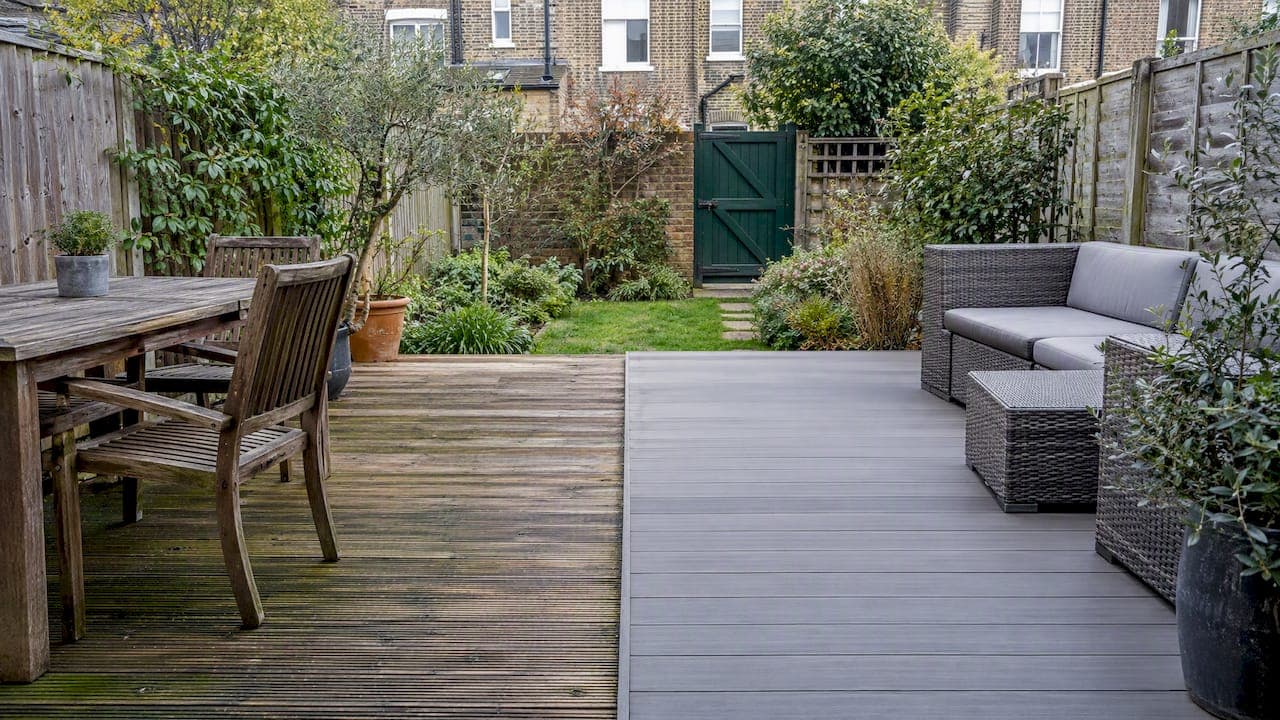
For most homeowners who want low upkeep and a long service life, composite decking is usually the better choice, while timber remains attractive where upfront cost or a fully natural finish matters most. The right answer depends on your budget, how long you plan to stay in the property and how much annual maintenance you are willing to take on. The checklist further down this guide helps you weigh those factors against the costs.
TL;DR:
- Composite decking lasts 25 to 30 years and requires less maintenance, making it more cost-effective over a long-term ownership period.
- Softwood decking costs less initially but typically needs re-oiling or staining yearly and lasts only 10 to 15 years.
- Capped composite boards resist fading and moisture better, but neither composite nor timber can be refinished once damaged or faded.
- Softwood is more affordable upfront but may need replacing within a decade, while composite or hardwood decks can last twice as long with fewer repairs.
- Proper waste disposal requires classification of old decking materials and is regulated by waste codes and licensed waste carriers.
Table of Contents
- Composite vs wood decking at a glance
- What composite decking is and how capped and uncapped boards differ
- What timber decking is: softwood versus hardwood options
- Costs, lifespan and why lifetime cost matters more than price per board
- Maintenance, cleaning and safety on composite and timber decks
- Pros and cons of composite and timber decking
- Planning rules and lawful disposal before you start
- How to choose the right decking for your garden
- Our perspective on decking choices across London gardens
- Get expert help with your decking project
- FAQ
- Sources
Composite vs wood decking at a glance
Composite decking costs more to buy but less to maintain over its lifetime, while softwood is cheaper initially but needs regular care to last.
These figures come from TradeCalculator's cost and performance comparison, which treats them as market indications rather than fixed quotations.
- Composite suits homeowners who want a low-maintenance deck and plan to stay in the property long term.
- Softwood suits those prioritising a lower upfront cost and a natural timber look.
- Hardwood suits homeowners who want timber's appearance with better durability than softwood, at a higher price.
What composite decking is and how capped and uncapped boards differ
Composite decking is made from a mix of wood fibre and plastic, formed into boards that mimic the look of timber while resisting rot and insect damage. Capped composite boards have a protective outer shell bonded around the core, which improves colour stability and resistance to staining and fading compared with uncapped boards, where the composite material is exposed on all sides.
- Capped boards generally hold their colour better and resist moisture absorption more effectively than uncapped boards.
- Composite cannot be sanded or refinished, so surface damage or heavy fading is permanent.
- Boards expand and contract with temperature more than timber, which matters during installation, as noted in TradeCalculator's comparison.
- Manufacturer warranties typically cover structural defects and fading within set limits, though terms vary by brand and should be checked before you buy.
What timber decking is: softwood versus hardwood options
Timber decking usually means either pressure-treated softwood, such as pine or spruce, or a hardwood species like oak or ipe. Treated softwood is the most common and affordable option, but it needs regular maintenance to prevent rot and splitting. Hardwood costs more but naturally resists decay better and often has a denser, smoother finish.
- Treated softwood needs re-oiling or staining roughly once a year to maintain its protective layer.
- Hardwood requires less frequent treatment but still benefits from periodic oiling to prevent greying.
- Both can splinter as boards age and weather, particularly softwood that has not been well maintained.
- Timber stays cooler underfoot in direct sun than some composite boards, which can be a practical consideration for exposed patios.
Costs, lifespan and why lifetime cost matters more than price per board
Looking at supply price alone can be misleading, because the materials behave very differently once installed. Softwood costs £15 to £30 per m² supply-only and £30 to £60 per m² installed, composite runs £40 to £80 per m² supply-only and £60 to £100 per m² installed, and hardwood sits at £40 to £70 per m² supply-only and £60 to £100 per m² installed, according to TradeCalculator.
Composite decking is estimated to last 25 to 30 years against 10 to 15 years for treated softwood, according to TradeCalculator's lifespan data, which means a softwood deck may need replacing once or even twice within the time a composite deck is still performing well.
| Factor | Composite | Softwood | Hardwood |
|---|---|---|---|
| Installed cost | £60 to £100/m² | £30 to £60/m² | £60 to £100/m² |
| Lifespan | 25 to 30 years | 10 to 15 years | 20 to 30 years |
| Annual upkeep cost | Low | Moderate to high | Moderate |
Over a 20-year ownership period, a softwood deck installed at the lower end of its price range may need at least one full replacement, while composite or hardwood decking installed once can outlast that period with far less ongoing spend. This is why comparing total cost across your expected ownership period gives a fairer picture than comparing board price alone.
Maintenance, cleaning and safety on composite and timber decks
Both materials need some seasonal attention, though the type and frequency differ considerably.
- Composite decking can usually be cleaned with warm water, mild detergent and a soft brush; always check the manufacturer's guidance before using a jet wash, as high pressure or the wrong nozzle can damage the surface finish.
- Timber decking needs sanding to remove splinters and greying, followed by staining or oiling at least once a year to protect against rot and moisture damage.
- Algae and moss build up on both materials in shaded, damp areas and should be removed promptly with a stiff brush or a decking-safe cleaner to maintain grip underfoot.
- Slip resistance improves on either material with textured or grooved boards, and anti-slip strips or coatings offer a simple retrofit option on older decking.
Pro Tip: Test any cleaning product or jet-wash setting on a hidden corner of the deck before treating the whole surface.
Pros and cons of composite and timber decking
Weighing the practical trade-offs side by side helps clarify which drawbacks matter most for your household.
- Composite pros: low ongoing upkeep, strong resistance to rot and insects, no splintering underfoot.
- Composite cons: can retain more heat in direct sun, surface damage cannot be sanded out, higher upfront cost.
- Timber pros: natural appearance, generally lower initial cost, can be sanded and refinished when worn.
- Timber cons: needs annual staining or oiling, higher long-term rot risk if maintenance is skipped, shorter typical lifespan for softwood.
Planning rules and lawful disposal before you start
Before any decking project begins, it is worth checking whether permitted development rules apply and how old materials will be disposed of.
- Decking no more than 300mm above ground level is usually permitted development, according to Planning Portal guidance, though coverage limits and listed building restrictions can still apply.
- Raised decks above that height, or those near boundaries or protected buildings, often need planning permission or a building-control check.
- Removed timber and composite waste must be classified correctly; untreated wood, plastic and treated timber fall under different waste codes, and a contractor acting as a waste carrier should provide a transfer note under the Gov.
- For related structural thresholds affecting outdoor and fitted projects, this guide to fitted structures and building regulations explains when building-control checks typically come into play.
How to choose the right decking for your garden
Matching the material to your priorities, rather than the lowest headline price, usually gives the better long-term result.
- Set your budget and expected ownership period: a longer stay favours composite's higher upfront cost, spread over more years.
- Consider household use: families with children or pets often prefer composite's splinter-free, low-maintenance surface.
- Be honest about maintenance tolerance: if annual sanding and oiling feels like a chore, composite removes that task almost entirely.
- Ask contractors about waste handling, subframe specification, thermal-gap allowances and warranty terms before accepting a quote.
Pro Tip: A contractor who cannot explain how they will classify and dispose of your old decking waste is a red flag worth asking more about.
Our perspective on decking choices across London gardens
Across composite and timber decking projects, composite tends to suit busy households and rental properties where low upkeep matters most, while timber still appeals where budget or a natural finish comes first. We coordinate removal and installation so old decking leaves the property lawfully from start to finish.
— Roman
Get expert help with your decking project
Whether you are removing old timber decking, installing a new composite deck or need a subframe built to last, we handle removal, installation and licensed waste disposal as one coordinated job.

We also offer pressure washing to keep a finished deck looking its best, with same-day availability for selected services where your location and schedule allow. Get a fixed quote for your decking project through LookDeVis Services and tell us what your garden needs.
FAQ
What are the downsides of composite decking?
Composite decking cannot be sanded or refinished, so scratches or heavy fading become permanent features of the board. It also tends to cost more upfront than softwood and can retain more heat underfoot in direct sunlight.
What is the 30cm rule for decking?
Decking built no more than 300mm (30cm) above ground level is usually treated as permitted development in England, according to Planning Portal guidance. Raised decks above this height, or those covering more than half the garden, may need planning permission.
Can you use a jet wash on composite decking?
Jet washing composite decking is often possible but should follow the manufacturer's specific guidance, as high pressure or an incorrect nozzle can damage the surface finish. Warm water, mild detergent and a soft brush are generally the safer everyday cleaning method.
Is composite decking worth the extra money?
For homeowners planning to stay in a property long term, composite decking's longer estimated lifespan of 25 to 30 years against 10 to 15 years for softwood, as reported by TradeCalculator, often offsets its higher upfront cost through lower maintenance spend. It suits anyone who would rather avoid annual sanding and oiling.
How do I dispose of old decking legally?
Removed decking should be classified correctly as untreated wood, treated wood or plastic, each carrying a different waste code under GOV.UK's duty-of-care guidance. A licensed waste carrier should provide a transfer note confirming where the waste was taken.
Sources
- Composite vs Timber Decking — UK Cost & Performance | TradeCalculator
- Decking: Planning Portal guidance
- Gov
Prices, timescales and information provided in this article are for general guidance and may vary depending on the property, site conditions, materials and scope of work. Please contact LookDeVis Services for an individual assessment and quotation. Where regulatory, planning or legal requirements apply, appropriate professional advice should be obtained.