

If you need a ballpark figure right now: expect to pay somewhere between £150 and £500+ for an end of tenancy clean in London, depending on property size and condition. A studio flat sits at the low end; a four-bedroom house with a neglected oven and stained carpets sits at the top.
Most London jobs take between 3 and 12 hours, scaling with property size and how much grime has built up since the last proper clean. The add-ons that push a quote up fastest are oven cleaning, carpet steaming, and (in central postcodes) parking or ULEZ charges tacked onto the callout fee.
- Typical London price band: a range starting from around £150, increasing with property size and condition
- Typical labour time: several hours depending on property size and cleanliness
- Most common paid extras: oven cleaning, carpet steam cleaning, congestion/ULEZ or parking surcharges
Before you book anything, it helps to see how those figures break down by property size, and what should be included as standard rather than charged as an extra.
Key Takeaways
Professional end of tenancy cleaning in London costs £150 to £500+ depending on property size, with photo evidence and a fixed quote offering the strongest protection for your deposit.
| Point | Details |
|---|---|
| London price band | Expect £150 to £500+ depending on property size, condition, and required extras. |
| Ovens and carpets cost extra | These are almost always quoted separately from the base clean, not included as standard. |
| Fixed quotes beat hourly rates | A fixed price removes the risk of an overrunning job costing more than expected. |
| Evidence protects your deposit | A VAT invoice and before-and-after photos are your strongest defence in a dispute. |
| Lookdevisservices offers insured local cleans | Provides itemised quotes, photo evidence, and licensed waste removal across Greater London. |
Table of Contents
- What does end of tenancy cleaning cost by property size in London?
- What's included in a professional end of tenancy clean?
- What factors affect end of lease cleaning rates in London?
- How do I choose a reliable end of tenancy cleaner in London?
- DIY, an hourly cleaner, or a guaranteed professional service?
- When should you book, and what should the guarantee cover?
- Real London quote examples: what's included at each price point
- How were these London prices worked out?
- Deposit disputes: what evidence actually protects you
- What hidden fees should you watch for in a London quote?
- Flat rate or hourly: which pricing model actually protects you?
- What happens if you need to cancel or reschedule?
- Does the price change depending on the time of year?
- Get a London end of tenancy quote from Lookdevisservices
- Sources
- FAQ
What does end of tenancy cleaning cost by property size in London?
The price you're quoted depends heavily on how many rooms need attention and how clean the property already is. A landlord who has kept on top of maintenance pays less than one dealing with three years of tenant wear and tear, even for an identical floor plan.
London prices tend to run above the national picture, largely because of higher labour costs and the parking and access charges that come with dense city postcodes. Checkatrade's regional cost breakdown confirms London consistently sits at the upper end compared with cities like Manchester or Birmingham.
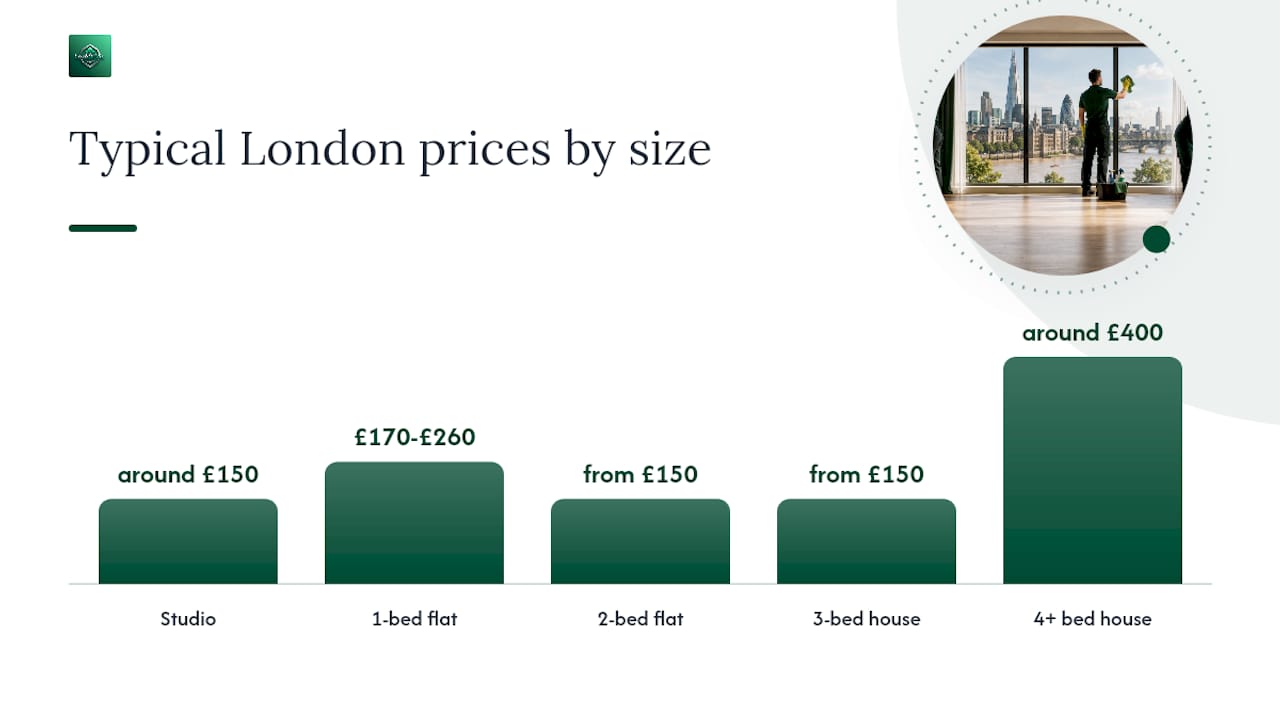
| Property size | Typical London price range | What typically pushes it higher |
|---|---|---|
| Studio | around £150 | Heavy limescale, neglected oven, pet odours |
| 1-bed flat | in the £170 to £260 range | Carpets throughout, balcony/patio doors, multiple bathrooms |
| 2-bed flat | a range starting from around £150 | Two bathrooms, built-in appliances, heavy kitchen grease |
| 3-bed house | a range starting from around £150 | Multiple floors, gardens requiring access, larger carpet area |
| 4+ bed house | tends to start around £400 and can be higher | Extensive carpets, several ovens/appliances, storage areas |
MyJobQuote's cost data puts average per-room add-ons at £40 to £80 for carpet cleaning, or £100 to £350 if you need the whole property done. Oven cleaning is usually quoted separately too, since it demands specific chemicals and far more time than a standard wipe-down.
A handful of factors decide whether your quote lands at the bottom or top of its band:
- Condition at handover — a property cleaned regularly through the tenancy costs noticeably less than one cleaned only at the end.
- Number of floors and stairs — more floors mean more time moving equipment and more surfaces to cover.
- Ovens and appliances requiring internal cleaning — these are priced as separate line items in most quotes.
- Carpets needing steam cleaning — charged per room or as a whole-property rate.
- Parking and access — inner London postcodes without free parking often add £15 to £40 to the final bill.
Get two or three quotes for the same scope of work before committing. A quote that looks cheap on paper but excludes the oven and carpets isn't actually the cheapest option once those extras get added back in.
What's included in a professional end of tenancy clean?
A genuine end of tenancy clean goes well beyond a normal weekly tidy. It's a deep clean designed to bring the property back to the condition recorded on the original inventory, which is exactly what letting agents check against during the final inspection.

Gtech's end of tenancy cleaning checklist confirms that oven interiors and appliance internals are among the most commonly failed items during checkout inspections, precisely because they're the parts tenants skip during routine cleaning.
Kitchen
- Oven interior, including racks and door glass
- Extractor fan and filters
- Inside and behind the fridge/freezer
- Worktops, splashbacks, and cupboard interiors
- Hob and grill degreasing
Bathroom
- Descaling taps, shower screens, and tiles
- Toilet, basin, and bath deep clean
- Extractor fan cleaning
- Grout and sealant checks
Living areas and bedrooms
- Skirting boards and window sills
- Light fittings and switches
- Carpet vacuuming (steam cleaning usually separate)
- Wardrobe interiors and shelving
Hallways and general
- Door frames and handles
- Radiators, front and back
- Window frames and glass
Tasks usually priced as add-ons rather than included as standard: carpet steam cleaning, oven deep cleans, upholstery cleaning, and any waste removal for items left behind by the outgoing tenant.
Pro Tip: Ask your cleaner to send before-and-after photos as they work, not just a final summary. Time-stamped images taken room by room give you far stronger evidence if the letting agent disputes the standard of the clean later.
What factors affect end of lease cleaning rates in London?
Property size sets the baseline, but several other variables swing the final price by hundreds of pounds either way.
- Property size and layout — more rooms and floors mean more labour hours.
- Starting condition — years of light maintenance versus heavy neglect make a real difference to quote size.
- Carpets and ovens — almost always quoted as separate line items rather than folded into the base price.
- Access and parking — properties without nearby parking, or in ULEZ zones, often carry a surcharge.
- Postcode demand — central London postcodes with high cleaner demand can run slightly above outer boroughs for identical work.
- Urgency — booking a clean for the next day, rather than a week ahead, usually costs more.
Secondary drivers worth knowing about: specialist stain treatment for carpets or upholstery, mould remediation in bathrooms with poor ventilation, and waste removal if the outgoing tenant has left furniture or rubbish behind. Each of these gets quoted on top of the base clean, and a reputable provider should itemise them rather than bundling them into a vague "deep clean" fee.
Pro Tip: If a cleaner offers you a choice between an hourly rate and a fixed quote for the same job, take the fixed quote whenever the property's condition is uncertain. Hourly billing puts the financial risk of a longer-than-expected job on you, not the cleaner.
How do I choose a reliable end of tenancy cleaner in London?
Vetting a cleaner takes five minutes on the phone and saves you from disputes weeks later. Ask these questions before you book:
- Are you fully insured for accidental damage during the clean?
- Do you hold a waste carrier's licence if rubbish removal is part of the job?
- What happens if the letting agent isn't satisfied — is there a re-clean guarantee, and how quickly?
- Will I receive a VAT invoice or receipt I can show my letting agent?
- Can you provide before-and-after photos as evidence?
Look for these trust signals when comparing providers:
- Clear, itemised quotes rather than a single vague total
- A written re-clean policy with a stated response time
- Insurance confirmed in writing, not just claimed verbally
- Photo evidence offered as standard, not as an optional extra
And watch for these red flags:
- No receipt or invoice offered
- Hourly estimates with no upper cap
- Vague scope ("we'll sort everything") instead of a room-by-room breakdown
- Reviews mentioning failed checkouts or disputed deposits
DIY, an hourly cleaner, or a guaranteed professional service?
The cheapest option on paper isn't always the cheapest option once your deposit is at risk. A DIY clean costs nothing beyond your time and cleaning products, but it puts the entire burden of matching the original inventory standard on you, with no photo evidence or receipt if the agent disagrees.
- DIY: Zero cash outlay, high time cost, no documentary evidence, higher deposit-risk.
- Hourly cleaner: Mid-range cost, can overrun on unclear jobs, evidence depends on what the cleaner provides.
- Guaranteed professional service: Fixed cost known upfront, includes photo evidence and invoice, re-clean policy reduces dispute risk.
Evo-PM's guidance on end of tenancy cleaning law confirms a landlord can't force you to hire a professional cleaner. What actually matters legally is returning the property to the condition recorded at move-in, and a professional invoice with photos simply makes that easier to prove if there's a dispute.
DIY makes sense for a small, well-kept flat where you've genuinely kept on top of cleaning throughout the tenancy. For anything larger, or where you're not confident the property matches the original inventory, a guaranteed service is the safer bet.
When should you book, and what should the guarantee cover?
Book your end of tenancy clean as close to your move-out date as possible, ideally within the final week, but reserve the slot two to three weeks ahead. London providers get booked up fast around month-end, when most tenancy changeovers happen.
- Book two to three weeks before your move-out date to secure your preferred slot.
- Confirm in writing what's included, plus any add-ons you need (oven, carpets).
- Request a VAT invoice and before-and-after photos as part of the booking.
- Ask what the re-clean policy covers and how quickly they respond if the agent flags an issue.
If the property fails inspection, contact your cleaner immediately with the agent's specific complaints. A provider with a genuine re-clean guarantee should return to address flagged areas at no extra cost, and can supply paperwork you can hand straight to your agent.
Pro Tip: Get your booking confirmation and scope of work in writing before the clean happens, not after. It's your first piece of evidence if anything is disputed later.
Real London quote examples: what's included at each price point
These anonymised snapshots reflect typical scopes seen across London bookings.
- 1-bed flat, standard clean: £180. Kitchen, bathroom, living areas, and bedrooms covered. Oven and carpets not included; likely hidden cost is a £20 parking charge in a controlled zone.
- 2-bed flat, deep clean with oven and carpets: £310. Full room-by-room clean plus oven interior and two rooms of carpet steaming. Watch for waste removal charges if furniture is left behind.
- 4-bed house, heavy clean: £480. Multiple bathrooms, extensive carpets, two ovens, and general heavy-duty degreasing. ULEZ and parking can add £30 to £40 on top.
When a quote lands in your inbox, check it answers three things: does it state exactly what's included, does it separate add-ons clearly, and does it mention parking or access charges upfront?
How were these London prices worked out?
These figures draw on published market price guides, landlord association guidance, and cleaning-industry checklists rather than a single source. Ranges were built by comparing reported averages across property sizes and rounding to reflect realistic quote bands, with London's typical premium factored in for labour and access costs.
Where sources gave overlapping ranges, the wider band was kept rather than narrowed artificially, since actual quotes vary by borough and provider. Primary source types used include GOV.UK guidance on tenant fees, Checkatrade's regional cost data, and property management checklists covering standard inclusions.
Deposit disputes: what evidence actually protects you
The single biggest factor in winning a deposit dispute isn't how clean the property is; it's whether you can prove it. NRLA guidance on inventory reports states plainly that a signed, time-stamped inventory taken at move-in, backed by dated photos, is the strongest defence either party has in a dispute.

For tenants, that means keeping your own photo record before you leave, alongside whatever your cleaning provider supplies. A VAT invoice from a professional cleaner, paired with before-and-after photos, gives you a paper trail that's hard for an agent to dismiss. Without it, disagreements often come down to one person's word against another's, which rarely goes well for the tenant.
A genuine re-clean guarantee adds a second layer of protection. If the agent flags an issue after your cleaner has finished, a provider who commits in writing to returning and fixing it at no extra charge closes the loop before it becomes a formal dispute. That's far cheaper, in time and stress, than fighting a deduction through the deposit protection scheme's adjudication process afterwards.
Keep every piece of paperwork: the original booking confirmation, the invoice, and any photos, until your deposit has actually landed back in your account. Disputes can surface weeks after you've moved out, and by then, memory alone won't help you.
What hidden fees should you watch for in a London quote?
The headline price on a quote rarely tells the whole story. Several charges commonly appear only once the job is underway, or buried in the small print.
- Travel and access fees — some providers charge extra for properties without nearby parking, particularly in central boroughs with paid parking zones.
- ULEZ charges — if your property sits inside the Ultra Low Emission Zone and the cleaning van doesn't comply, this cost sometimes gets passed to you.
- Materials surcharge — a small number of providers add a flat fee for specialist cleaning products, though most reputable firms include this in the base price.
- Damage during cleaning — a rare but real risk; insured providers cover this, uninsured ones may leave you to argue over who pays.
- Waste removal — if the outgoing tenant leaves furniture or rubbish, clearing it usually costs extra unless agreed in advance.
The fix is simple: ask for a fully itemised quote before booking, and specifically ask "is there anything else I could be charged for on the day?" A provider with nothing to hide will answer that question in one sentence.
Flat rate or hourly: which pricing model actually protects you?
Most London providers price jobs one of two ways, and the difference matters more than people assume.
A flat rate quote is based on a walkthrough or detailed description of the property, and the price stays fixed regardless of how long the job actually takes. This protects you from surprise costs if the cleaner finds more grime than expected once they start.
Hourly pricing charges by the hour, which can work in your favour for a small, well-maintained flat that's genuinely quick to clean. But it shifts risk onto you if the job runs long, whether because of an unexpectedly dirty oven or awkward access.
For most end of tenancy jobs, where getting your deposit back depends on the outcome, a fixed quote is the safer choice. It gives you cost certainty and removes any incentive for a provider to work slowly. Reserve hourly pricing for smaller, straightforward jobs where you're confident about the scope and the property's condition.
What happens if you need to cancel or reschedule?
Cancellation policies vary between providers, but most London cleaning companies build in a notice period, typically 24 to 48 hours, before a booking incurs a charge. Cancel within that window and you'll usually pay nothing beyond a small admin fee, if any.
Cancel later than that, particularly on the day of the booking, and many providers charge a percentage of the quoted price or a flat cancellation fee, since a cleaning slot held for you can't easily be reallocated at short notice. Rescheduling is usually free if you give reasonable notice, though last-minute changes during busy periods (like month-end) may be harder to accommodate without a small charge.
Always ask about the cancellation policy before you book, not after you need to use it. A provider who's upfront about this in writing is generally more trustworthy than one who mentions it only when you try to cancel.
Does the price change depending on the time of year?
London end of tenancy cleaning prices fluctuate with demand, and demand tracks the rental market's own rhythm. The final week of any month sees the highest volume of tenancy changeovers, since most tenancies run on calendar-month terms, which means booking slots are tightest and prices sometimes sit at the higher end of the range.
Summer months, particularly June through September, also see a spike in bookings as students and young professionals move between rentals ahead of the new academic and work year. Booking two to three weeks ahead rather than a few days before your move-out date gives you more choice of provider and a better chance of avoiding any urgency premium.
Quieter periods, like the run-up to Christmas or midwinter, tend to have more availability and occasionally slightly more flexibility on price, simply because providers have fewer jobs competing for the same slots.
A local perspective on London checkouts
The oven and the carpets. Almost every failed checkout our teams get called about comes down to one or both. It's rarely dramatic, just the parts tenants genuinely forget once moving day chaos sets in.
Lookdevisservices covers Greater London with insured teams who provide photo evidence and proper invoices as standard, because that paperwork is what actually protects your deposit.
Get a London end of tenancy quote from Lookdevisservices
If you'd rather not chase quotes across half a dozen providers, Lookdevisservices offers a straightforward alternative: one insured, local team that handles the clean and gives you the paperwork to back it up.

As a fully insured provider covering Greater London, Lookdevisservices can supply the documentation that actually protects your deposit: a VAT invoice, before-and-after photos, and a clear scope agreed before work starts. If waste removal is part of your move-out, our licensed waste removal service handles bulky items under proper waste carrier licensing rather than leaving you to arrange separate disposal. Check our service areas across London to confirm coverage for your postcode, then get in touch for a fixed quote.
Call 07348 758581 or email lookdeviscompanylegal@gmail.com to book a slot and request your before-and-after photo evidence and invoice as part of the job. If you'd prefer to start with more detail on scope and pricing, visit our end of tenancy services page to request a free quote.
Sources
For legal questions about what a landlord or agent can lawfully charge, consult the Tenant Fees Act guidance for landlords and agents or the Gov. For the exact legal text, see the Legislation. For practical checklists and pricing detail, the Gtech end of tenancy cleaning checklist and NRLA's guidance on inventory evidence are worth bookmarking.
FAQ
How much does end of tenancy cleaning cost in London?
Expect £150 to £500+ depending on property size, with a 1-bed flat typically costing £170 to £260 and a 4+ bed house running £400 to £500 or more.
Is £20 an hour a lot for a cleaner?
For London specifically, £20 an hour sits within the typical range for professional cleaning, though end of tenancy jobs are more commonly quoted as a fixed price rather than hourly given the scope involved.
How much can a landlord charge for cleaning in the UK?
A landlord can't force a tenant to pay for a professional clean as a condition of the tenancy; they can only deduct reasonable costs from the deposit if the property isn't returned to the standard recorded on the original inventory, as confirmed by Evo-PM's guide to end of tenancy cleaning law.
What will a cleaner do in 3 hours?
Three hours typically covers a standard clean of a studio or small 1-bed flat, including kitchen surfaces, bathroom, living areas, and bedrooms, though oven interiors and carpet steaming usually need extra time booked separately.
Does Lookdevisservices provide evidence for deposit disputes?
Yes, Lookdevisservices supplies before-and-after photos and a VAT invoice as standard for end of tenancy jobs across Greater London, giving tenants documentation to present to their letting agent if needed.