
Replacing a standard 6 ft (1.8 m) garden fence in the UK typically costs between £85 and £180 per linear metre, fully installed. The single biggest variable is material choice combined with whether the existing posts need replacing — those two factors alone can shift your total by hundreds of pounds on even a modest run.
Here is what that looks like in practice for a 15 m garden boundary:
- Budget timber lap panels (15 m): approximately £900–£1,300 installed
- Mid-range closeboard (15 m): approximately £1,200–£1,950 installed
- Composite fencing (15 m): approximately £1,800–£3,000 installed
These figures assume concrete posts, standard ground conditions, and removal of the old fence. Prices rise in London and the South East, where labour alone can add £20–£60 per metre.
Pro Tip: Contractors use a simple decision rule: if roughly 30% or more of your fence needs repair or replacement, a full replacement almost always works out cheaper than piecemeal repairs over the next few years. Use it as your first filter before requesting quotes.
Key takeaways
Fence replacement cost in the UK ranges from £85 to £300 per metre installed, with material choice and post condition the two factors that move the price most.
| Point | Details |
|---|---|
| Typical installed cost | Standard timber fencing runs £85–£180 per metre fully installed; composite sits at £180–£300 per metre. |
| The 30% decision rule | If 30% or more of your fence needs work, full replacement almost always costs less than cumulative repairs. |
| Posts drive hidden costs | Concrete footing extraction adds £50–£200 per post and is the most common budget surprise on otherwise simple jobs. |
| Compare quotes like for like | Ask every contractor to confirm whether waste disposal and footing extraction are included before accepting any figure. |
| Lookdevisservices | Offers fixed-price, fully itemised fencing quotes with licensed waste removal for residential and commercial properties across London. |
Table of Contents
- What does fence replacement cost per metre and per panel?
- What should a professional fencing quote include?
- What factors raise or reduce the price?
- DIY versus hiring a professional: what is the realistic saving?
- How to estimate your own fence replacement cost
- Repair versus full replacement: how to decide
- Gates, extras, and removal of the old fence
- Fencing installation in London: what Lookdevisservices offers
- Request a fixed quotation for your fence replacement
- Sources
What does fence replacement cost per metre and per panel?
The headline per-metre figure covers several distinct cost elements, and understanding each one is what lets you compare quotes fairly. Typical installed prices for standard timber panel fencing commonly fall in the £90–£180 per metre band, with composite and premium options sitting higher.
Assumptions: 6 ft / 1.8 m height; concrete posts at 2.4 m centres; gravel boards included; old fence removal included; standard ground conditions.
What makes up the per-metre price?
Breaking the installed rate into its components shows where the money actually goes:
- Fence panels: £25–£80 per panel depending on material and width
- Posts (concrete or timber): £15–£45 per post; concrete posts last considerably longer
- Gravel boards: £8–£20 per board
- Post fixings and concrete: £5–£15 per post
- Labour: £40–£100 per metre, varying by region and complexity
- Old fence removal and disposal: £5–£15 per metre on average
- Gates and extras: priced separately (see the gates section below)
Labour accounts for a meaningful share of the total. According to BookaBuilderUK, a typical worker's day rate runs £150–£250, with London and South East crews sitting at £200–£250 per day. On a standard two-person job, that labour cost alone can reach £80–£100 per metre before a single panel goes in.
Material choices also shape the long-term picture: timber typically lasts 10–15 years with regular staining and treatment, while composite can reach 20–30 years with minimal upkeep. The upfront premium for composite often pays back over a second fence cycle.
What should a professional fencing quote include?
A properly itemised quote is your strongest protection against unexpected costs. When a contractor hands you a single lump-sum figure with no breakdown, you have no way to know whether waste disposal is included, how many posts are being set, or what happens if the ground is harder than expected.
A complete quote should show each of the following line items clearly:
- Materials: panel type, quantity, post type and quantity, gravel boards, fixings, concrete
- Labour: hours or days, crew size, and rate per day or per metre
- Old fence removal: whether included or charged separately, and how the debris leaves site
- Waste disposal: skip hire or trade-waste collection, with the contractor's waste carrier licence number
- Post setting detail: depth, concrete mix, and curing time before panels are fitted
- Gates: itemised separately with hardware costs
- VAT: clearly stated as inclusive or exclusive
- Payment terms: deposit amount, stage payments, and final payment trigger
- Guarantee: duration on workmanship and on materials (manufacturer's warranty)
- Insurance: public liability cover, minimum £1 million
Red flags to watch for
- A quote with no line items — just a total price and a start date.
- No mention of how old posts or concrete footings will be handled.
- Waste removal described as "included" with no skip or disposal detail.
- An unusually high minimum labour charge that inflates small jobs disproportionately.
- No written guarantee on workmanship.
- No mention of insurance or a request for full payment upfront.
Questions worth asking before you accept
Ask the contractor to confirm: how deep the posts will be set; whether the quote covers extraction of existing concrete footings; what happens if buried services are found; and whether the waste carrier licence number can be provided in writing. Planning permission is rarely needed for domestic fences, but if your property is in a conservation area or adjoins a highway, the contractor should flag this before work starts rather than leave it to you.
Many quotes differ most on labour assumptions and waste disposal. Asking suppliers to show labour hours and skip or trade-waste fees separately is the single most effective way to compare them fairly.
What factors raise or reduce the price?
The per-metre ranges above assume a straightforward job on level ground with reasonable access. Several factors can push your actual quote well above or below those figures.
Material type is the largest single driver. Swapping from basic lap panels to closeboard adds roughly £20–£40 per metre. Moving to composite adds £70–£150 per metre over timber.
Post condition is the second most consequential factor. If posts need extracting and resetting, costs rise sharply, particularly where concrete footings are involved.

Ground conditions matter more than most homeowners expect. Clay soil or ground with buried rubble can add £20–£40 per metre to labour costs. Rock or heavily compacted ground may require a breaker or mini-digger, adding a day's plant hire (typically £150–£300) on top of standard rates.
Access affects both labour time and equipment. A rear garden accessible only through the house adds time for every delivery of materials and every barrow of spoil. Narrow side passages, steps, or a shared driveway all slow the job.
Fence height above the standard 1.8 m requires larger posts, additional rails, and more material per metre. Going to 2.0 m or 2.4 m can add £15–£30 per metre.
Number of gates adds a fixed cost per opening regardless of run length (see the gates section).
Regional labour rates are a consistent variable. London and South East contractors typically charge £20–£60 per metre more than equivalent crews in the Midlands or North.
Pro Tip: Before any contractor visits, probe the ground along the fence line with a metal bar or screwdriver to check for buried concrete. Old concrete post footings that were never fully removed are the most common hidden cost on otherwise simple jobs. Knowing they are there before you request quotes lets you ask specifically how each contractor prices their extraction.
DIY versus hiring a professional: what is the realistic saving?
For a straightforward panel replacement on sound existing posts, DIY is genuinely achievable for a competent homeowner with a free weekend. For anything involving post extraction, concrete setting, or a run longer than 10 m, the case for professional installation becomes considerably stronger.
DIY: honest pros and cons
- Saves on labour: on a 10 m run, you might save £400–£700 in labour costs
- No workmanship guarantee: if posts are not set correctly, panels will fail within a season
- Tools required: post-hole digger or auger (hire cost £40–£80/day), spirit level, concrete mixer or bags, safety equipment
- Waste disposal: you are responsible for removing old timber and concrete; a skip costs £150–£350 depending on size and location
- Time: a 10 m run typically takes an experienced DIYer two full days; a professional two-person crew often completes the same run in one day
- No manufacturer warranty activation: some composite suppliers require professional installation for the warranty to be valid
Hiring a professional: what you get
- Workmanship guarantee (typically 1–5 years)
- Correct post depth and concrete mix for your ground conditions
- Waste carrier licence for legal disposal
- Public liability insurance covering accidental damage
- Faster completion, usually with less disruption
For a 10 m run, the DIY materials cost alone typically runs £350–£600. A professionally installed equivalent costs £600–£1,400 depending on material and region. The gap narrows considerably once you factor in tool hire, skip hire, and the time cost of two days' work.
Questions to ask when hiring a contractor
- Are you fully insured, and can you provide your public liability certificate?
- What is the workmanship guarantee period?
- Have you worked with concrete post extraction before, and how do you price it?
- How will the old fence and concrete be disposed of, and can you provide your waste carrier licence number?
- Will the quote change if ground conditions differ from what we expect?
How to estimate your own fence replacement cost
A simple formula gives you a working budget before any contractor visits. Use it to sense-check quotes and identify line items that seem out of proportion.
The estimator formula:
Worked example 1: 10 m small rear garden, timber lap panels
Assumptions: 6 ft panels, concrete posts at 2.4 m centres, standard ground, no gates, South East labour rate.
Worked example 2: 30 m suburban perimeter, closeboard
Assumptions: 6 ft closeboard, concrete posts, standard ground, one single gate, South East labour rate.
Worked example 3: 100 ft (approx. 30.5 m) composite fencing
Assumptions: 6 ft composite, aluminium or steel posts, standard ground, no gates, London labour rate.
For a quick cross-check, the UKFenceCalculator lets you enter run length, panel choice, and gate count to generate a budget estimate — useful for validating the figures above against your specific combination of materials.
Most UK homeowners pay between £60 and £150 per metre for a new fence fully installed, so a 30 m run typically falls in the £1,800–£4,500 range before gates and extras.
Repair versus full replacement: how to decide
The 30% rule is the most practical starting point. If roughly 30% or more of the fence needs attention — whether that is rotted boards, leaning posts, or failed concrete footings — a full replacement almost always costs less over five years than repeated repairs.
Decision checklist
- Under 10% needs work: repair is sensible; replace individual boards or reset a single post
- 10–30% needs work: assess post condition carefully; if posts are sound, panel replacement may suffice
- Over 30% needs work: full replacement is almost always the better financial decision
- Any post is leaning more than 5°: the post needs resetting or replacing regardless of panel condition
- Concrete footings are cracked or heaving: extraction and resetting is unavoidable
Typical repair cost ranges
| Repair type | Typical cost |
|---|---|
| Replace a single timber panel (posts sound) | £100–£150 |
| Reset a leaning post (no extraction) | £80–£150 |
| Replace a rotted post (with concrete extraction) | £100–— |
| Replace individual boards on closeboard | £50–£90–£180 per section |
| Stain or treat existing fence (per metre) | £5–£15 per metre |
Single panel replacement runs around £100–£150 when posts remain sound; replacing posts or extracting concrete footings adds materially to that figure.
Pro Tip: Keep a simple log of every repair and its cost. When cumulative repairs over three years approach 40–50% of the full replacement cost, you have crossed into false economy territory. The log also helps when requesting quotes, because contractors can see the fence's history at a glance.
How long does a fence replacement take?
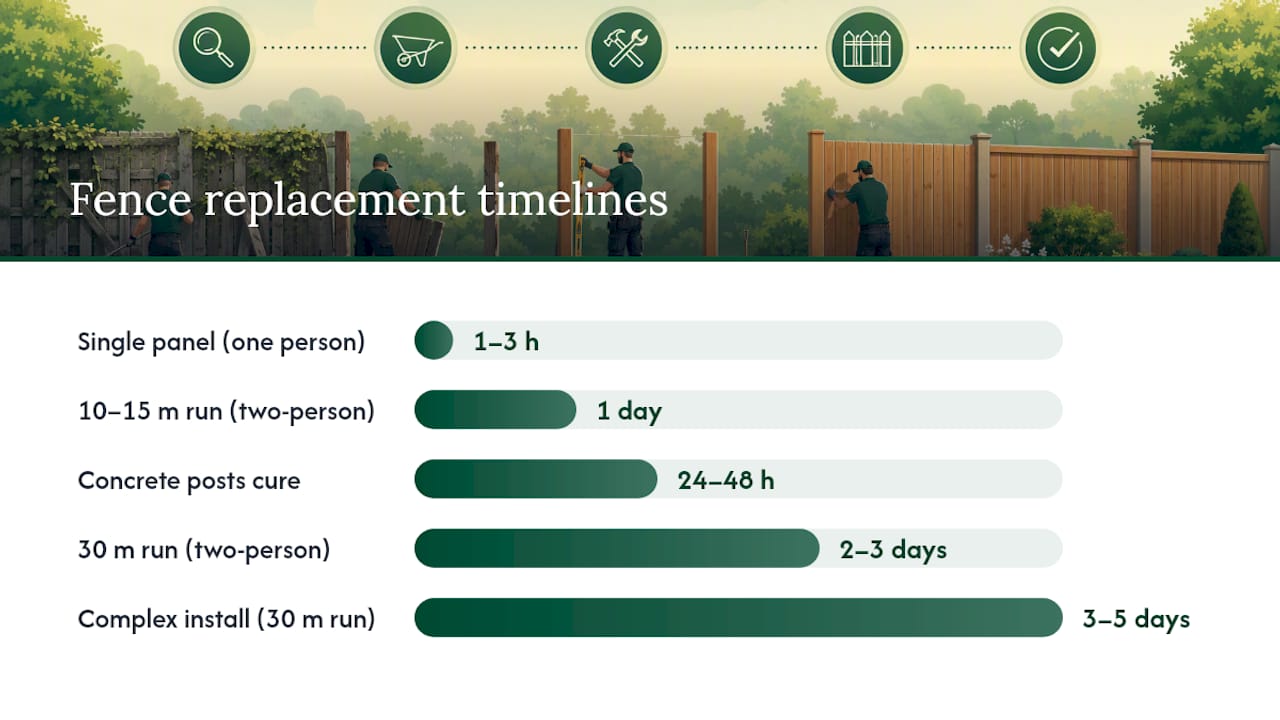
Timelines vary significantly with run length, ground conditions, and crew size. Here is what to expect:
- Single panel replacement: 1–3 hours for one person
- 10–15 m run (two-person crew): typically one full day, including removal and concrete setting
- 30 m run (two-person crew): two to three days; concrete curing adds a waiting period before panels are fitted
- Jobs requiring concrete footing extraction or a mini-digger: add one day for plant hire and extraction before any new posts go in
- Complex installs (slopes, multiple gates, difficult access): three to five days for a 30 m run
Concrete posts need 24–48 hours to cure before panels are attached, so most professional crews set posts on day one and return to fit panels on day two. Factor this into access planning, particularly if the fence is a boundary with a neighbour.
Scheduling seasonality is worth noting. Spring and early summer are the busiest periods for fencing contractors, and lead times of three to six weeks are common. Booking in late autumn or winter often means faster availability and occasionally a lower rate, though wet or frozen ground can slow post setting.
Gates, extras, and removal of the old fence
These line items are where budgets most often fall short. Each is straightforward to price once you know what to ask for.
Common extras and typical costs
| Extra | Typical cost range |
|---|---|
| Single timber gate (supply and fit) | £250–— |
| Double timber gate (supply and fit) | £900–£1,300 |
| Composite or metal gate (single) | £1,200–£1,950 |
| Gate hardware (hinges, latch, bolt) | £30–£100 |
| Fence stain or preservative treatment | £5–£15 per metre |
| Skip hire (2–4 cubic yard) | £150–£350 |
| Old fence removal only (no new fence) | £8–£20 per metre |
| Concrete footing extraction (per post) | £50–£200 per post |
Removing old concrete post footings is disproportionately expensive relative to the rest of the job. A single footing can take 30–60 minutes to extract by hand, and a run with ten posts can add half a day's labour before a single new post goes in. For large runs, a mini-digger makes extraction faster but adds hire costs.
For the disposal side, Lookdevisservices holds a waste carrier licence covering legal removal of timber, concrete, and mixed garden waste, which removes the need for homeowners to arrange a separate skip.
Fencing installation in London: what Lookdevisservices offers
Lookdevisservices provides fixed-price fencing installation for residential and commercial properties across Greater London. Every quotation is itemised, covering materials, posts, concrete, labour, and waste removal in a single transparent figure — no hidden extras after the job starts.
Key benefits for homeowners requesting a quote:
- Single point of contact for fencing, groundwork, and waste removal
- Licensed waste disposal included as standard, with no need to arrange a separate skip
- Fully insured crews with public liability cover
- Fixed quotations agreed before work starts, with no day-rate surprises
- Workmanship guarantee on all installations
- Experienced with concrete post extraction, including difficult ground conditions
To get an accurate quote, have the following ready: total linear metres (or the number of panels), current post condition (sound, leaning, or unknown), number of gates required, and any known access constraints. Lookdevisservices serves London and surrounding areas, with crews experienced in the full range of ground conditions found across Greater London.
A note from Roman
One quoting mistake I see repeatedly is homeowners comparing quotes that are not measuring the same job. One contractor includes waste removal and concrete post extraction; another quotes panels and labour only. The totals look similar on paper, but the cheaper quote often becomes the more expensive job once the extras appear on the final invoice.
The simplest fix: before you request quotes, photograph the entire fence line, note the condition of every post, and measure the run yourself. Send the same information pack to every contractor. When quotes come back, ask each one to confirm explicitly whether concrete footing extraction and waste disposal are included. That single question will tell you more about a contractor's transparency than any other.
Request a fixed quotation for your fence replacement
Lookdevisservices gives London homeowners a genuinely different experience from the typical fencing quote: a single fixed price that covers materials, labour, concrete post setting, and licensed waste removal, with no day-rate ambiguity and no invoice surprises. For a property where fencing, groundwork, and garden clearance all need attention, one call covers the lot.

To get your fixed quotation, share your linear metres, post condition, gate count, and any access notes. Lookdevisservices's insured crews will assess the site and return a fully itemised quote before any work begins. For broader garden projects alongside your fencing, the team also covers landscaping and hard groundworks and full garden maintenance services across London.
Request your fixed fencing quote today and have an accurate budget in hand before you compare a single contractor.
Sources
- Garden fence costs in 2026 - MyBuilder
- Bookabuilderuk
- Fence installation cost UK 2026 | £60 to £150 a metre | Less
- Fences, gates and garden walls planning permission | Planning Portal
- Calculate your full fence cost - gates, skips & design. | UKFenceCalculator
- How much does a garden fence cost in the UK? | Duffield Timber