
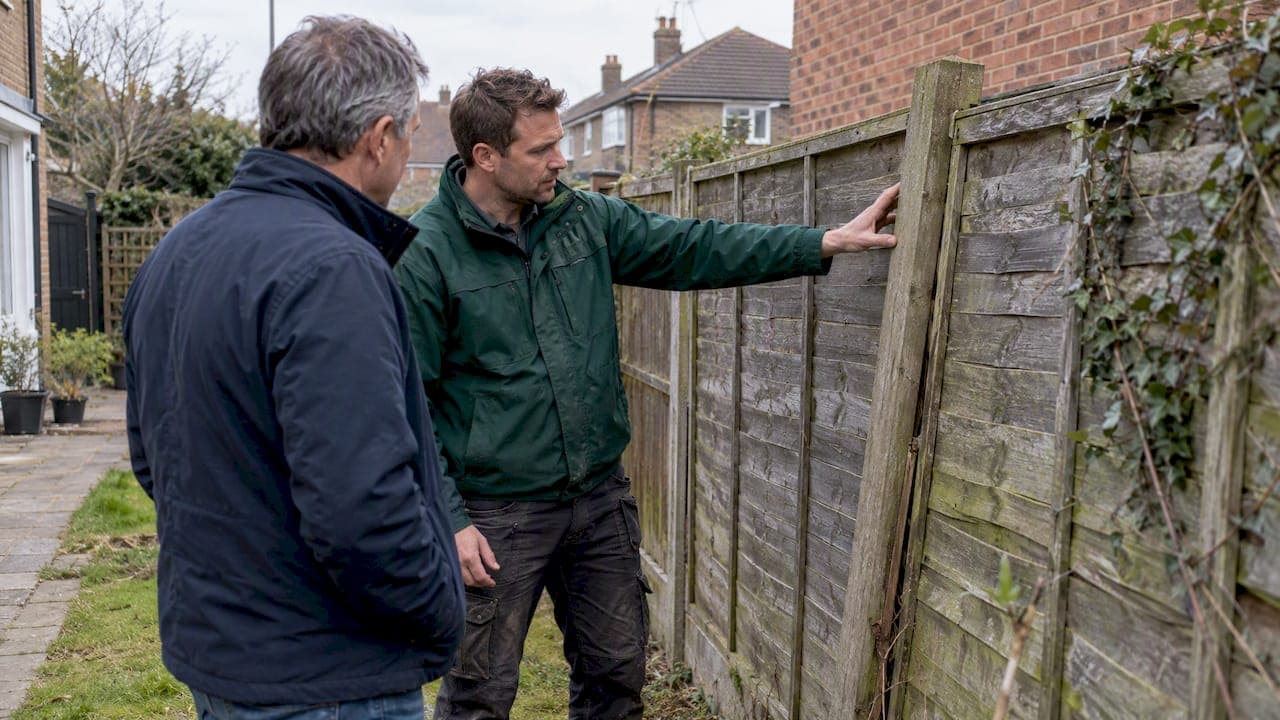
For fencing installation, repair or maintenance across Greater London, choose a local, insured contractor. We handle site inspections, written quotes, removal and installation for both residential and commercial boundaries. Request a free quote to get a clear price and timescale before any work begins.
TL;DR:
- Most fence repairs are localized, such as replacing a single panel or post, but widespread rot or movement often requires full boundary replacement.
- Contractor quotes vary depending on site conditions, with full installations taking more time and costing more than minor repairs or maintenance.
- Soil conditions, ground obstacles, and old fencing removal can significantly influence the final price and project duration.
- Proper post-setting methods and regular seasonal checks can prevent costly fence failures and liabilities later on.
- Planning permission is usually not needed for fences under 2 meters, but height increases or special circumstances might require approval.
Table of Contents
- What fencing services cover: installation, repair and maintenance
- How installers diagnose damage: repair or replace?
- Typical costs and timescales for fencing work
- Planning permission, height limits and boundary checks
- How to choose and hire a fencing contractor
- What we offer for fencing jobs
- Warranty and guarantees offered by fencing contractors
- Insurance and liability considerations for hired fencing services
- Payment terms and methods commonly accepted by fencing contractors
- Contractor perspective: maintenance priorities and avoiding bigger bills
- Get a free fencing quote from us
- FAQ
- Sources
What fencing services cover: installation, repair and maintenance
Fencing work generally falls into a few clear categories, and knowing which one applies to your property helps you request the right quote from the start. New installations replace a boundary entirely, often after storm damage or when upgrading an ageing fence line. Repairs target specific failures such as a single leaning post or a split panel, while maintenance covers treatment, tightening fixings and minor adjustments that extend a fence's working life.
Common services include:
- New fence installations across full boundary runs
- Panel replacements for damaged or rotten sections
- Post repairs, including concrete and timber posts
- Gravel board replacement to stop ground-level rot
- Commercial boundary and security fencing solutions
- Ongoing maintenance such as treatment and fixing checks
Timber panel fencing remains popular for cost and appearance, though it needs more maintenance than concrete post and gravel board systems. A single damaged panel is usually a straightforward repair, but a fence showing rot or movement along several sections typically points towards a fuller replacement.
How installers diagnose damage: repair or replace?
A competent installer will not simply quote for the first problem they see. They assess the whole run to work out whether a targeted repair will hold or whether the structure needs replacing.
- Check post stability by applying gentle pressure to see how much movement there is at ground level.
- Inspect the post base for rot, since timber posts often fail below the soil line long before the visible section shows damage.
- Look at panel movement and whether fixings have pulled loose from the posts.
- Examine gravel boards for rot, as these sit closest to the ground and usually fail first.
- Map the pattern of damage across the boundary rather than treating each fault in isolation.
Localised rot at one or two posts can often be resolved by resetting or replacing just those posts, while widespread rot or repeated failures across multiple posts usually signals that the whole run and its foundations need replacing. Before calling a contractor, note anything unusual: a post leaning more than before, panels that have failed more than once in the same spot, or a boundary shared with a neighbour's property.
Pro Tip: Take photos of any leaning posts or rotten sections before your inspection, as this helps the contractor prepare a more accurate quote in advance.

Typical costs and timescales for fencing work
Fencing contractors generally price jobs using a few common models: per metre for full runs, per panel for partial replacements, per post for isolated repairs, or a day rate for smaller jobs with uncertain scope. Materials, site access, ground conditions and the removal of old fencing all affect the final figure, so two quotes for what looks like the same job can differ considerably once these factors are accounted for.
- Small repairs, such as a single post or panel, tend to be the quickest jobs, often completed within a day
- Panel replacements across a longer run take more time due to post-setting and concrete curing
- Full installations require the most time, particularly where old fencing needs removing and disposing of first
- Ground conditions, such as clay soil or buried services, can extend both time and cost
Fencing permitted development rules commonly cap height at over 1 metre next to a public road or over 2 metres elsewhere before planning permission is required. This threshold is one of the most common reasons a straightforward replacement suddenly needs a planning check, so it is worth confirming before work starts. Always treat verbal estimates as a starting point and ask for an itemised written quote that separates labour, materials and waste disposal, since this is the clearest way to compare bids on a like-for-like basis.
Planning permission, height limits and boundary checks
Most fence replacements and repairs do not need planning permission, provided the work fits within permitted development rules. The Town and Country Planning permitted development order sets specific height conditions for fences, gates and walls, and exceeding them, or increasing the height of an existing boundary, can take the work outside permitted development.
- Fences taller than approximately 1 metre next to a public highway, or higher than about 2 metres elsewhere, usually require planning permission
- Conservation areas, listed buildings and properties covered by an Article 4 direction can carry extra restrictions
- Local council guidance confirms building-regulations approval is not usually needed for boundary fences, but the structure must still be safely built
- Tenants should secure written landlord consent before altering any boundary fence, as unauthorised changes can breach the tenancy agreement
Boundary ownership is worth confirming before any work begins. Check your property deeds, and where ownership is unclear, an RICS-recommended surveyor can help establish the correct boundary line. If a dispute does arise with a neighbour, Citizens Advice recommends checking the deeds first and attempting informal resolution before considering legal routes.
How to choose and hire a fencing contractor
A reliable contractor should be easy to check before you commit to any work. Ask to see proof of insurance, confirm they hold a licensed waste carrier registration for disposing of old fencing, and request a written, itemised quote rather than a verbal estimate.
- Ask who supplies the materials and what specification is included, such as timber grade or post type.
- Ask about the post-setting method, since concrete footings generally outlast posts set directly in soil.
- Confirm how the boundary line will be verified before work starts, particularly on shared boundaries.
- Ask how old fencing and waste will be removed and disposed of.
- Agree a payment schedule before work begins, including any deposit and final payment terms.
Pro Tip: A trustworthy quote separates labour, materials and disposal costs clearly, so you can see exactly what you are paying for at each stage.
Watch for red flags: a large unexplained upfront deposit, a vague scope of work with no specification, no local contact details, or an inability to provide proof of insurance. These are common signs worth raising before agreeing to any contract.
What we offer for fencing jobs
When you book fencing work with us, the process starts with a site inspection so we can assess post condition, access and the full scope before pricing anything. From there, we provide a written quote covering materials, labour and disposal, agree a start date that suits your schedule, and remove old fencing through licensed waste handling once the new boundary is in place.

We work as a fully insured team, offering free quotes and same-day or urgent availability for selected locations and services where our schedule allows. Whether you need a single post repaired at a residential property or a full commercial boundary replaced, we can arrange the job as a one-off project or build it into a regular maintenance plan alongside other grounds or property work.
Warranty and guarantees offered by fencing contractors
Fencing contractors vary in how they structure guarantees, so it is worth asking directly rather than assuming cover is standard. A typical guarantee relates to workmanship, meaning the contractor stands behind the installation itself, such as post stability and fixings, for an agreed period after completion. Materials often carry a separate guarantee from the manufacturer, particularly for pressure-treated timber or concrete components, and this is usually distinct from the labour guarantee the contractor offers.
Ask your contractor to confirm the guarantee period in writing as part of the quote, along with what it actually covers. A guarantee that only covers materials, for example, will not help if a post fails due to poor setting rather than a faulty product. Equally, a guarantee with no defined timeframe is difficult to rely on if a problem appears months later.
Good quotations should state the post-setting method, whether concrete or ground socket, alongside the guarantee period, since both affect how long a fence is likely to last and what happens if something fails early. Keep a copy of your written quote and any guarantee terms, as this becomes your reference point if a repair is needed under warranty. If a contractor cannot answer basic questions about what their guarantee covers, treat that as a point worth clarifying before you commit to the job.
Insurance and liability considerations for hired fencing services
Insurance matters for two separate reasons when hiring fencing work: protecting you if something goes wrong during the job, and protecting you from liability for the finished fence itself. A contractor's public liability insurance should cover accidental damage to your property or a neighbour's during installation or removal, so it is reasonable to ask for proof of this before work starts.
Liability does not end once the fence is built. As a property owner, you generally remain responsible for ensuring your boundary fence is safely constructed and maintained, even where no planning permission or building-regulations approval was required for the work. Local authority guidance confirms that building-regulations approval is not usually needed for boundary fences, but owners remain liable for unsafe structures that cause injury or damage, and dangerous fencing should be reported to building control.
This is particularly relevant for landlords and commercial property managers, where a poorly maintained fence could create a liability issue affecting tenants, visitors or neighbouring property. Checking that your contractor carries adequate insurance, and keeping your fence properly maintained afterwards, reduces that exposure considerably. If you are ever unsure whether a specific boundary situation creates a liability risk, it is worth raising the question directly with your contractor or a qualified surveyor rather than assuming it does not apply to you.
Payment terms and methods commonly accepted by fencing contractors
Payment structures for fencing work tend to follow a similar pattern across the industry, though the exact terms should always be confirmed in your written quote rather than assumed. Many contractors ask for a deposit before ordering materials, with the balance due on completion once you have had a chance to inspect the finished work. A reasonable deposit reflects the cost of materials being ordered specifically for your job, rather than an arbitrary upfront sum.
Most contractors accept standard payment methods such as bank transfer and card payment, and some offer cash as an option for smaller jobs. Avoid any contractor who insists on a large cash deposit with no paperwork, as this removes your ability to query charges later if a dispute arises.
Agree the full payment schedule in writing before work begins, including the deposit amount, when the balance is due, and what happens if additional work is identified once the job is underway. For larger commercial contracts, staged payments tied to project milestones are common and give both parties a clearer record of progress. Whatever the arrangement, a written agreement protects you if there is ever a disagreement about what was paid, and when.
Contractor perspective: maintenance priorities and avoiding bigger bills
In our view, the fences that fail expensively are usually the ones nobody checked seasonally. A quick look at post bases and fixings twice a year catches rot early, long before it spreads along a run. Correct post-setting and suitable materials from the start matter more than most owners realise, both for how long a fence lasts and for who is liable if it fails.
— Roman
Get a free fencing quote from us
We make requesting a quote simple: tell us the fence length, describe the problem, and send a few photos if you can, and our team will come back with a written quote covering materials, labour and disposal.

Having access details ready, such as side gates or shared boundary notes, helps us plan the visit efficiently. We are ready to assess your boundary and give you a clear price. Request your free fencing quote today.
FAQ
What is the average cost of fencing in the UK?
Fencing costs vary widely depending on materials, fence length, post type and site access, so there is no single reliable figure that applies across all jobs. The most accurate way to understand likely costs for your property is to request an itemised written quote that separates labour, materials and disposal.
How much do fencers charge per day in the UK?
Day rates for fencing contractors vary by region, job complexity and whether materials are included, so figures differ considerably between contractors. Requesting a written quote based on your specific job, rather than relying on a generic day rate, gives a far more accurate picture of the likely cost.
What is the 2m fence rule?
Under permitted development rules, a fence over 2 metres high generally requires planning permission, unless it sits next to a highway used by vehicles, where the limit drops to 1 metre. Conservation areas, listed buildings and Article 4 directions can impose additional restrictions beyond these standard limits.
How much should I pay a fencer?
What you pay should match an itemised written quote covering materials, labour and waste disposal for your specific job, rather than a flat industry figure. Comparing quotes on the same basis, including post-setting method and guarantee period, is the clearest way to judge whether a price is fair for the work involved.
Do I need planning permission to replace an existing fence?
Replacing an existing fence at the same height usually falls within permitted development and does not need planning permission. If you plan to increase the height, or the property is listed, in a conservation area, or covered by an Article 4 direction, it is worth checking with your local planning authority first, as explained in guidance from the Planning Portal.
Sources
- Planning Permission - Fences, gates and garden walls - Planning Portal
- If you disagree with your neighbour about a wall or fence - Citizens Advice
- Boundaries, party walls and garden walls | Royal Borough of Kingston upon Thames
- The Town and Country Planning (General Permitted Development) (England) Order 2015 - Class A
Prices, timescales and information provided in this article are for general guidance and may vary depending on the property, site conditions, materials and scope of work. Please contact LookDeVis Services for an individual assessment and quotation. Where regulatory, planning or legal requirements apply, appropriate professional advice should be obtained.