
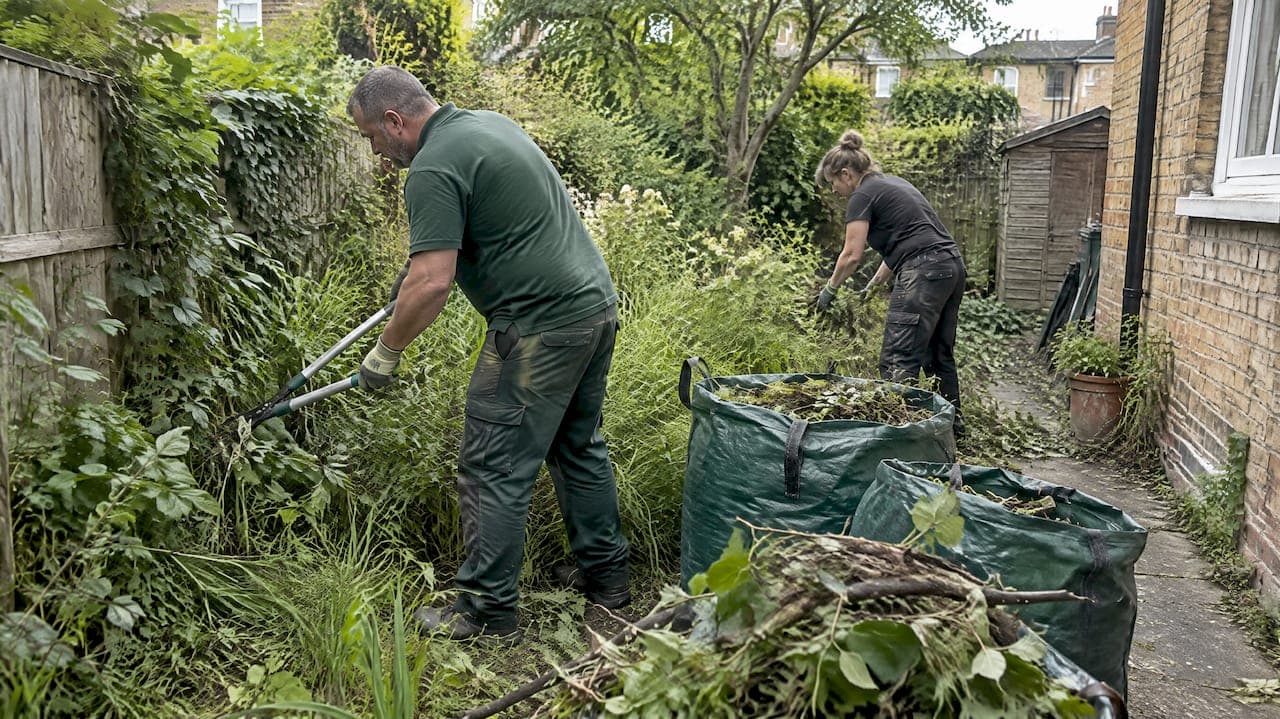
Garden clearance in London typically costs from a modest starting price for a small garden to a higher figure for a large, heavily overgrown plot, with mid-sized jobs varying depending on access and waste volume. These figures are indicative starting points, not fixed quotes: an accurate price needs photos or a site visit, and the quote must include legal waste disposal. A professional clearance company can provide a written quote based on your garden's actual condition.
TL;DR:
- London garden clearance costs range from about £150 for small gardens to over £400 for heavily overgrown or large plots, depending on access and waste types.
- The biggest cost factor after size is access; narrow alleys, upper-story gardens, or restricted parking can significantly increase the price due to extra labour.
- Waste type impacts costs, with green waste being cheaper to dispose of than mixed or hazardous waste like old fencing or asbestos.
- Contractors' quotes vary based on pricing models such as hourly, per-load, or fixed job, with detailed written estimates including all scope and waste disposal.
- Providing clear photos, access info, and waste estimates beforehand helps secure accurate quotes; always compare at least three responses and verify waste carrier registration details.
Table of Contents
- Typical cost bands for small, medium and large garden clearances
- Price drivers: access, waste type and extra work that raise the cost
- How contractors typically charge and how to read a written quotation
- Cost-saving measures that do not risk compliance or safety
- Getting accurate quotes: what to send and how many to collect
- Legal duty of care and waste-transfer requirements
- How a London clearance team approaches pricing and delivery
- Book a free quote for garden clearance in London
- Sources
- FAQ
Typical cost bands for small, medium and large garden clearances
London gardens vary enormously, so most clearance companies work in loose bands rather than a single price list. A small garden, often a courtyard or a terraced house's rear plot up to around 20 square metres, usually needs a couple of hours of cutting back and bagging. A medium garden, perhaps 20 to 60 square metres with moderate overgrowth, takes longer because of the extra cutting, loading and disposal involved. A large garden, anything above 60 square metres or one that has been neglected for several seasons, can involve a full day's work with multiple vehicle loads.
Indicative London price ranges, treated as "from" figures rather than guaranteed totals, tend to fall into these bands:
- Small garden clearance: from around £150, suited to courtyards, small patios or a modest back garden with light growth.
- Medium garden clearance: typically from £250 to £400, covering a standard semi-detached or terraced garden with shrubs, weeds and some fallen branches.
- Large or heavily overgrown clearance: often from £400 upwards, for gardens that have not been maintained for a long period or that include substantial vegetation and waste volume.
Some trade directories list sample London ranges that sit broadly within this pattern, with example average bands around £160 to £400 depending on scope. These figures are useful as a rough benchmark when you are setting an initial budget, but they should never replace a proper quote based on your own garden.
As a worked example: say a terraced property in Lewisham has a 30 square metre rear garden with knee-high grass, a few overgrown shrubs and some fly-tipped rubbish near the fence. That would likely sit in the medium band, perhaps toward the upper end if access to the front of the house is restricted and everything has to be carried through a narrow side passage.
London rates tend to run higher than many other parts of the UK for a few practical reasons. Labour costs in the capital are generally higher than the national average, reflecting the cost of living and travel time between jobs. Waste disposal and tip fees also tend to cost more in London boroughs, and transport through congested streets eats into the working day, particularly in areas with low-traffic schemes, parking restrictions or congestion charging zones. A contractor quoting for a job in central London or a borough with difficult parking will usually build that time cost into the price.
None of this means London clearance is overpriced. It reflects the genuine cost of operating a compliant, insured service in a dense city, where every extra fifteen minutes spent finding parking or carrying waste bags down three flights of stairs is time that has to be accounted for somewhere.
Price drivers: access, waste type and extra work that raise the cost
Two gardens of similar size can produce very different quotes, and the difference almost always comes down to a handful of variables that experienced contractors check for before they price a job.
Access is usually the single biggest factor after size. A garden reachable by vehicle, with a gate wide enough for a wheelbarrow, takes far less time to clear than one at the rear of a flat above ground level, accessible only through a narrow side alley or up a flight of external steps. Every bag that has to be carried by hand rather than wheeled adds labour time, and labour time is what you are mostly paying for.

Waste type matters just as much as volume. Green waste, cut vegetation, grass clippings and hedge trimmings, is relatively straightforward to dispose of through licensed green waste routes. Builders' waste, old fencing, rubble or anything mixed with household rubbish, follows a different and often costlier disposal path. If there is any suspicion of hazardous material, such as old asbestos sheeting used as a garden shed roof, that changes the job entirely and needs a specialist response rather than standard clearance.
The extent of vegetation drives both time and equipment needs. A garden with waist-high brambles, a dead tree limb or a dense thicket of ivy may require a strimmer, a chainsaw or even a stump grinder, rather than hand tools and shears. Equipment hire and the skill needed to use it safely both feed into the final price.
A number of add-on services commonly increase the quote beyond a standard clearance:
- Fencing removal: taking down and disposing of old fence panels or posts adds both labour and waste volume.
- Patio or soil removal: lifting slabs or removing excess soil is physically demanding and often charged separately.
- Skip versus vehicle loads: a skip may suit a large one-off job, while a van-based collection suits smaller or staged clearances, and the choice affects cost.
- Same-day or emergency work: urgent requests, for example ahead of a property viewing or a tenancy changeover, can carry a premium for prioritised scheduling.
Pro Tip: Take a few photos of the densest, hardest-to-reach corner of your garden before you call anyone. Contractors price conservatively when they cannot see the worst of it, so a clear picture of the difficult bits often gets you a tighter, more accurate quote.
How contractors typically charge and how to read a written quotation
Garden clearance pricing in London generally follows one of three models, and knowing which one you are being offered helps you compare quotes fairly.
- Hourly rates suit small, well-defined jobs where the time needed is easy to estimate, such as a single afternoon tidying a courtyard garden. You pay for the time worked, sometimes with a minimum call-out charge.
- Per-load pricing charges based on how much waste is removed, often by the van load or by weight. This model tends to suit medium-sized clearances where the main cost driver is volume rather than time on site.
- Fixed-job pricing gives you a single agreed figure for the whole clearance, based on a described scope of work. This is the most common approach for larger or more complex jobs, since it removes the risk of the job running over on an hourly rate.
Whichever model is used, a professional written quotation should set out the full scope of what is included, not just a headline number. At minimum, look for the following in any quote you receive:
- A clear description of the work, including what counts as "clearance" versus any extra services like fencing removal.
- Confirmation that waste disposal is included in the price, along with the contractor's waste carrier registration details.
- Expected timings, including the likely start date and how long the job will take.
- Payment terms, including any deposit requirement and how the balance is settled on completion.
A few warning signs suggest a quote is worth questioning rather than accepting. A vague verbal estimate with no written confirmation of scope leaves you with little protection if the job changes on the day. A contractor who cannot or will not provide waste transfer paperwork is a serious red flag, since you remain legally responsible for where your waste ends up. Finally, Citizens Advice type consumer-protection principles apply here too: be wary of any request for a deposit above roughly 25% of the total price before work has even started.
Cost-saving measures that do not risk compliance or safety
Reducing the bill for a garden clearance is often simply a matter of saving the contractor time, and a little preparation beforehand can shave a reasonable amount off the quote without cutting corners on safety.
Small tasks you can safely do yourself include:
- Clearing loose rubbish, bagging obvious litter or moving plant pots, so the team can focus on the heavier cutting and loading work.
- Marking access routes clearly, for example propping open a side gate, so no time is lost working out the quickest way to the waste collection point.
- Separating recyclables where you already know certain materials, such as bricks or scrap metal, could be set aside rather than mixed into general waste.
Some tasks are best left entirely to a professional team. Large tree work, anything involving a chainsaw at height, or any structure you suspect might contain asbestos, such as an old garden shed roof, should never be attempted as a cost-saving measure. The risk to your safety and the legal consequences of mishandling hazardous material far outweigh any money saved.
Many contractors can also stage larger jobs across two or more visits, which spreads the cost and sometimes allows for composting of suitable green waste on site rather than full removal, reducing the volume that needs transporting away. It is entirely reasonable to ask a contractor whether staging or partial composting could lower your quote. What is not reasonable is pushing a contractor to skip proper waste disposal, work without the agreed equipment, or rush a job in a way that compromises safety. A fair negotiation adjusts scope or timing, not legal compliance.
Getting accurate quotes: what to send and how many to collect
The quality of the quote you receive depends heavily on the quality of the information you provide. Before you contact any contractor, including LookDeVis Services, it is worth preparing a short brief.
- Take clear photos of the whole garden from a few angles, along with close-ups of the densest overgrowth, any fencing or structures to be removed, and the access route from the street or driveway.
- Note any access restrictions, such as narrow side passages, steps, shared communal gardens or parking limitations that might affect how quickly a team can work.
- Estimate the waste volume as best you can, even roughly, such as "a few van loads" or "enough to fill a small skip", so contractors are pricing against a similar expectation.
- Collect at least three quotes before deciding. Citizens Advice recommends this approach for home improvement work generally, and the same logic applies well to garden clearance: it gives you a realistic sense of the going rate and flags any outlier, whether unusually cheap or unusually expensive.
When comparing responses, check that each quote shows the total cost clearly, states whether VAT is included, and sets out any deposit terms in plain language. It is also worth asking each supplier directly for their waste carrier registration number, confirmation that a waste transfer note will be provided, proof of insurance and whether VAT is already included in the headline figure. A contractor who answers these questions promptly and in writing is generally a safer choice than one who is vague or reluctant.
Legal duty of care and waste-transfer requirements
Garden clearance always involves getting rid of someone else's waste, and English law puts a clear responsibility on the person who arranges that disposal, not just the contractor who physically removes it. Under the waste duty of care code of practice, property owners must ensure that waste is transferred only to an authorised waste carrier. If you hire someone who later fly-tips your garden waste, you can still be held responsible, because the law follows the waste back to the person who arranged its removal.
The GOV.UK guidance on disposing of business or commercial waste sets out the same principle for commercial premises and landlords: if you engage a private business to take waste away, you should check they are an authorised carrier and obtain a waste transfer note for each load. A valid carrier holds an upper-tier registration number, which typically starts with the letters CBDU. It is worth asking for this number before work begins and keeping the waste transfer note once the job is finished.

You should retain waste transfer documentation for two years, as set out in the same duty of care guidance, since this is the record that protects you if a dispute or investigation arises later.
A valid carrier's registration can be checked against the details published when they register or renew as a waste carrier, and this is a reasonable step to take before committing to a larger job. Local authorities can issue fixed-penalty notices where household waste duty of care is breached, and guidance for local authorities on these penalties notes that landlords and commercial premises can face different rules from ordinary householders. Landlords arranging clearance between tenancies should be particularly aware that the status of the waste, and therefore the applicable duty, can shift depending on who generated it and when.
How a London clearance team approaches pricing and delivery
Most reputable clearance companies in London price a job the same way: ask for photos or a visit, confirm access and waste type, then put the scope and the disposal method in writing before anyone picks up a spade. That sequence exists because garden clearance is one of those jobs where the gap between "looks straightforward" and "actually straightforward" is often wide, and a contractor who skips the questions is usually the one who adds surprise charges later.
Reputable clearance companies typically ask for photos, access details and an estimate of waste volume before confirming a price, so the figure given reflects the actual garden rather than a guess. A typical quote covers labour and legal waste disposal together, since splitting them out tends to create confusion about what is actually included. Same-day or urgent clearance can sometimes be arranged, though this depends on location, team availability and the scale of the job, so it is worth asking early rather than assuming it is guaranteed.
Working with an insured team using a licensed waste carrier and appropriate professional equipment matters more than it might seem at first glance, because it is what stands between you and the liability described in the section above. It also means a clearance can be coordinated with other work a property might need, such as pressure washing a patio that has been hidden under growth for years, or a wider refurbishment ahead of a sale or a new tenancy, without bringing in a separate contractor for each stage.
— Roman
Book a free quote for garden clearance in London
If you have read this far, you probably already have a rough sense of which cost band your garden falls into. The next useful step is turning that estimate into a firm, written quote, and that is where LookDeVis Services comes in. We cover gardening, garden clearance, landscaping, waste removal, pressure washing, tree surgery and wider building refurbishment across Greater London, so a clearance can be arranged on its own or combined with other work your property needs.
To get a quick and accurate quote, send us:
- Clear photos of the garden, including the most overgrown areas and any structures to be removed.
- Access details, such as steps, narrow passages or parking restrictions near the property.
- An estimate of waste volume, even a rough one, so we can price against a realistic scope.
Our teams are insured and work through licensed waste handling arrangements, so disposal is covered properly as part of the job rather than left to chance. If you would like a free quote or site visit, get in touch with LookDeVis Services and tell us what your garden needs.
Sources
The legal points in this guide draw on GOV.UK's waste duty of care code of practice and its guidance on disposing of business or commercial waste, along with the rules for registering as a waste carrier and the fixed-penalty guidance for local authorities. Consumer-protection advice on collecting multiple quotes comes from Citizens Advice, and indicative London price bands referenced earlier are drawn from Checkatrade's London garden clearance listings. For wider context on how London trades price urgent or specialist call-outs, Frost Plumbing's guide to drain unblocking costs offers a useful comparison of similar pricing logic in another trade.
- Gov
- Find an installer for energy efficiency home improvements - Citizens Advice
- Garden clearance cost estimates — Checkatrade (London)
FAQ
How much does it cost to clear an overgrown garden in the UK?
Costs vary by size and condition, but in London an overgrown garden clearance typically starts from around £150 for a small plot and can run to £400 or more for a large or heavily neglected garden, as outlined in the cost bands above. The final figure depends on access, waste type and how much vegetation needs cutting back, so a photo-based or on-site quote gives the most accurate number.
How much should I pay a gardener per hour in the UK?
Hourly gardening rates vary by region and by the complexity of the work, and no single UK-wide figure applies evenly across all areas. For garden clearance specifically, many London contractors prefer per-load or fixed-job pricing over a straight hourly rate, since clearance work rarely fits a predictable number of hours.
What is the average cost of a garden makeover in the UK?
A full garden makeover usually combines several services, such as clearance, landscaping, turfing and planting, so its cost sits well above a clearance job alone and depends entirely on the scope agreed with the contractor. Properties in London combining clearance with landscaping should expect the higher end of local pricing, reflecting the labour and disposal costs discussed earlier in this guide.
How much does it cost to remove garden waste in the UK?
Garden waste removal costs depend on volume and how it is collected, whether by skip, van load or local authority green waste service, and prices differ between boroughs and providers. Within a garden clearance quote, waste removal should always be included as part of the price rather than charged separately, since legal disposal through an authorised carrier is a requirement, not an optional extra.
Do I need to check a garden clearance company's waste carrier registration?
Yes. Property owners are responsible for ensuring their waste goes to an authorised waste carrier, so it is sensible to ask for a carrier's registration number and a waste transfer note before work begins. LookDeVis Services operates through licensed waste handling arrangements as part of its standard clearance service.
Prices, timescales and information provided in this article are for general guidance and may vary depending on the property, site conditions, materials and scope of work. Please contact LookDeVis Services for an individual assessment and quotation. Where regulatory, planning or legal requirements apply, appropriate professional advice should be obtained.