
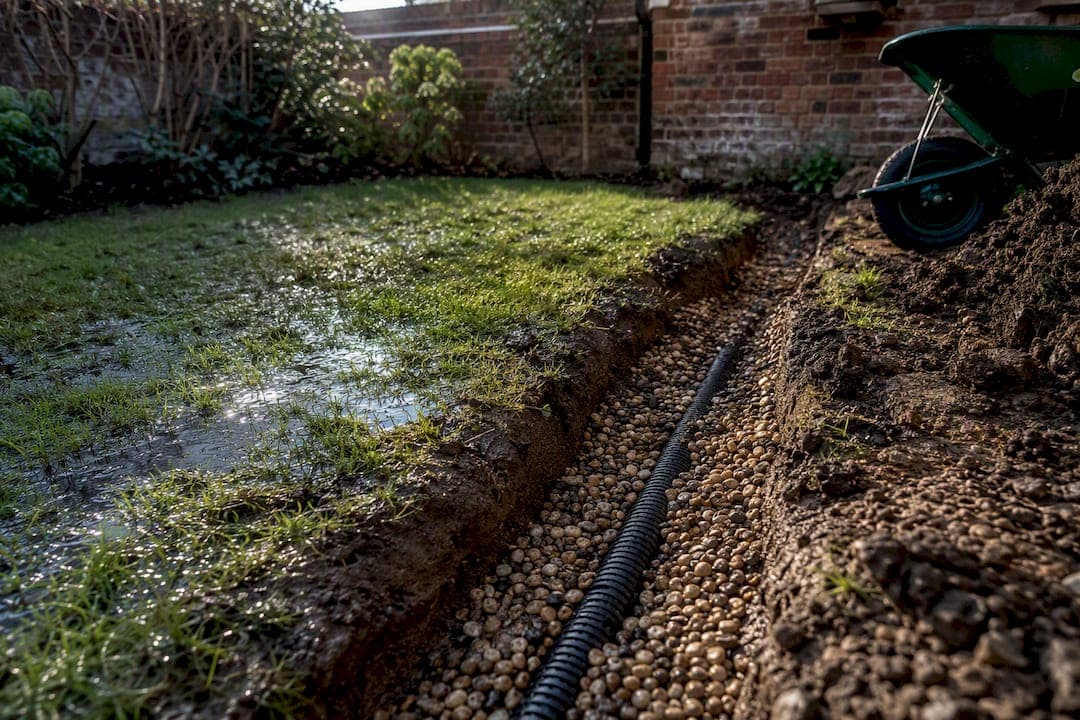
Minor pooling after rain usually needs soil improvement and basic maintenance, not excavation. Persistent puddles or heavy surface water call for engineered drainage such as a French drain, soakaway, or channel drain, sized correctly for your soil. Groundwater problems near foundations, or any soakaway design work, should go to a specialist, since sizing follows BRE Digest 365 and you cannot legally discharge surface water into a foul sewer. For Greater London gardens, LookDeVis Services can survey the site and install the right fix.
TL;DR:
- Proper site surveys and percolation tests are essential for sizing soakaways correctly, especially on clay-heavy soils, to prevent failure.
- Costly damages or ineffective drainage occur if soakaways are undersized, poorly sited, or if high groundwater makes them unsuitable.
- Routine maintenance, like clearing gutters and rerouting downpipes, can often resolve waterlogging without excavation.
- Installing French drains, land drains, and channel drains requires correct sizing, adequate outlets, and adherence to legal siting distances.
- Hiring licensed and experienced contractors ensures compliance with UK law and proper integration of drainage into wider garden projects.
Table of Contents
- What are the main garden drainage solutions in the UK?
- What quick fixes should you try before digging?
- How do soakaways and percolation testing actually work?
- What does professional garden drainage cost in the UK?
- How do you choose a reliable drainage contractor?
- LookDeVis Services' local perspective on drainage in London gardens
- Get a garden drainage survey and quote from LookDeVis
- Sources
- FAQ
What are the main garden drainage solutions in the UK?
Choosing the right method starts with understanding what each one actually does, because they solve different problems. A French drain is a gravel-filled trench over a perforated pipe that collects and redirects groundwater along a linear path. It works well for a soggy strip along a fence line or between a lawn and a patio, provided there's somewhere lower for the water to go.
Land drains, essentially perforated pipe laid without the full gravel trench, spread across a wider area and are common where a whole lawn sits wet rather than just one channel. Soakaways are underground chambers, often built from plastic crates, that let collected water percolate slowly into surrounding soil. They suit gardens with free-draining subsoil and a roof or paved area feeding water in.
Channel drains (also called slot drains) sit flush with patios, driveways, or thresholds, catching surface water before it reaches the house. Aco drains and mono-slot drains are branded and generic versions of the same idea, both feeding into a pipe run or soakaway. Drainage gulleys and shingle gullies work as simple collection points at the base of downpipes or low corners, often the cheapest fix for a single wet spot.
Swales and rain gardens take a softer approach, using shaped shallow channels and planting to slow and absorb runoff rather than pipe it away. Regrading a slope, raised beds, permeable paving, and rainwater harvesting systems (butts or tanks that store roof water for reuse) round out the toolkit.
- Line trenches and soakaways with a geotextile membrane to stop soil clogging the gravel or crates.
- Fit a silt trap before any soakaway to extend its working life.
- Every drain needs a genuine outlet. A trench that simply moves water from one wet patch to another achieves very little.
What quick fixes should you try before digging?
Before any excavation, check the basics that cause a surprising amount of waterlogging on their own.
- Clear gutters, downpipes, and gullies of leaves and debris, then check they discharge somewhere sensible rather than straight onto a flowerbed.
- Fit or clean out silt traps at drain entry points.
- Reroute a downpipe onto gravel, a border, or into a small soakaway instead of a hard surface where it just sheets across the lawn.
- Aerate compacted lawns with a fork or hollow-tine tool, but only once the ground has firmed up. RHS advice on wet soils supports improving soil structure with organic matter before reaching for hardware.
- Top-dress with compost to improve structure over a season or two.
- Consider raised beds or a small regrade if there's genuinely nowhere for surface water to go.
Pro Tip: Wait 48 to 72 hours after heavy rain before walking on or working saturated soil. Compacting wet ground can make drainage worse for six to twelve months, undoing exactly what you're trying to fix.
How do soakaways and percolation testing actually work?
A soakaway only works if the surrounding soil can absorb water fast enough, which is precisely what a percolation test measures. You dig a test pit, fill it with water, and time how quickly it drains, then use that rate to size the soakaway according to BRE Digest 365. Skipping this step is the single most common reason DIY soakaways fail on London's clay-heavy soil.
Siting matters as much as sizing. Soakaways generally need to sit at least 5 metres from any building and 2.5 metres from a boundary, protecting foundations and neighbouring land from water migration.
- Silt ingress clogs crates over time; a silt trap upstream reduces this significantly.
- Undersizing leaves the pit overwhelmed after heavy rain, so water backs up rather than draining away.
- High groundwater or heavy clay can defeat a soakaway entirely, in which case an attenuation tank with controlled discharge, designed by an engineer and often requiring building-control sign-off, is the correct fix rather than another soakaway.
Repairs usually mean jetting out silt, replacing a failed membrane, or rebuilding to the correct BRE-calculated size rather than guessing at a bigger hole.
What does professional garden drainage cost in the UK?
Costs vary enormously with soil type, access, and scale, so treat any figure as an indicative starting point rather than a quote. A small DIY French drain or single soakaway pit, using bought materials and a weekend's digging, tends to sit at the lower end of the scale. A professionally surveyed and installed soakaway or land drainage system covering a full garden, including a percolation test and reinstatement of turf or planting, costs considerably more once labour, crates, and disposal are factored in.
- Late summer to early winter is the RHS-recommended window for trenching, when ground is driest and least prone to compaction.
- Survey and percolation testing typically happen first, followed by excavation, pipework and crate installation, then reinstatement.
- Costs rise where there's difficult access, buried services nearby, close proximity to buildings, a large catchment area from roofs and paving, or where an attenuation tank and engineer's design are required instead of a simple soakaway.
How do you choose a reliable drainage contractor?
A proper quote should never skip the technical groundwork, so use these questions to separate a serious contractor from a quick fix.
- Ask whether they'll carry out a site survey and percolation test before quoting a fixed price.
- Check they reference BRE Digest 365 for soakaway sizing rather than a rule of thumb.
- Request a written plan showing the outlet, pipe route, and how the garden will be reinstated afterwards.
- Confirm insurance cover and, where waste is removed from site, a valid waste-carrier licence.
- Get an itemised quote covering soil testing, excavation, pipework, crates, silt-trap, and reinstatement separately.
Pro Tip: Be wary of anyone quoting a very low fixed price without visiting the garden first, or who suggests connecting surface water drainage to the foul sewer. That's not lawful practice under Gov, and it's a clear sign to look elsewhere.
LookDeVis Services' local perspective on drainage in London gardens
London gardens bring their own headaches: small plots where a soakaway has nowhere legal to sit, terraces with buried services under every likely trench route, and neighbours close enough that a badly sited drain becomes a dispute waiting to happen. Our teams survey for these constraints first, checking soil, access, and outlet options before recommending anything.
What tends to work best is treating drainage as part of a wider job rather than an isolated dig. A survey, percolation test, drainage installation, turf or planting reinstatement, and licensed removal of spoil and old materials can run as one coordinated visit instead of three separate trades. If you're preparing for a quote, photos of where water pools, how long it takes to clear, and a rough garden plan help us assess the job faster and more accurately.
— Roman
Get a garden drainage survey and quote from LookDeVis
If your lawn is still holding water three days after rain, or a corner of the garden has become unusable every winter, a proper survey beats another season of guesswork. LookDeVis Services is a direct, local alternative to piecing the job together yourself or juggling separate tradespeople. We combine the site survey, percolation testing, drainage installation, hard landscaping reinstatement, and licensed waste removal into one visit, so there's no gap between digging the trench and finishing the garden properly.

Our teams cover Greater London and work with homeowners, landlords, and property managers on projects ranging from a single soakaway to a full landscaping services job with drainage built in. If your garden needs both hard landscaping and ongoing soil-first care, our gardening services team can also handle aeration, top-dressing, and planting once the groundwork is done.
To get started, photograph the wet areas, note when they appeared and how long they last, and get in touch for a free quote. Call 07348 758581 or email lookdeviscompanylegal@gmail.com to arrange a survey.
FAQ
How can you improve drainage in a garden in the UK?
Start with soil-first fixes: clear gutters and gullies, aerate compacted lawn, top-dress with compost, and reroute downpipes onto permeable ground. If pooling persists, a French drain, land drain, or soakaway, correctly sized to your soil, is the next step.
What does a garden drainage system typically cost in the UK?
Small DIY jobs, like a single soakaway pit or short French drain, cost far less than a professionally surveyed system covering a whole garden with reinstatement included. Get a site-specific quote rather than relying on a general figure, since soil type and access change the price significantly.
What are the best patio drainage options in the UK?
Channel drains, also called slot drains, fitted flush along a patio edge or threshold are the standard fix for surface water on hard landscaping. Our patio installation team can build these in at the same time as laying new paving.
What does UK law say about garden drainage?
You cannot legally discharge surface water from a garden into the public foul sewer, and most councils expect a lawful Sustainable Drainage Systems (SuDS) approach instead, such as a soakaway or permeable surfacing. Soakaways must also be sized using BRE Digest 365 and sited at least 5 metres from buildings and 2.5 metres from boundaries.
Recommended
Prices, timescales and information provided in this article are for general guidance and may vary depending on the property, site conditions, materials and scope of work. Please contact LookDeVis Services for an individual assessment and quotation. Where regulatory, planning or legal requirements apply, appropriate professional advice should be obtained.