
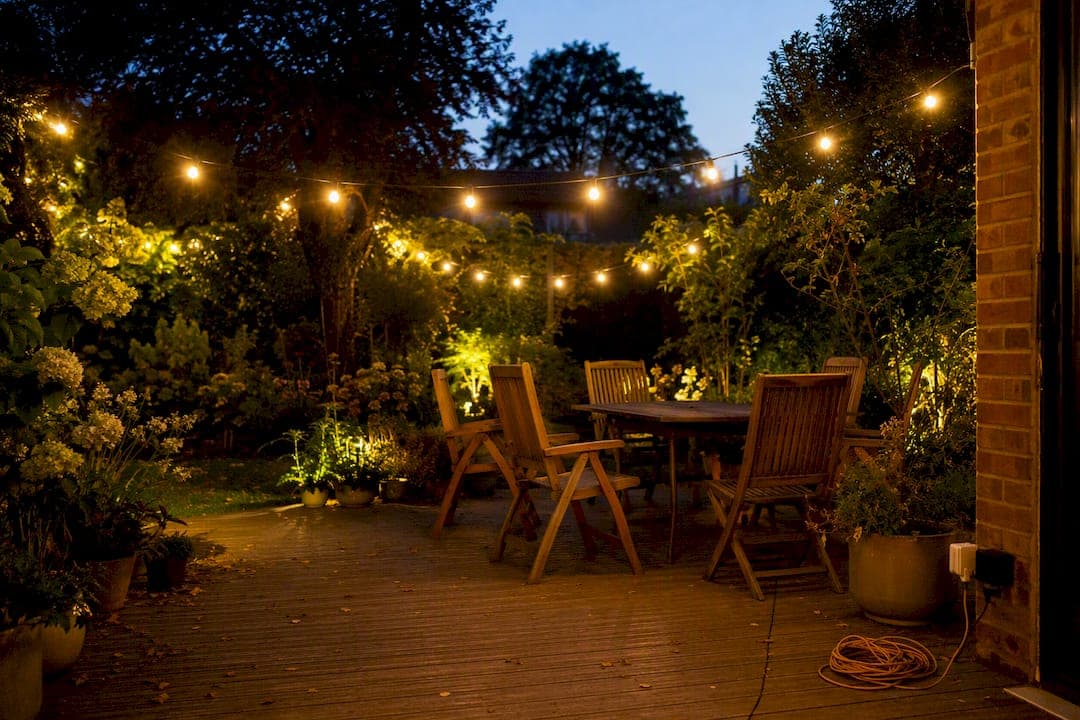
Layered lighting, not one bright fitting, is what makes a UK garden work after dark. The most reliable approach combines task lighting for safety, ambient lighting for atmosphere, and accent lighting for focal points, as UK lighting guidance recommends. Start with these five ideas:
- Path and step lighting — low-level fittings spaced 1.5–2 metres apart for safe, even footing.
- Uplighting on a specimen tree — a spike fitting angled up through the canopy for drama.
- Festoon lights over seating — instant warmth strung between posts or a house wall.
- Recessed strip lighting under a deck or bench — subtle glow for evening dining.
- Lanterns or fairy lights on a table or fence line — the cheapest way to add atmosphere.
Path lights, festoons and lanterns are DIY-friendly. Anything wired into the mains, especially recessed or buried fittings, usually needs an electrician or qualified professional.
TL;DR:
- Installing a layered lighting scheme with the correct IP ratings prolongs the durability of UK gardens and ensures functionality in different conditions.
- Path, step, and floodlighting should be mapped at dusk, with a focus on safety, proper spacing, and beam direction to avoid glare and nuisance.
- LED fittings and solar options offer energy-efficient, low-maintenance choices, but higher-rated IP fixtures and professional wiring are necessary in exposed or water-prone areas.
- Costs range from under £300 for DIY starter kits to over £4,000 for complex, multi-zone professional installations with smart controls and pond lighting.
- A professional design and installation by qualified electricians is recommended when creating new circuits or installing fittings near water to meet safety regulations.
Table of Contents
- Garden lighting ideas UK gardens actually suit
- How to plan a garden lighting scheme step by step
- Which fitting type suits which job
- IP ratings, wiring rules and what needs an electrician
- What garden lighting costs in the UK
- Making garden lighting efficient and low maintenance
- Lessons from installing garden lighting across London gardens
- Get your garden lighting designed and installed properly
- Key Takeaways
- Sources
- FAQ
Garden lighting ideas UK gardens actually suit
Some ideas work in a courtyard, others need space to breathe. Here are the options worth considering, ranked roughly by how often they earn their place in a UK garden.
1. Festoon or string lights. Best strung over a patio, pergola or seating area. Warm white bulbs create a relaxed, sociable feel. Hang at head height plus 30cm and support the run every two to three metres so cable doesn't sag. Plug-in kits are DIY; anything wired to an outdoor socket circuit should be checked by an electrician.
2. Fairy lights and lanterns. Cheap, flexible and ideal for small gardens or balconies. Battery lanterns need no wiring at all, making them the easiest starting point for renters or anyone testing a scheme before committing.
3. Spike uplighters. Push into a border to throw light up through foliage or onto a wall. Angle at 15 to 30 degrees off vertical to avoid glare into windows. Low-voltage spike sets are widely DIY-installable.
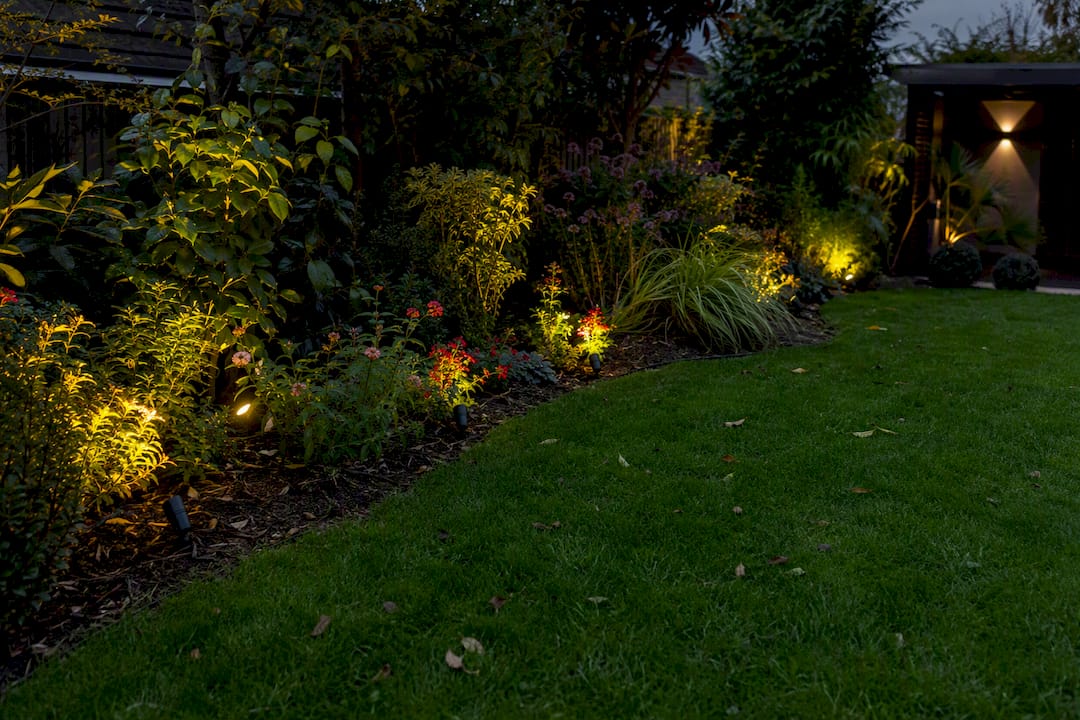
4. Tree uplighting. A single well-placed uplighter beneath a mature tree creates genuine drama and reads well from indoors. Position it close to the trunk so the beam grazes the bark and canopy rather than flooding the whole tree.
5. Moonlighting or downlighting. Fittings mounted high in a tree and angled down mimic dappled moonlight on the lawn below. This is one of the more advanced effects and usually needs an electrician for cable runs and secure fixing.
6. Recessed step lights. Small flush fittings set into the riser of each step. Essential for safety on any staircase with more than two steps, and a strong candidate for Part P notification if wired into a new circuit.
7. Path bollards. Freestanding posts that give a soft pool of light without a harsh runway effect. Space them 1.5 to 2 metres apart as a practical starting rule and avoid placing them in a dead straight line, which looks municipal rather than domestic.
8. Wall-washers and downlights. Mounted on a house wall or fence to graze light down a textured surface such as brick or render. Effective for boundary walls in larger gardens.
9. Decking and under-bench LED strips. Low, warm strip lighting tucked under a step or bench edge lights the area you sit in without glare. Works especially well when decking is being installed from scratch, since cable channels can be built in before boards go down.
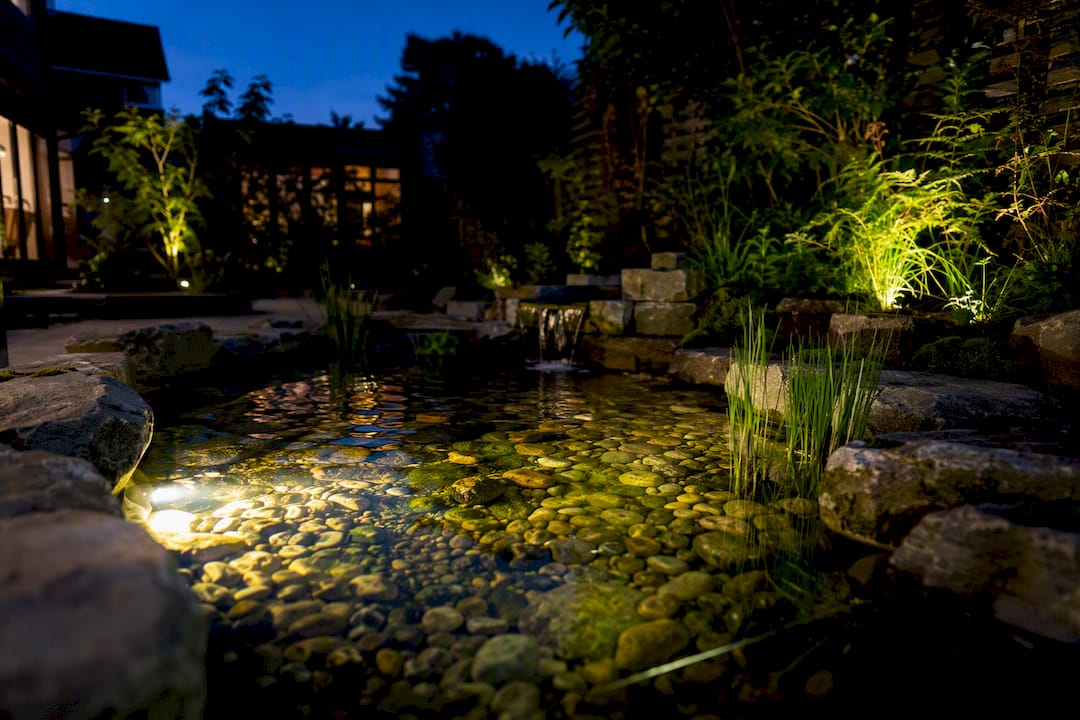
10. Pond and submersible lights. Anything going into water needs an IP68 rating. These fittings turn a still pond into a genuine evening feature and are among the most technically demanding to fit correctly.
11. Freestanding lanterns, candles and fire pits. No wiring, no planning, pure atmosphere. A fire pit doubles as heat and light on cooler evenings, which suits gardens that also have an outdoor cooking area.
12. Solar and battery spikes. The lowest-cost, lowest-effort option. Good for borders and casual accent lighting, though performance drops in winter.
13. Spotlights for sculpture or a specimen plant. A tightly focused beam on one object, such as a piece of garden art or an ornamental grass, gives a gallery-like focal point.
14. Gravel and driveway lighting. Bollards or recessed ground fittings along a drive improve safety and kerb appeal, particularly useful for commercial or rented properties needing a tidy first impression.
Small gardens do best with fairy lights, lanterns, and one or two spike uplighters, since a handful of well-placed fittings goes further in a compact space than a dozen scattered ones. Larger or feature gardens suit tree uplighting, wall-washers, and pond lighting, where there's enough distance for the beams to create real depth rather than crowding each other out.
Pro Tip: Fit warm white bulbs (around 2700K) everywhere except spotlights on stone or metal sculpture, where a cooler tone can look sharper. Mixing colour temperatures across a garden is the fastest way to make a scheme look accidental rather than designed.
How to plan a garden lighting scheme step by step
A good plan takes an evening, not a weekend, and it saves you from buying fittings you'll later regret.
1. Take dusk photos and sketch the garden. Walk the garden at dusk with your phone camera and note where shadows fall, where paths become hard to see, and which features catch the eye. Mark these on a rough sketch, including steps, seating, borders and any water feature. Practical UK planning guides recommend doing this before buying a single fitting.
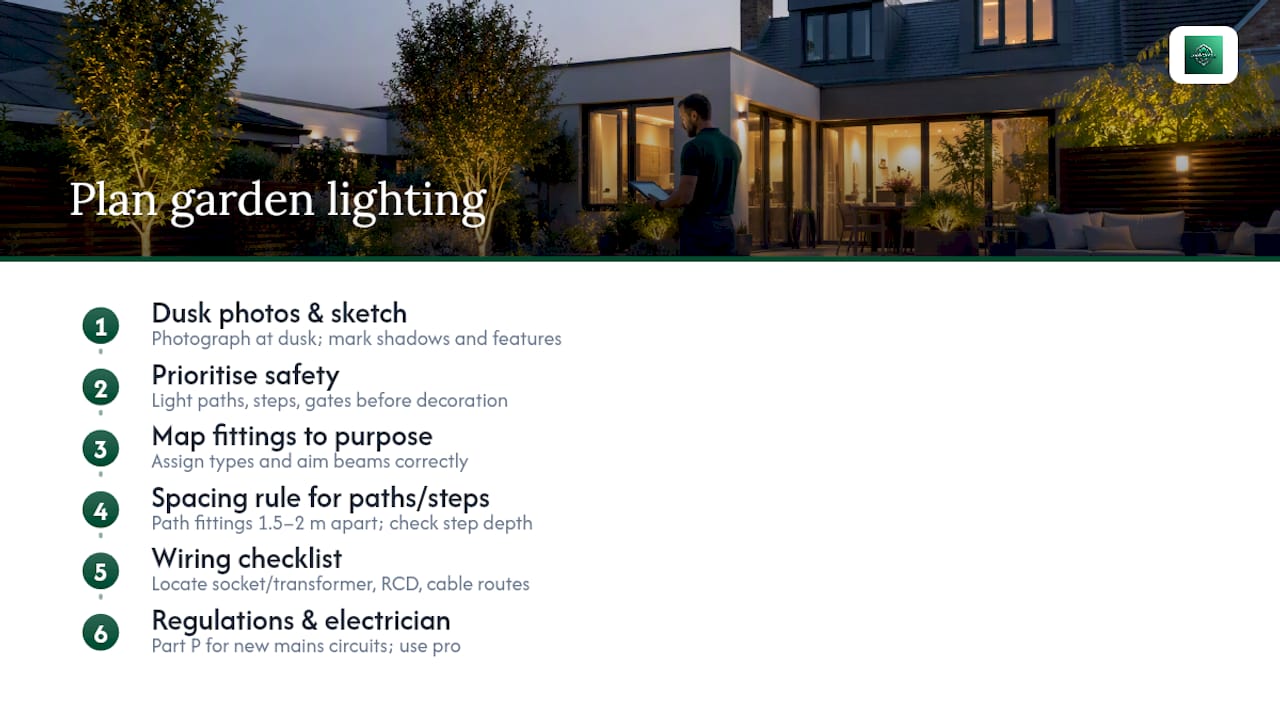
2. Prioritise safety first. Paths, steps, gates and entrances come before anything decorative. A trip hazard in the dark is a bigger problem than an unlit border.
3. Map fittings to purpose and direction. Assign a fitting type to each marked point on the sketch: bollards for the path, a spike uplighter for the tree, a strip light under the deck edge. Angle every fitting so the beam points at what you want lit, not at a neighbour's window or your own patio doors.
4. Apply a spacing rule for path and step lights. Space low path fittings 1.5 to 2 metres apart for an even, gentle pool of light rather than a runway of bright dots. For recessed step lights, measure the exact riser height before ordering, since fittings vary in depth and a shallow step won't take a deep housing.
5. Run through a wiring checklist before you buy anything. Check you have an accessible outdoor socket or transformer location, confirm RCD protection on the circuit, plan cable routes that avoid future digging, and leave room for planting to grow around in-ground fittings without swallowing them within two seasons.
Roughly two-thirds of straightforward garden lighting jobs, such as plug-in festoons, solar spikes and battery lanterns, can be handled without an electrician. Anything creating a new mains circuit, however, falls under Part P building regulations and should go through a qualified professional.
Which fitting type suits which job
Choosing the right fitting matters as much as choosing where to put it. Here's what each type is built for:
- Spike uplighters — narrow beam angle (15 to 30 degrees), low wattage LED, best for trees and wall textures. Warm white (2700K) suits foliage and brickwork.
- Bollards — wider spread, 300 to 600mm height, ideal for path edges and driveways where a gentle glow is wanted rather than a bright point.
- Recessed step lights — flush fittings with a shielded lens to prevent glare into the eyes of anyone walking down; low lumen output is enough since they're viewed at close range.
- Wall-washers and downlights — mounted higher, angled to graze a vertical surface; useful on rendered or brick boundary walls.
- Festoon and string lights — warm white filament-style bulbs for a sociable, informal look over seating.
- Submersible pond lights — IP68 rated, low voltage, designed to sit fully underwater without degrading.
- LED strips — flexible, low profile, good for decking edges and under benches; check the strip's own IP rating before fitting outdoors.
- Lanterns — freestanding or hung, battery or mains, the most flexible option for casual atmosphere.
- Smart fittings — app or hub-controlled bulbs and strips that add scheduling and dimming, useful where a garden is used at varying times through the week.
For coastal or particularly wet UK sites, stainless steel, copper, or UV-stable plastic housings hold up far better than painted or untreated metal, which corrodes and pits within a couple of seasons near salt air or heavy rainfall. Copper in particular develops an attractive verdigris patina over time, which many UK garden designers now specify deliberately rather than treating as wear and tear.
IP ratings, wiring rules and what needs an electrician
Every fitting you buy carries an IP (Ingress Protection) rating, and matching it to its location is not optional if you want the light still working next spring.
- IP44 is the minimum for sheltered spots, such as under a covered porch or against a wall with an overhang.
- IP65 is recommended for exposed paths, patios and anywhere rain hits directly.
- IP67 to IP68 is required for splash zones and anything submerged, such as pond or fountain lighting, according to UK electrical guidance.
Buying an IP44 fitting for an exposed patio is one of the most common and avoidable mistakes homeowners make. It will work for a few months, then corrode from the inside.
On the regulatory side, Part P of the building regulations covers fixed electrical work around a dwelling, including garden lighting. Whether a job is notifiable depends largely on whether it involves a new circuit; simply swapping a light fitting on an existing circuit usually isn't, but installing a new outdoor circuit for recessed or buried lighting generally is. RCD (residual current device) protection is essential on any outdoor circuit, and this is exactly the kind of detail worth confirming with a qualified electrician before work starts.
Practical installation points worth knowing:
- Bury cables at the depth specified for the cable type, typically deeper under lawns than under paving.
- Keep garden lighting on its own isolated circuit where possible, so it can be switched off independently for maintenance.
- Reduce light nuisance to neighbours by shielding fittings, angling beams downward, and using timers rather than leaving lights on all night.
Pro Tip: If in doubt about a fitting's rating for its location, buy one grade higher than you think you need. An IP65 fitting in a sheltered spot causes no harm, but an IP44 fitting in an exposed one will fail within a year.
What garden lighting costs in the UK
Budgets vary enormously depending on scope, but there are three realistic bands worth knowing before you start pricing up a scheme.
- Starter DIY schemes (solar spikes, plug-in festoons, a handful of battery lanterns) typically cost under £150 to £300 for two to six fittings, and most homeowners fit these themselves in an afternoon.
- Mid-range professional installs, covering a proper mix of path, accent and seating lighting with proper cabling, typically run from £1,500 to £3,000, including labour and a transformer setup.
- Larger multi-zone schemes, especially those adding smart controllers, buried cabling across a bigger plot, or pond lighting, can reach £4,000 to £6,000 or more depending on the number of fittings and complexity of the run.
Entry-level professional schemes start from around £800 to £1,200 for smaller gardens needing a modest number of fittings and a single circuit.
The electrician becomes essential the moment you're creating a new circuit, burying cable under a path that's about to be relaid, or fitting anything with an IP67/68 rating near water. Staging the work properly, wiring before paving goes down, cabling before turf is laid, avoids the costly rework of digging up a finished patio because a cable route was forgotten.
Making garden lighting efficient and low maintenance
LED fittings use a fraction of the energy of old halogen garden spotlights and last considerably longer, which matters when a scheme might run six or eight fittings every evening through autumn and winter. Warm white LEDs around 2700K are the standard recommendation for planting and general ambience, since cooler tones tend to flatten foliage and stone rather than flatter it.
Solar lighting is genuinely convenient. No cabling, no running costs, and it's the easiest option for renters or anyone testing a layout. The trade-off is variable performance through UK winters, when short daylight hours limit charging. A hybrid battery system, one that charges via solar but can also be topped up or swapped, is often a better long-term compromise than pure solar for anything you rely on regularly.
A simple maintenance routine keeps a scheme looking sharp:
- Wipe lenses and solar panels clear of algae, dirt and leaf debris every couple of months.
- Check seals on outdoor fittings each spring, since freeze-thaw cycles over winter can work them loose.
- Replace solar batteries roughly every one to two years, since capacity fades even when the panel itself is fine.
- Inspect cable entry points for damp ingress after heavy frost or prolonged rain.
Pro Tip: Do one seasonal check in early spring, before the garden fills out again. It's far easier to spot a failed seal or a dead battery when borders are bare than once planting hides every fitting.
Lessons from installing garden lighting across London gardens
Every project confirms the same thing: sequencing matters more than the fittings themselves. Wiring needs planning before paving or decking goes in, not after, because lifting a finished patio to add a cable run costs far more than running it first. Recessed lights, in particular, need close coordination between the electrician and the landscaping team so housings sit at the right depth before the surface is finished.
The best-performing gardens use discreet fixtures that vanish by daylight and finishes, copper, olive-toned metals, that weather gracefully rather than looking tired within a year. LookDeVis Services supports customers through exactly this kind of coordinated project, offering free quotes, fully insured teams, and combined landscaping and lighting installs, so wiring, paving and planting are planned together from day one.
— Roman
Get your garden lighting designed and installed properly
If a DIY string of festoon lights isn't quite what you had in mind, and you'd rather have someone plan the cable routes, match the IP ratings and handle the electrical sign-off, Lookdevisservices is the alternative to piecing a scheme together yourself. We coordinate lighting design with the hard landscaping itself, cable routing, recessed fittings, path and patio work, waste removal from the dig, so nothing gets fitted before the wiring is in the right place.

Every quote is free, and our teams are fully insured for both residential and commercial gardens across Greater London. Typical projects range from a simple path and seating scheme through to full multi-zone installs with pond lighting, tree uplighting and smart controls, always priced with a fixed quotation before work begins. If your lighting plan involves new paving, decking or planting alongside it, our landscaping services team can scope the whole project as one job rather than several disconnected trades.
Get in touch on 07348 758581 or lookdeviscompanylegal@gmail.com for a free quote, or start by browsing our gardening services page to see how lighting fits alongside the rest of your garden plans.
Key Takeaways
Layered lighting, task, ambient and accent, paired with the correct IP rating for each fitting's location, is what separates a garden scheme that lasts from one that fails within a season.
| Point | Details |
|---|---|
| Use a layered approach | Combine task lighting for safety, ambient for atmosphere, and accent for focal points. |
| Match IP ratings to exposure | IP44 for sheltered spots, IP65 for exposed paths and patios, IP67–IP68 for water features. |
| Plan before you dig | Sketch the garden at dusk and map wiring routes before paving or decking goes in. |
| Budget realistically | DIY starter kits cost under £300; professional schemes typically run £1,500–£3,000 or more. |
| Get professional help when needed | Lookdevisservices offers free quotes and insured teams for coordinated lighting and landscaping installs. |
Sources
- ILP guidance: garden and outdoor lighting good practice
- Building regulations: Part P (England & Wales) guidance
- Garden lighting design UK: costs, ideas & installation (2026)
- How to light a garden like an expert — House & Garden
- IP rating for outdoor lights (KG Electrical Contractors)
FAQ
What are the best outdoor lighting options in the UK?
A layered mix works best: path or step lighting for safety, spike uplighters for trees, and festoon or lantern lighting for seating areas, with IP ratings matched to each location's exposure.
What are some ideas for garden lights in the UK?
Popular choices include festoon lights over patios, solar spike uplighters in borders, recessed step lighting on staircases, and submersible IP68 lights for ponds or water features.
What are the latest trends in outdoor lighting?
Smart, app-controlled fittings with scheduling and dimming are increasingly common, alongside warm white LEDs around 2700K that keep planting and stonework looking natural rather than clinical.
What are some creative garden light ideas?
Uplighting a specimen tree, wall-washing a textured boundary wall, or lighting a single sculptural plant with a tight spotlight all create striking focal points without lighting the whole garden.
Do I need an electrician for garden lighting?
Plug-in festoons, solar spikes and battery lanterns are DIY-friendly, but anything creating a new mains circuit falls under Part P and should be installed or certified by a qualified electrician.
How much does professional garden lighting cost in the UK?
Modest schemes typically start from £800 to £1,200, mid-range installs run £1,500 to £3,000, and larger multi-zone systems can reach £4,000 to £6,000 or more depending on complexity.