
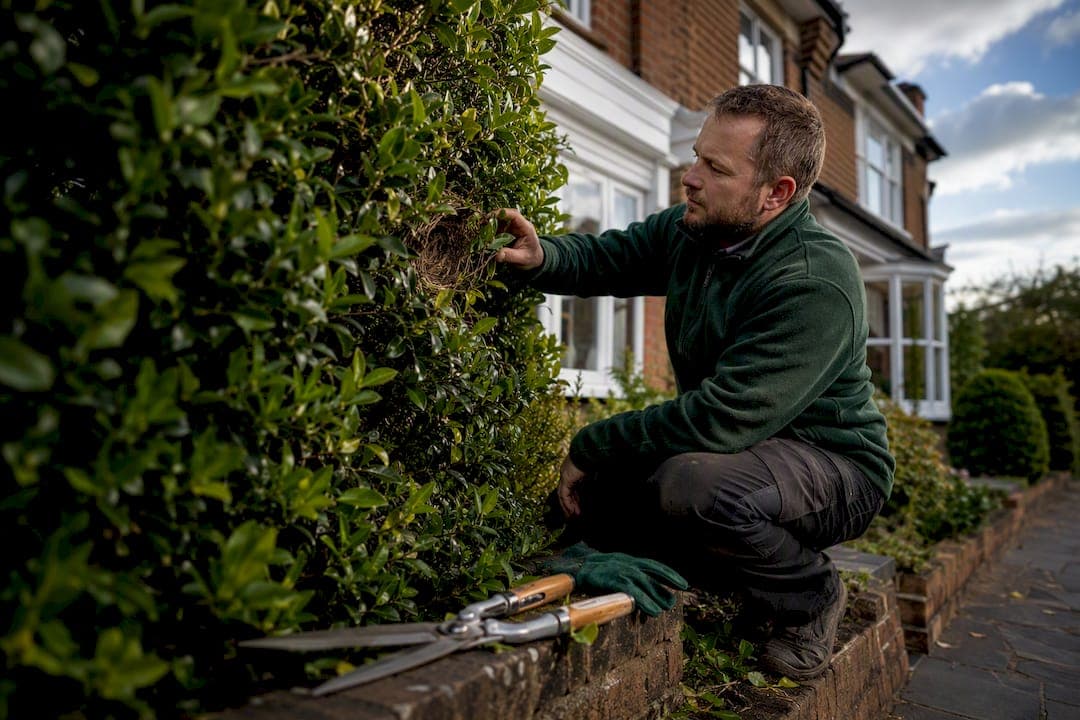
For safe, lawful and reliable hedge trimming in London, hire a licensed local contractor. Timing and price depend on hedge size, species and site access, and the main nesting season runs from 1 March to 31 August, so professional advice matters before you book. Request an indicative quote with a few photos and you will get a realistic price within a day or two.
TL;DR:
- Most London hedge services are priced based on length, height, species, and site access, with renovation work often spanning multiple years and visits.
- Professional tools and staging techniques are chosen according to hedge type, with safety measures including PPE, risk assessments, and appropriate equipment.
- Hedge work during the main bird nesting season requires pre-job nest checks, and strict regulations on important hedgerows apply on farmland, but not typically on residential gardens.
- Clear access, accurate measurements, and photos help secure precise quotes, with waste disposal included or charged separately, and insurance verified before booking.
- DIY trimming suits low, formal hedges, but overgrown or inaccessible hedges better suit professional services to prevent plant damage and ensure legal compliance.
Table of Contents
- What professional hedge trimming services include
- Methods, tools and safety: how professionals tackle different hedge types
- Timing, nesting season and council rules about high hedges
- How pricing and quotes work
- Preparing for the visit and green waste disposal options
- Trust and safety checks: vetting a hedge trimming quote
- Why choose LookDeVis Services for hedge trimming
- How long hedge trimming jobs take and turnaround expectations
- Criteria for choosing a professional hedge trimming service
- Questions to ask potential hedge trimming providers
- How to verify insurance and licensing of providers
- When to book a professional versus attempt DIY
- Book LookDeVis Services: how to request a quote or an urgent visit
- Sources
- FAQ
What professional hedge trimming services include
A hedge trimming service covers more than a quick tidy with shears. Professional teams generally offer maintenance trimming to keep an established hedge in shape, formative pruning for younger hedges still developing their form, and full renovation or staged reductions for hedges that have outgrown their space over several seasons. Removal and stump grinding are also available where a hedge needs to come out entirely.

Most London providers structure hedge work around two booking types: a one-off visit for a specific job, or a recurring maintenance plan that keeps a hedge under control throughout the year. The right choice depends on how quickly the hedge grows and how much upkeep the property owner wants to manage.
Typical scope includes:
- Side and top trimming to a set shape or height
- Hedge reduction for hedges that have become too tall or wide
- Renovation pruning staged across two or three visits for badly overgrown hedges
- Removal of hedge cuttings and green waste from site
- Minor fencing repairs where a hedge has grown into or damaged a boundary
When requesting a quote, ask whether waste removal, follow-up visits and any staged renovation work are included in the price or charged separately. A clear scope at the outset avoids disputes once the job is under way.
Methods, tools and safety: how professionals tackle different hedge types
The tools a contractor brings depend on the hedge, not just its size. Formal hedges with small leaves, such as box or yew, are usually cut with hand shears because powered blades can tear the foliage and leave a ragged, brown-tinged finish. Larger informal hedges and bigger jobs call for powered trimmers, and anything above head height typically needs pole trimmers or a working platform rather than a freestanding ladder.
Renovation work follows a different approach entirely. Many species, particularly most conifers, do not reshoot reliably from old bare wood, so a hard cut in one go can leave permanent gaps. Professional guidance recommends staging drastic reductions over two to three years, cutting back one side at a time to let the plant recover between visits.
Safety practice on a professional job typically includes:
- Personal protective equipment for eyes, hands and hearing
- A residual current device fitted for any corded electric trimmer, with the cable kept over the shoulder to avoid accidental contact
- Tripod ladders with adjustable legs or working platforms on uneven ground
- A site risk assessment before work begins, particularly near roads, power lines or neighbouring properties
Pro Tip: Ask whether the crew will use hand shears or powered trimmers on formal hedges. Hand tools generally give a cleaner finish on small-leaf species and are worth the extra time on a prominent boundary hedge.
Timing, nesting season and council rules about high hedges
Timing is where most hedge disputes and legal headaches begin. The main bird nesting season in the UK runs from 1 March to 31 August, and it is an offence to damage or destroy an active nest while birds are using it, under the Wildlife and Countryside Act 1981. Any reputable contractor will check a hedge for active nests before cutting, and delay work if one is found.
Separate rules apply to hedgerows on agricultural land. A regulation introduced in 2024 imposes a cutting ban between 1 March and 31 August on "important hedgerows" meeting certain length and location criteria, with limited exceptions for safety, obstruction and disease. The related hedgerow management rules also require record-keeping when an exemption is used. These rules are aimed primarily at farmland boundaries rather than typical residential gardens, but they show how firmly the nesting season is protected in law.
For garden hedges that grow too tall and block light, the process runs through the council rather than the courts. Complaints about a "high hedge" fall under Part 8 of the Anti-social Behaviour Act 2003, and a high hedge is generally defined as a line of two or more evergreen or semi-evergreen plants over 2 metres tall that acts as a barrier to light or access. Councils have discretion over remedial action and are not required to force every hedge down to a strict 2 metre height, so outcomes vary by case.
Councils generally expect neighbours to have tried to resolve a hedge dispute amicably before a formal complaint is lodged, and complaints can carry a council fee. Speaking to a neighbour early, ideally with a written note of what was agreed, tends to save time and money on both sides.
Exceptions that allow cutting during the main season include immediate safety concerns, a hedge obstructing a road or path, and diseased or dangerous growth. If a nest is discovered mid-job, the practical step is to leave that section untouched and continue elsewhere, then return once the nest is confirmed empty.

How pricing and quotes work
Hedge trimming prices in London vary because no two hedges are the same job. Several factors combine to set the final figure, and understanding them helps you compare quotes fairly.
- Linear length and height: a longer, taller hedge takes more time and often needs a platform or pole tools, which adds to labour.
- Species and density: dense, fast-growing hedges such as leylandii or privet take longer to cut and produce more waste than a lighter, slower-growing species.
- Access: a hedge reachable from a driveway costs less to trim than one behind a locked side gate or shared alleyway where equipment has to be carried in by hand.
- Waste volume: thick renovation cuttings generate far more green waste than a light annual trim, and disposal is usually priced by volume or by the load.
- Renovation staging: a hedge that needs cutting back over two or three years is quoted as a staged plan rather than a single visit, with each stage priced separately.
Most contractors quote in one of three ways: a fixed price per metre for straightforward trims, an hourly labour rate plus a separate disposal charge for less predictable jobs, or a staged plan price for renovation work spread across multiple visits. Prices are best treated as indicative until a contractor has seen photos or visited the site.
A proper quote should set out the scope of work, whether waste disposal is included, any access notes that affect the price, a rough timeframe for the visit, confirmation of insurance cover and clear payment terms. If a quote is missing any of these, ask before agreeing to book.
Preparing for the visit and green waste disposal options
A little preparation keeps the visit efficient and avoids delays once the crew arrives. Clear access to the hedge, move any garden furniture, bins or vehicles blocking the working area, and flag anything overhead such as washing lines or low cables. If parking is limited, let the contractor know in advance so they can plan where to leave a van.
Before the crew starts, it is worth checking these points:
- Whether green waste removal is included in the price or charged as an extra
- Whether the disposal is via a licensed waste carrier, and asking for that carrier's registration if disposal forms part of the quote
- Where pets and children will be kept during the visit, particularly if power tools are in use
- Whether any fencing, planting or ornaments near the hedge need protecting
After a renovation cut, hedges often benefit from mulching around the base and watering during dry spells to support recovery. If the job is staged, ask the contractor to note a rough date for the next visit so the plan stays on track.
Trust and safety checks: vetting a hedge trimming quote
Before booking, a few quick checks separate a reliable contractor from a risky one. Confirm public liability insurance is in place, ask for a licensed waste carrier reference if disposal is included, and for larger renovation jobs, ask whether a method statement will be provided.
Watch out for these red flags:
- No written scope of work, just a verbal price
- Pressure to pay the full amount in cash before work starts
- No identifiable business name, vehicle branding or contact details
- Reluctance to confirm who covers the cost of accidental damage
Pro Tip: Get the scope of work, price and payment terms in writing before the crew arrives. A short e-mail confirmation is enough and gives you something to refer back to if anything is unclear later.
Confirm in advance who is responsible for any damage to fences, paving or neighbouring property, and who holds the paperwork for waste disposal. A contractor confident in their own compliance will answer these questions without hesitation.
Why choose LookDeVis Services for hedge trimming
An insured property services business can handle hedge trimming alongside garden clearance and general home-services including waste removal so cuttings can be cleared in the same visit. Waste is managed through appropriate licensed disposal arrangements, and same-day or urgent appointments may be available depending on location and team availability.
For overgrown hedges, renovation can be staged across multiple visits rather than risking a single hard cut that damages the plant. To get an accurate quote, it helps to send a few photos of the hedge, rough dimensions of length and height, and a note on access such as side gates, shared driveways or parking restrictions. That detail lets the team price the job properly before anyone steps on site.
How long hedge trimming jobs take and turnaround expectations
Job length depends on the same factors that drive price: length, height, density and access. A straightforward maintenance trim on a domestic front hedge might take an hour or two, while a long boundary hedge or a dense, overgrown one can take a full day or more, especially where waste has to be bagged and carried out through a narrow side passage.
Renovation work is different again, since it is deliberately spread across two or three separate visits over consecutive years rather than completed in one session. Booking turnaround for a straightforward trim is often within a few days to a week, subject to team availability, while same-day or urgent visits may be possible for selected services and locations. Larger renovation projects or jobs combined with garden clearance and waste removal should be booked further ahead, particularly during the busier spring and autumn seasons when demand for garden work rises across London.
Criteria for choosing a professional hedge trimming service
Choosing between hedge trimming providers comes down to a handful of practical checks rather than guesswork. Experience with your specific hedge type matters: a company that regularly renovates overgrown leylandii will handle that job differently from one that mainly trims small formal box hedges.
Genuine customer reviews, even a small number, give a sense of reliability and communication style. Certifications worth asking about include public liability insurance, a licensed waste carrier registration if disposal is part of the job, and, for larger tree-adjacent work, any relevant tree surgery qualifications held by the team. A provider that coordinates hedge trimming with garden clearance, waste removal or fencing repairs under one booking can also save time on larger property projects, since there is only one team to schedule rather than several trades.
Price should be weighed against scope rather than compared as a single number. A cheaper quote that excludes waste disposal may end up costing more once you factor in a separate skip or collection.
Questions to ask potential hedge trimming providers
A short list of questions before booking clarifies exactly what you are paying for and avoids surprises on the day.
- Is the price fixed for the described scope, or could it change once the crew sees the hedge?
- Is waste removal included, and if so, is it handled by a licensed waste carrier?
- What tools will be used on this particular hedge, and why?
- How is an overgrown hedge staged if it cannot be cut back in one visit?
- What happens if an active bird nest is found during the job?
- Who is responsible if a fence, path or plant is damaged during the work?
Providers confident in their process will answer these without hesitation, and the answers themselves are a reasonable guide to how the job will go.
How to verify insurance and licensing of providers
Insurance and waste licensing are worth confirming before, not after, a booking is made. Ask for the name of the insurer or the policy type covering public liability, and request written confirmation by e-mail if it is not offered upfront. This does not need to be complicated: a short line confirming cover, sent before the job, is enough for most residential bookings.
If green waste disposal is part of the quote, ask for the contractor's licensed waste carrier reference and whether disposal goes through municipal green waste collection or a commercial route. A provider who cannot answer either question directly is worth reconsidering, particularly for larger renovation jobs where several loads of cuttings need to leave the site legally.
When to book a professional versus attempt DIY
Small, low, formal hedges within easy reach are reasonable to trim yourself if you are comfortable using shears safely. Height, access problems, staged renovation or simply not having a free weekend are the point where hiring a professional starts to make more sense. DIY saves money upfront but costs time and, on overgrown hedges, carries a real risk of damaging the plant permanently. If you are unsure which side of that line you fall on, arranging a free quote costs nothing and gives you a clear comparison.
— Roman
Book LookDeVis Services: how to request a quote or an urgent visit
Getting a hedge trimmed properly in London starts with a quick call, an e-mail or a few photos, no long forms or site visits required before you get a price. An insured team with licensed waste handling integrated into the process can clear cuttings in the same visit rather than leaving them for you to deal with separately.

To speed up your quote, include:
- Photos of the hedge from a couple of angles
- Rough length and height
- Any access notes, such as side gates or shared driveways
- Whether you need a one-off trim or ongoing maintenance
Same-day and urgent bookings may be available depending on your location and team availability. Visit the LookDeVis Services landing page to request a free quote or get in touch directly by phone or e-mail.
Sources
- Bird nesting season guidance — Somerset County Council
- How to trim a hedge — RHS Advice
- Legislation
- Gov
FAQ
How much does it cost to have hedges trimmed?
Cost depends on the hedge's length, height, species and how easy the site is to access, so providers give indicative quotes rather than a single fixed rate. An accurate price can be provided after reviewing a few photos and basic measurements. Waste disposal and renovation staging are usually priced separately if not included in the base quote.
Is it illegal to trim hedges in summer?
Trimming a garden hedge in summer is not automatically illegal, but you must avoid damaging an active bird nest, since the main nesting season runs from 1 March to 31 August and disturbing a nest in use is an offence. Stricter cutting bans over the same dates apply specifically to certain hedgerows on agricultural land under separate regulations, which do not generally cover typical residential garden hedges.
What are the current hedge cutting rules for hedgerows?
Rules for hedgerows on agricultural land restrict cutting between 1 March and 31 August for hedgerows meeting certain length and location criteria, with defined exemptions and record-keeping requirements. Garden hedges are not covered by these agricultural rules, but nesting season protections under the Wildlife and Countryside Act 1981 still apply to any hedge with an active nest.
What are the laws about high hedges between neighbours?
A high hedge complaint can be raised with the local council under Part 8 of the Anti-social Behaviour Act 2003, and a high hedge is generally a line of two or more evergreen or semi-evergreen plants over 2 metres that blocks light or access. Councils have discretion over what remedial action to require and are not obliged to force a hedge down to a strict height in every case, and they generally expect neighbours to have tried resolving the issue directly first.
Prices, timescales and information provided in this article are for general guidance and may vary depending on the property, site conditions, materials and scope of work. Please contact LookDeVis Services for an individual assessment and quotation. Where regulatory, planning or legal requirements apply, appropriate professional advice should be obtained.