
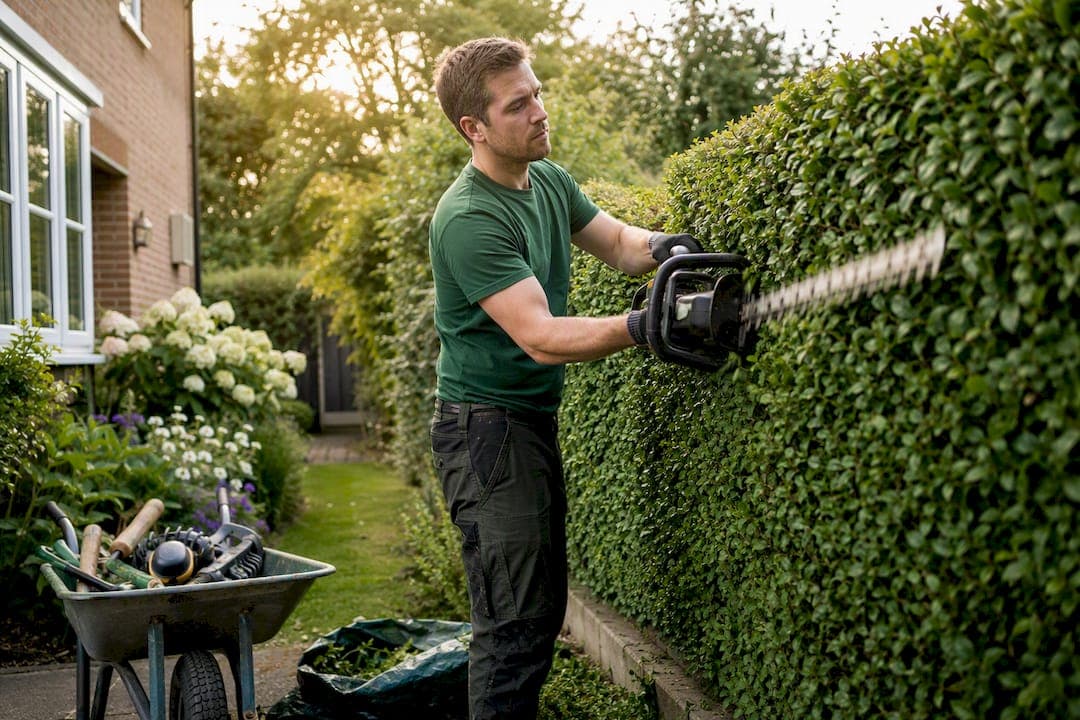
You can trim most garden hedges whenever you like, but two sets of rules can stop you dead: the Management of Hedgerows (England) Regulations 2024, which bans cutting "important" countryside hedgerows between 1 March and 31 August, and the Wildlife and Countryside Act 1981, which makes it an offence to damage an active bird's nest at any time of year.
Before you pick up the trimmer, run three checks:
- Does your hedge meet the length and location tests that bring it under the 2024 Regulations (over 20 metres, or bordering agricultural land)?
- Is it nesting season, and have you actually looked inside the hedge for nests?
- If it's a boundary dispute rather than a legal-status question, is this a job for your local council's high-hedges procedure instead?
Most ordinary garden hedges fall outside the strict hedgerow rules entirely. The real legal exposure for most homeowners is the Wildlife and Countryside Act, not the 2024 Regulations.
For agricultural hedgerows, notify the Rural Payments Agency. For neighbour disputes over height, that's your local council. For everything else, common sense and a bit of legal awareness go a long way.
Key Takeaways
Lawful hedge trimming in the UK depends on hedge type, timing, and whether active nests are present, not on a single blanket rule.
| Point | Details |
|---|---|
| Check hedge status first | Establish whether your hedge meets the 20-metre or agricultural-boundary test before assuming the 2024 Regulations apply. |
| Respect the 1 March–31 August window | Important hedgerows cannot be cut in this period without a valid exemption or RPA derogation. |
| Nests override everything | The Wildlife and Countryside Act 1981 applies year-round, regardless of hedgerow exemptions or dates. |
| High hedges go through councils | Part 8 of the Anti-social Behaviour Act 2003 governs neighbour disputes, not DIY trimming across the boundary. |
| Document your decisions | Photographs, notification paperwork, and dated notes protect you if a job is ever questioned. |
Table of Contents
- Hedge trimming law UK: what the 2024 Regulations actually say
- Can I cut hedges in nesting season under the Wildlife and Countryside Act?
- What are the rules on high hedges and neighbour disputes?
- A pre-trimming checklist for homeowners and land managers
- When should you call in a professional for hedge work?
- Sources
- FAQ
Hedge trimming law UK: what the 2024 Regulations actually say
The Management of Hedgerows (England) Regulations 2024 introduced a fixed prohibited period for cutting or trimming "important" hedgerows: 1 March to 31 August. This is the headline rule behind most hedge trimming law UK searches, and it replaced older cross-compliance rules that only applied if you claimed farm subsidies. Now the ban applies regardless of whether you receive payments.
Not every hedge counts. The Management of Hedgerows (England) Regulations 2024 apply where a hedgerow is over 20 metres long, or meets another hedgerow at each end, and it grows on or next to land used for agriculture, forestry, or equestrian purposes. A hedge dividing two gardens in a housing estate almost never qualifies. A hedgerow running along a farm boundary, a paddock, or a smallholding often does.
Several exemptions let work go ahead inside the prohibited period:
- Hedge-laying or coppicing carried out between 1 September and 30 April, within the traditional seasonal window for that technique.
- Work necessary to prevent a hedge causing danger to people, such as obstructing sightlines on a road or footpath.
- Cutting required for sowing a crop, provided you've notified the regulator first.
- Work covered by written permission or a derogation granted by the Rural Payments Agency.
Roughly one-fifth of England's hedgerow network sits under some form of agricultural management, which is why the RPA's own guidance stresses notifying before, not after, you cut. If you're relying on an exemption, the work must be kept to the minimum necessary for that specific purpose, not a general tidy-up.
Pro Tip: Photograph the hedge before and after any exemption work, and keep a dated note of why you cut it. If the RPA or a council officer ever queries the job, contemporaneous evidence is far more persuasive than a memory of what you meant to do.
Can I cut hedges in nesting season under the Wildlife and Countryside Act?
Legally, yes, but only if you're certain no bird is nesting in it. The Wildlife and Countryside Act 1981 makes it an offence to intentionally damage or destroy the nest of any wild bird while it's in use or being built. This applies to every hedge in the country, garden or agricultural, protected hedgerow or not, and it runs independently of the 2024 Regulations.
The commonly cited nesting season is 1 March to 31 August, but that's a working guideline, not a legal boundary. Some species nest earlier or later, and local guidance recommends re-checking a hedge every 48 hours if you're working near or inside that window, since nests can appear within days.
A practical nest check means:
- Looking through the hedge from both sides in daylight, not just glancing at the surface.
- Listening for repeated alarm calls or birds flying in and out of one spot.
- Checking dense, thorny sections first (blackthorn and hawthorn are nesting favourites).
- Postponing work in that section if you find anything, even an apparently empty nest.
This is where hedgerow exemptions can mislead people. Having RPA permission or a valid exemption for cutting an agricultural hedgerow does not override the Wildlife and Countryside Act. You still need to check for nests and stop if you find one, regardless of what the 2024 Regulations allow.
Pro Tip: Keep a simple written log of nest checks, dates and findings. If a job needs to be paused because of an active nest, a documented record protects you if a neighbour or council later questions the delay.
What are the rules on high hedges and neighbour disputes?
Height disputes between neighbours sit under a completely different law: Part 8 of the Anti-social Behaviour Act 2003. This covers what's formally defined as a "high hedge": a line of two or more evergreen or semi-evergreen trees or shrubs that rises above 2 metres and blocks light or access to a neighbouring property.
Councils don't get involved automatically. The expected sequence runs like this:
- Talk to your neighbour first, ideally in writing, and try to agree a compromise on height or maintenance.
- If that fails, submit a formal complaint to your local authority under the high-hedges procedure, usually with a fee attached.
- The council investigates, weighs both sides, and decides whether the hedge is genuinely causing an unreasonable loss of light or enjoyment.
- If it upholds the complaint, it can issue a remedial notice setting out what work must be done and by when.
- Non-compliance can lead to enforcement action, including fines and the council recovering the cost of doing the work itself.
A remedial notice can require a hedge to be reduced to a set height, but a council cannot lawfully order its complete removal, nor demand a reduction so severe it would kill the hedge outright.
What you can't do is take matters into your own hands beyond your boundary. You may cut back branches or roots that cross onto your property, but the trimmings and any fruit generally remain the legal property of the hedge's owner. RHS guidance on overgrown hedges recommends offering cuttings back to your neighbour rather than disposing of them yourself, which avoids an entirely separate and unnecessary dispute over property.
A pre-trimming checklist for homeowners and land managers
Before booking any hedge work, work through a short sequence rather than jumping straight to the shears. Start with who owns the hedge and who is legally allowed to cut it: a boundary hedge is often jointly owned, and cutting your neighbour's side without permission can amount to trespass, even if the branches overhang your garden.
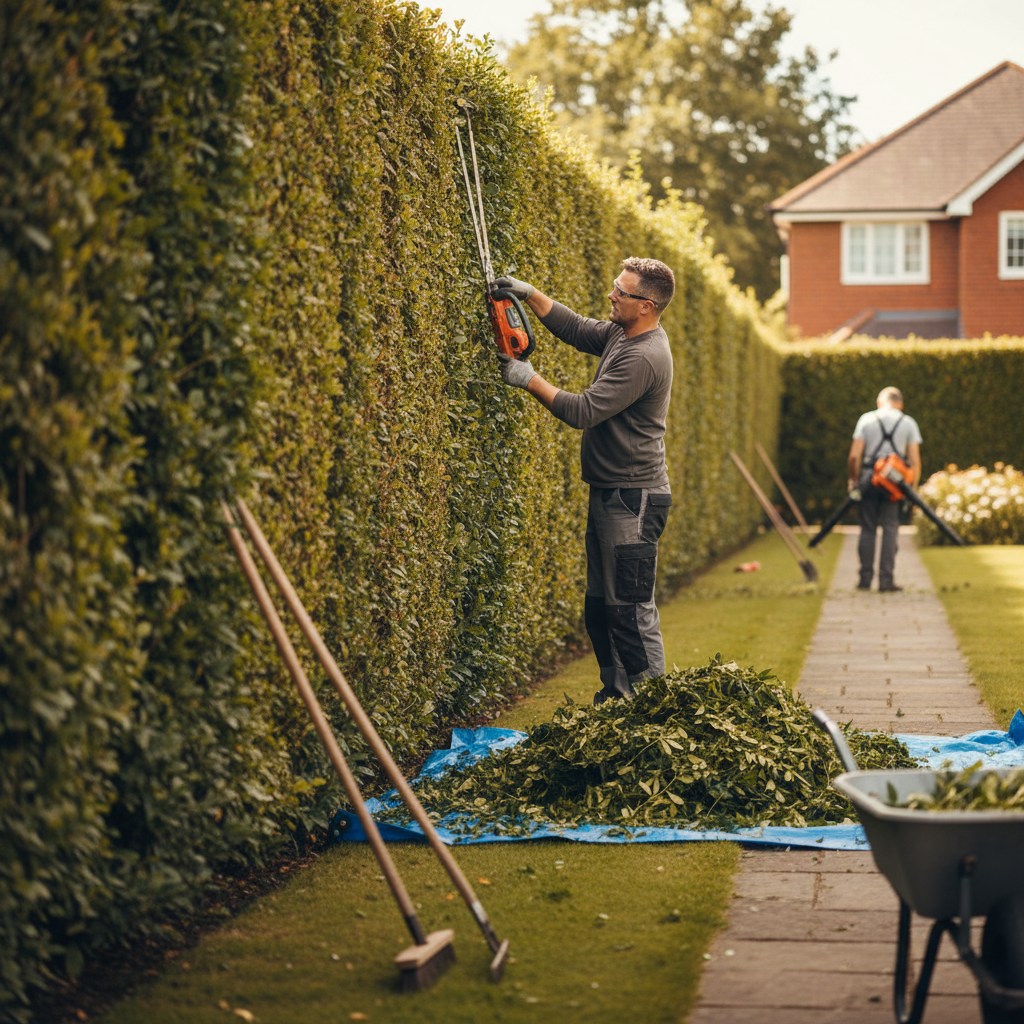
Timing matters more than most people assume:
| Hedge type | Safe cutting window | Key restriction |
|---|---|---|
| Ordinary garden hedge (non-agricultural) | Most of the year | Avoid if active nests present |
| Agricultural hedgerow (meets 2024 criteria) | 1 September to 31 February | Prohibited 1 March to 31 August |
| Any hedge, any category | Year-round in theory | Wildlife and Countryside Act applies whenever nests are active |
Keep records as you go: dated photographs, any RPA notification or derogation paperwork, and a note of conversations with neighbours about shared hedges. This costs nothing and takes minutes, but it's the difference between a quick explanation and a drawn-out dispute if a question ever arises.
On cost and equipment: a hedge under about 2 metres is usually manageable with domestic tools. Once a hedge exceeds roughly 2.5 metres, or involves a genuine hedgerow rather than a garden boundary, you're typically looking at ladders, powered cutters, and safe waste handling, which is when hiring a specialist starts to make financial and practical sense. Regular garden maintenance between seasons also keeps hedges from reaching that point in the first place.
When should you call in a professional for hedge work?
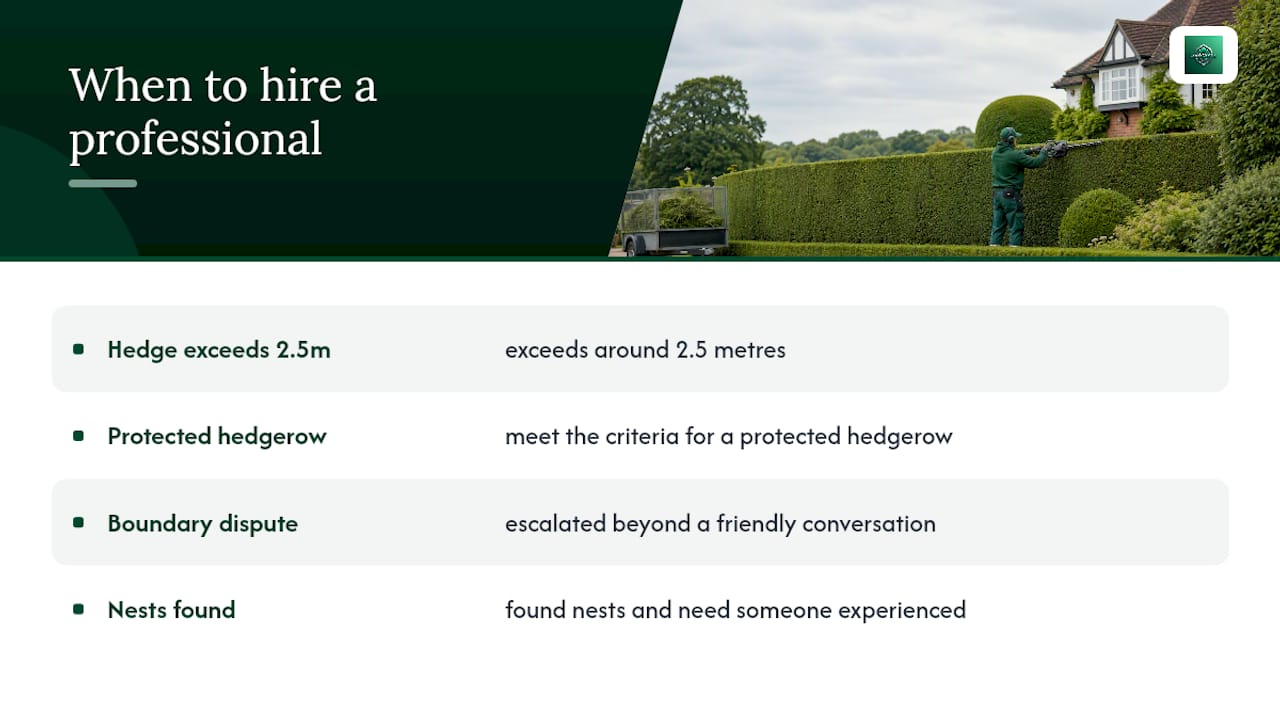
Some jobs are worth doing yourself. Others carry enough legal or physical risk that a licensed contractor is the sensible choice. Hire a professional when the hedge exceeds around 2.5 metres, when you suspect it might meet the criteria for a protected hedgerow, when a boundary dispute has escalated beyond a friendly conversation, or when you've found nests and need someone experienced in working around them safely.
A properly run job includes a nest check before any cutting starts, a basic risk assessment for access and equipment, a record of any communications with neighbours or notifications to the RPA, and licensed removal of the resulting green waste rather than leaving it for you to deal with.
A hedge job done properly leaves behind more than a tidy boundary. It leaves a paper trail that protects you if anyone ever questions the work.
Lookdevisservices has handled residential hedge maintenance across Greater London, including a documented hedge trimming project in Harrow HA1, and works to the checks outlined above as standard practice, not an optional extra. To arrange an assessment, call 07348 758581 or email lookdeviscompanylegal@gmail.com.
A note from Roman
Most hedge disputes I've seen written about come down to timing, not malice. Someone cuts in April because that's when they have a free weekend, not because they intend to disturb a nest. The 2024 Regulations and the older wildlife protections both exist to close that gap between convenience and consequence. Lookdevisservices takes the cautious route on every job, checking nests and boundaries before touching a hedge, because a fully insured local team should never need to gamble on "probably fine."
Sources
This article is general information, not a substitute for advice from a qualified lawyer. Consult a qualified legal professional about your own circumstances before acting on anything here.
FAQ
Is it illegal to cut hedges now in the UK?
It depends on the hedge. Most garden hedges can be cut at any time, but important agricultural hedgerows cannot be trimmed between 1 March and 31 August under the Management of Hedgerows (England) Regulations 2024, and no hedge can be cut if it contains an active bird's nest.
Can I legally cut my neighbour's hedge?
You can trim branches or roots that cross onto your property, but you cannot cut your neighbour's hedge on their side without permission, as that could amount to trespass and property damage.
Is there a new law about hedge height in the UK?
There's no universal maximum height for ordinary garden hedges, but the 2024 Regulations introduced new cutting-date restrictions for qualifying agricultural hedgerows, and Part 8 of the Anti-social Behaviour Act 2003 already lets councils act on high hedges over 2 metres that block light.
Is it illegal to cut hedges after March?
Only if your hedge is an important hedgerow covered by the 2024 Regulations, in which case cutting is prohibited from 1 March to 31 August. Ordinary garden hedges can still be cut after March, but you must check for active nests first under the Wildlife and Countryside Act 1981.