
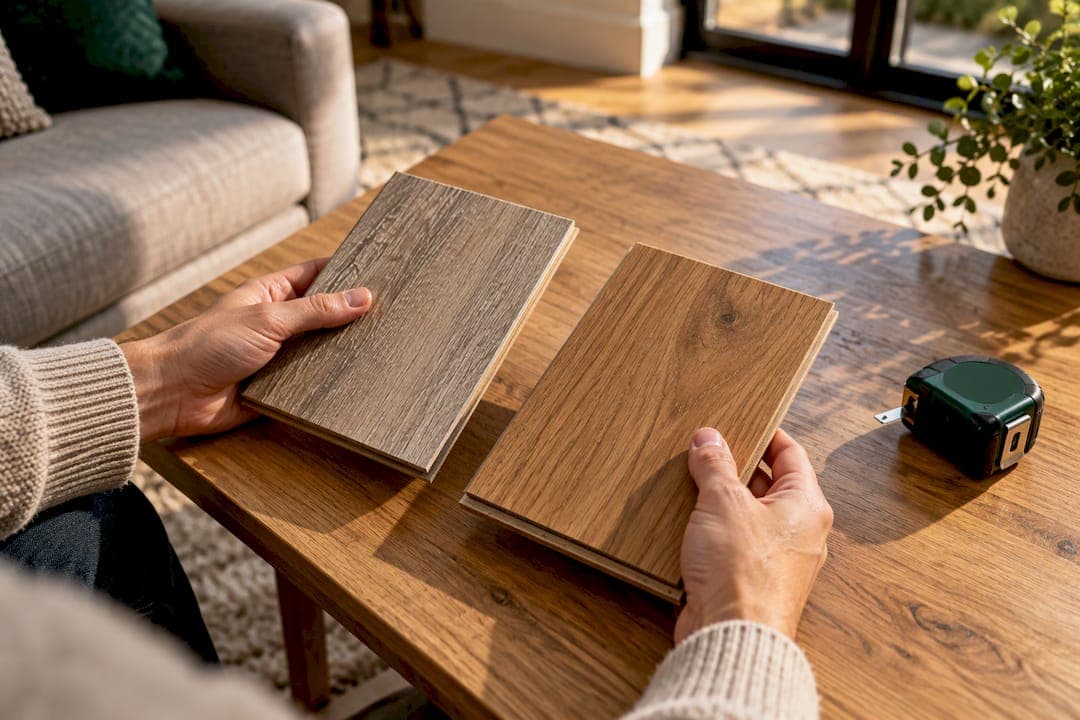
For most homeowners on a tight budget, laminate is the sensible choice thanks to its lower upfront cost and low maintenance needs. Owners planning a long-term investment, especially in living spaces where a natural timber look matters, tend to prefer engineered wood because it can be refinished and holds its value better over time.
TL;DR:
- Engineered wood costs significantly more than laminate but offers better appearance, refinishing potential, and a lifespan of several decades with proper maintenance.
- Laminate's lower initial cost and scratch resistance make it ideal for rentals and high-traffic areas, but it cannot be refinished and typically lasts around ten years.
- Both materials are sensitive to moisture, with laminate being more vulnerable to swelling and generally unsuitable for bathrooms, while engineered wood can handle spills better if promptly dried.
- Installation costs vary based on whether the floor is floated, glued, or bonded, and include subfloor moisture testing and preparation, which can substantially affect the final price.
- Choose products with low VOC certifications, and always request a moisture test before ordering flooring to avoid costly surprises and ensure safe indoor air quality.
Table of Contents
- Comparing cost, appearance and lifespan
- Moisture handling and where each material belongs
- Installation steps and the hidden costs to budget for
- Care, repairs and how long each floor really lasts
- Health, air quality and environmental standards to check
- Your checklist and the questions worth asking suppliers
- How LookDeVis Services supports your flooring project
- Trade-offs that homeowners actually face
- Book a survey or request a quote
- Sources
- FAQ
Comparing cost, appearance and lifespan
Laminate generally costs less to buy and fit, while engineered wood is priced higher due to its real timber wear layer. The gap widens once you factor in installation labour and any subfloor work, which we cover later.
Appearance is where the two materials diverge most. Laminate uses a printed decorative layer, so however sharp the image, it cannot replicate the grain variation of real wood underfoot. Engineered wood carries a genuine timber veneer, which is why it reads as authentic even close up. Wear-layer thickness matters here too: a thicker veneer on engineered wood supports deeper sanding and a longer working life, while a thicker laminate wear layer mainly improves scratch resistance rather than authenticity.
Lifespan expectations differ accordingly:
- Laminate typically lasts around a decade or more depending on foot traffic and quality, after which boards are usually replaced rather than restored.
- Engineered wood can last several decades when properly maintained, since the solid timber top layer allows for periodic refinishing.
- Warranty length is a useful proxy for expected durability, so compare the years offered rather than the headline price alone.
Moisture handling and where each material belongs
Laminate's core is typically a fibreboard that swells if water penetrates through joints or edges, so standing water is its biggest enemy. Engineered wood behaves better structurally because its multi-ply core improves dimensional stability compared with solid timber, though its real wood surface still needs prompt drying if spills happen.
- Kitchens suit engineered wood with sealed joints or a moisture-resistant laminate, provided spills are wiped up quickly.
- Bathrooms are generally unsuitable for either material; vinyl or stone-look alternatives handle standing water far more reliably.
- Hallways benefit from either option, though laminate's harder surface often copes better with grit and repeated foot traffic.
- Living rooms and bedrooms are where engineered wood's appearance and refinishing potential pay off most.
Underfloor heating works with both materials in principle, but engineered wood's stable core makes it the safer pick, since cross-laminated layers limit expansion and contraction as temperatures shift. Where moisture risk is genuinely high, water-resistant alternatives such as LVT or SPC are worth considering instead of either wood-based option.
Installation steps and the hidden costs to budget for
Laminate is usually laid as a floating floor over underlay, which keeps labour costs down. Engineered wood can be floated, glued down or fully bonded to the subfloor, with bonded installations costing more but offering better sound deadening and stability.
- Book a subfloor moisture check before ordering materials, since damp readings often reveal the need for a damp-proof membrane or levelling compound, which adds to the final bill.
- Ask whether the quote includes underlay, skirting removal and refitting, and waste disposal, as these are frequently priced separately.
- Confirm whether old flooring needs to be lifted and disposed of, since subfloor preparation is often the largest single variable in a final invoice.
- Request a written breakdown so you can compare like-for-like quotes rather than a single lump sum.
Pro Tip: Always ask an installer to test subfloor moisture on site before you sign off a quote, not after the flooring has already arrived.
Care, repairs and how long each floor really lasts
Both floors need regular sweeping and a damp (not wet) mop, avoiding standing water on either surface. Stains should be lifted promptly with a manufacturer-approved cleaner rather than an abrasive pad, which can dull the surface finish.
- Engineered wood can typically be sanded and refinished multiple times, depending on how thick the top veneer is, restoring the surface without replacing the whole floor.
- Laminate cannot be refinished; a scratched or damaged board is usually replaced individually or the section re-laid.
- Watch for lifting edges, persistent gaps or a sponge feel underfoot, all signs that remedial work is needed before damage spreads.
Health, air quality and environmental standards to check
Formaldehyde and other volatile organic compounds released from wood-based products are a recognised indoor air concern, and the HSE flags formaldehyde as hazardous with guidance that also informs consumer safety discussions.

High-quality laminate flooring can meet strict EU Ecolabel Total VOC limits below 0.16, a threshold designed to limit indoor emissions from finished flooring products.
When comparing products, look for compliance with EN standards such as EN 13329, which governs laminate performance classes, and check that suppliers can reference recognised Ecolabel criteria. After installation, ventilate the room well for the first few days and choose products with published low-VOC certification rather than relying on smell alone as a guide.

Your checklist and the questions worth asking suppliers
Before committing, work through a short list of practical checks rather than choosing on price or looks alone.
- Decide your budget against expected lifespan, since a cheaper laminate replaced twice can cost more than one engineered wood installation.
- Ask what warranty actually covers, structural failure or just surface wear, since the two are priced very differently.
- Insist on a subfloor moisture reading before any board is ordered.
- For engineered wood, ask the veneer thickness in millimetres, since this determines how many times it can be refinished.
- For laminate, ask about edge-sealing and water-resistance ratings if the room sees any moisture at all.
- Request a fitted quote rather than a supply-only price so hidden labour and preparation costs are visible upfront.
- For larger or older properties, commission a proper subfloor survey rather than relying on a quick visual check.
How LookDeVis Services supports your flooring project
Professional property services companies can coordinate the practical side of flooring work through building refurbishment and flooring installation teams, often managing old floor removal and debris clearance. Insured teams can help identify subfloor moisture issues before they become expensive surprises, coordinating trades so the project moves from survey to finished floor without clients needing to manage separate contractors.
Trade-offs that homeowners actually face
In practice, most people choose laminate for rentals and busy family areas, and engineered wood where they plan to stay put and want a floor that ages well. Whatever you pick, insist on a moisture test and check the VOC standard before you order.
— Roman
Book a survey or request a quote
Specialist property services providers can survey subfloors, handle preparation work and coordinate flooring fitters as part of refurbishment projects, removing common uncertainties in flooring choice. If a renovation involves clearing old units, refitting a kitchen or removing waste, these can often be combined into a single project visit by professional teams.

Get in touch through our landing page to request a free quotation or book a site survey for your flooring project.
Sources
- COMMISSION DECISION (EU) 2017/176 on establishing EU Ecolabel criteria for wood-, cork- and bamboo-based floor coverings
- MyBuilder — Flooring installation costs (advice)
- DIY Doctor — How to lay engineered wood flooring
FAQ
What is better, engineered wood or laminate flooring?
Neither is universally better: engineered wood suits homeowners who want an authentic timber look and the option to refinish, while laminate suits tighter budgets and lower-maintenance areas. The right choice depends on the room, your budget and how long you plan to stay in the property.
What are the downsides of engineered wood flooring?
Engineered wood costs more upfront than laminate and its real wood surface can still be damaged by standing water if spills are not cleaned up quickly. It also generally needs bonded or glued installation for the best stability, which adds to labour costs.
What is the healthiest flooring to put in your house?
Look for products certified against recognised VOC limits, since the EU Ecolabel sets a Total VOC threshold below 0.16 for wood-based floor coverings. Good ventilation after installation and choosing certified low-emission products both help reduce indoor air concerns highlighted by HSE guidance on formaldehyde.
What is the newest trend in flooring?
Homeowners are increasingly pairing durable, water-resistant flooring with softer textiles such as rugs to define open-plan spaces, an approach illustrated in current open-plan living designs. Choosing eco-friendly rugs for wood-style floors is a simple way to add warmth without compromising the floor's durability.
Prices, timescales and information provided in this article are for general guidance and may vary depending on the property, site conditions, materials and scope of work. Please contact LookDeVis Services for an individual assessment and quotation. Where regulatory, planning or legal requirements apply, appropriate professional advice should be obtained.