
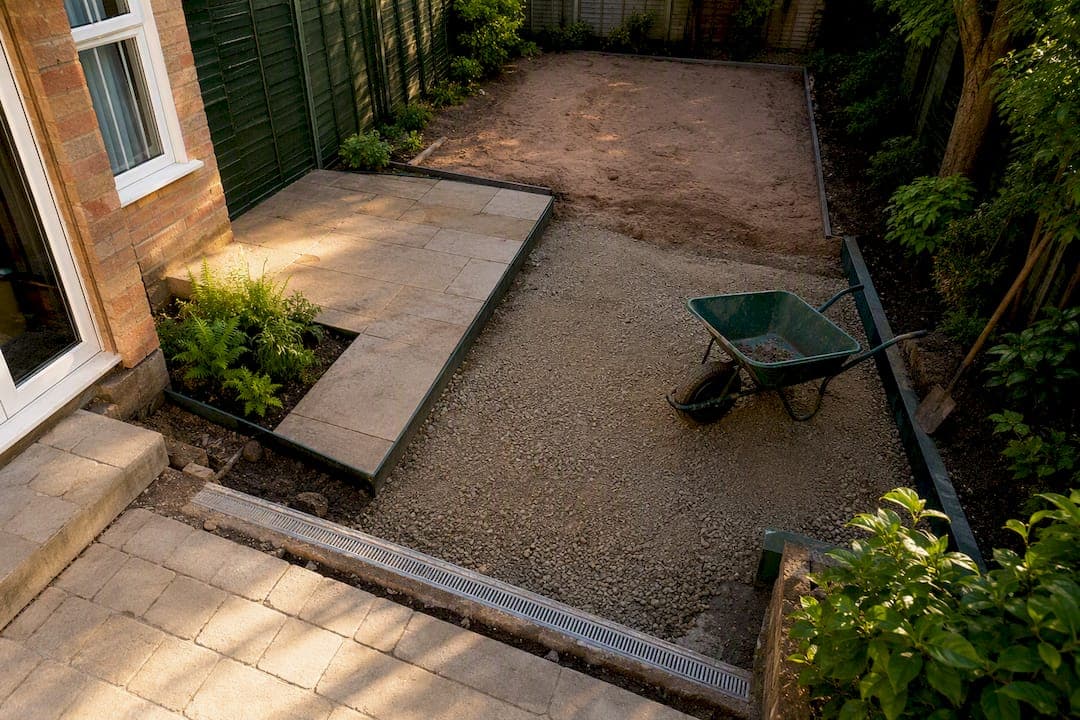
Most small to mid-range London garden projects typically cost within a range starting in the low tens of thousands, with central zones commanding a premium over outer boroughs. Materials, site access and drainage work drive the biggest swings in price. Read on for the full cost breakdown, then use our checklist to compare quotes and request a site visit for an accurate figure.
TL;DR:
- London landscaping projects typically cost between £12,000 and £80,000, with larger and more complex gardens demanding higher budgets.
- Site access, drainage complexities, and material choices, such as porcelain paving or mature trees, are major factors influencing quote variations.
- London-specific costs include higher labor rates, congestion charges, limited delivery windows, and licensed waste disposal, which can significantly increase expenses.
- Obtaining detailed, itemized quotes that specify materials, access, and inclusions is essential for fair comparison and accurate budgeting.
- Booking during colder months and opting for simpler materials, like concrete instead of porcelain, can help reduce overall landscaping costs in London.
Table of Contents
- How does landscaping cost in London compare with the UK average?
- What do individual landscaping tasks cost in London?
- Why do quotes vary so much between contractors?
- What makes landscaping specifically more expensive in London?
- How do you get accurate landscaping quotes in London?
- How does LookDeVis Services approach London landscaping budgets?
- What should a London landscaping budgeting checklist include?
- How can you reduce landscaping costs in London?
- How much do different landscaping specialists charge in London?
- Does the season affect landscaping prices in London?
- Do you need planning permission for landscaping work in London?
- What London landscaping budgets get wrong most often
- Get a fixed London landscaping quote from LookDeVis Services
- Sources
- FAQ
How does landscaping cost in London compare with the UK average?
Landscaping costs more in London than almost anywhere else in the UK, and the gap is wider than most homeowners expect. National figures put a typical landscaping project between £3,500 and £22,000, with a UK average around £8,500. London adds a premium above the national average, varying by borough and centrality of the property.
That uplift comes from a mix of higher labour rates, tighter access, and the sheer logistics of getting materials to a terraced house in zone 2 versus a detached property in Surrey. Once you see the actual project bands, the reason becomes obvious.
Typical London garden project costs (2026):
- Small city garden refresh: £12,000–£25,000
- Mid-size garden redesign projects typically cost in the range of twenty to several tens of thousands of pounds
- Large or complex transformation: £45,000–£80,000+
These bands cover full design-and-build projects rather than single tasks. A small city garden refresh might involve new paving, planting and lighting on a modest-sized plot. A mid-size redesign usually involves structural changes such as level changes, a new patio and turf or artificial grass together. Where per-square-metre figures exist, they tend to sit well above equivalent rural or suburban rates once you factor in labour, waste removal and delivery access. Garden designers in London often quote per-square-metre design fees separately from build costs, which we cover further down.
What do individual landscaping tasks cost in London?
Breaking a project into its component tasks makes budgeting far more manageable than trying to price a whole garden as one figure. Most quotes bundle several of these elements together, so knowing the individual rates helps you spot where a supplier's numbers look unusually high or suspiciously low.
- Turfing (natural grass): typically a range of prices per square metre reflecting typical turfing costs, including ground preparation and supply. Artificial grass costs more upfront (often £40–£80/m² including base work) but eliminates ongoing mowing and watering.
- Paved patios: averaging around £65–£80 per square metre for standard paving supply and installation, rising sharply for porcelain or natural stone.
- Decking: timber decking generally starts lower per square metre than composite, but composite decking costs more upfront in exchange for lower long-term maintenance.
- Fencing: priced per linear metre, with feather-edge and close-board timber fencing at the lower end and higher panels, concrete posts or bespoke screening adding cost.
- Planting: highly variable, from a few pounds for bedding plants to several hundred pounds for a semi-mature tree, depending on species and size.
- Garden lighting: low-voltage LED systems are the most common choice, with cost driven by the number of fittings and cable runs rather than the fittings themselves.
- Small projects overall: average small landscaping jobs (a single flower bed, a small patio repair) often fall in the £250–£2,500 range.
Most reputable London contractors quote supply and labour together in one line, but always ask which is which. Sub-base preparation, excavation and drainage tie-ins are frequently quoted as add-ons rather than included in the headline patio or decking price, and VAT is usually added separately unless the quote explicitly states it is included.
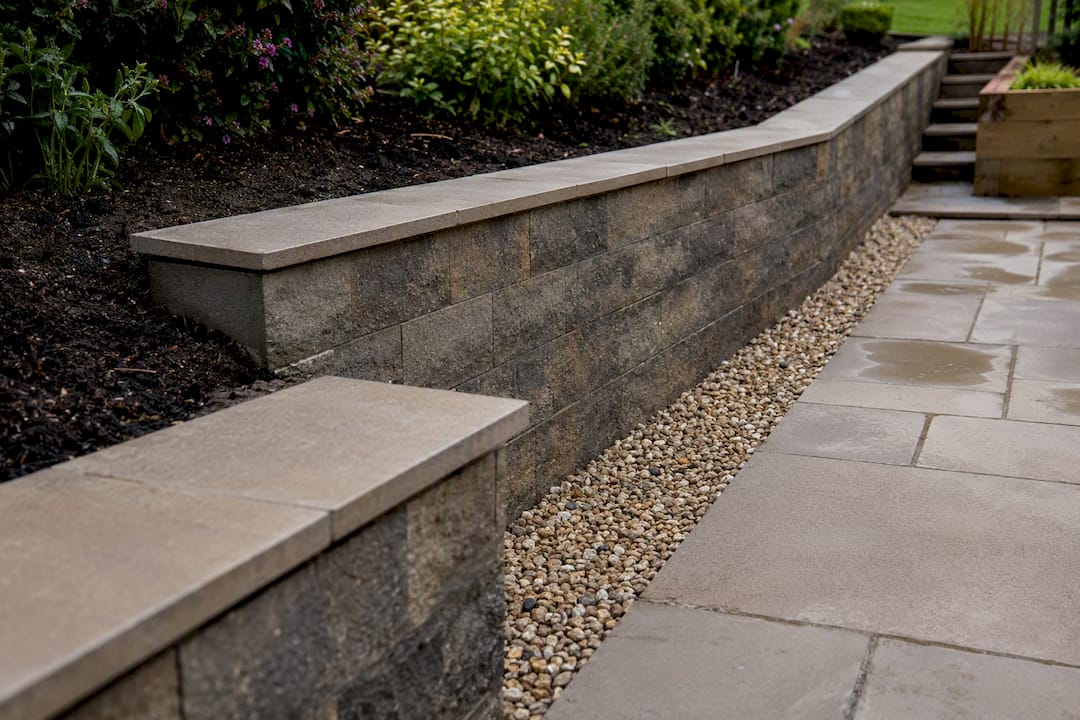
Retaining walls, terracing and mature tree planting are the three tasks most likely to blow a budget. A retaining wall can add £800–£2,500 per linear metre depending on the construction method, and once a garden needs terracing on a slope, groundworks and drainage both escalate together rather than separately.
Why do quotes vary so much between contractors?
Two contractors can price the same garden and land £10,000 apart, and it almost always comes down to three things: materials, site complexity, and how much groundwork the job actually needs.
Material choice alone can swing a patio budget by two or three times. Concrete paving sits at the affordable end, natural sandstone costs noticeably more, and porcelain paving, now the most requested finish for contemporary London gardens, commands the highest per-square-metre price of the three. None of these choices is wrong; they simply belong to different budgets.
Site complexity is the second driver, and it's the one homeowners underestimate most. A garden with level changes needs retaining structures or steps. Poor natural drainage means a soakaway or channel drainage system has to go in before any paving is laid, and that work is invisible once the project finishes, which is exactly why it gets skipped in cheap quotes.
- Porcelain paving typically costs more per square metre than concrete equivalents, reflecting material and cutting costs.
- Level changes of more than one step usually require a retaining structure, adding both materials and labour time.
- Garden lighting and outdoor electrics need a qualified electrician, adding a fixed cost on top of the landscaping work itself.
- Planning considerations for structures over a certain height or projects near boundaries can extend timelines and, occasionally, add fees.
Pro Tip: Ask every contractor to state their material specification by name and thickness, not just "paving" or "decking". A 20mm porcelain slab and an 18mm budget slab look identical in a written quote but behave very differently after two London winters.
What makes landscaping specifically more expensive in London?
London's premium isn't just about higher day rates. It's about the practical difficulty of getting people, plant and materials onto a site in a dense city.
Landscaper day rates in London typically run £200–£335, with hourly rates of £36–£64, roughly 30 to 50% above the UK average.
The access penalty: properties without rear vehicle access often add £1,500–£4,000 to a project for manual handling, wheelbarrow runs, and smaller plant hire such as micro-diggers.
Beyond parking and access, several London-specific costs are easy to overlook:
- Congestion charge and ULEZ compliance for contractor vehicles, which some suppliers absorb and others pass on as a line item.
- Restricted delivery windows on residential streets, sometimes requiring smaller, more frequent deliveries rather than one bulk drop.
- Licensed waste disposal, which costs more in London due to landfill tax and transfer station fees, and which must be handled by a licensed carrier.
Always confirm in writing whether a quote includes congestion charges, plant hire, and licensed waste removal, since these are the three items most often assumed away in a deceptively low bid.
How do you get accurate landscaping quotes in London?
Comparing quotes fairly means insisting on the same level of detail from every contractor, not just the same headline figure.
- Request a written specification, not a verbal estimate. It should name the materials, thickness, sub-base depth, and drainage solution being used, not just describe the finished look.
- Clarify inclusions and exclusions. Ask explicitly whether waste removal, deliveries, parking permits and VAT are included in the headline price or added afterwards.
- Check insurance and licensing. A landscaper working on your property should hold public liability insurance and, if they're removing waste, a valid waste carrier's licence.
- Ask for a payment schedule and timeline. Staged payments tied to project milestones protect you far better than a large deposit upfront.
- Request references or examples of finished work, ideally similar in scale to your own garden.
A simple scoring matrix helps when quotes differ on more than just price: score each supplier out of five on price, timeline realism, insurance evidence, and reference quality, then compare totals rather than headline cost alone.
Pro Tip: Always ask for an itemised quote rather than a single lump sum. If a contractor won't break down materials, labour and waste separately, that's usually a sign the figure was built backwards from a number they thought you'd accept.
How does LookDeVis Services approach London landscaping budgets?
LookDeVis Services operates as a fully insured, licensed waste carrier delivering landscaping projects across London, from patio replacements to complete garden transformations. Every quote is built around the specifics of your site, not a generic template.
That means correctly specified sub-base depths, drainage tie-ins named by solution rather than left vague, and site supervision on more complex projects, exactly the inclusions that protect you from mid-project surprises. If your garden needs professional attention, request a site visit and free quote by calling 07348 758581 or emailing lookdeviscompanylegal@gmail.com.
What should a London landscaping budgeting checklist include?
A garden budget falls apart when contingency and hidden costs get bolted on as an afterthought rather than planned from the start. Build your figure in this order:
- Set your headline budget band using the project size closest to yours (small refresh, mid-range redesign, full transformation).
- Add a contingency of at least 15 to 20%. Industry data suggests comparable construction projects commonly run 18 to 22% over budget, and gardens are no exception once groundworks begin.
- List every task separately (paving, turf, fencing, planting, lighting) with its own low and high estimate, rather than one combined figure.
- Add site-specific costs: access difficulty, waste disposal, drainage works, and any permissions your borough requires.
- Confirm VAT treatment for every quote, since some smaller traders aren't VAT-registered while larger firms will be.
- Set a payment schedule tied to milestones (start, mid-project, completion) rather than a single upfront payment.
- Keep a decision log of every material and design choice agreed, so variations mid-project are easy to price fairly.
Working through these steps before you approach any contractor means you'll recognise straight away whether a quote is comprehensive or has quietly left something out.
How can you reduce landscaping costs in London?
Cost control in London landscaping comes down to timing, scope and material choice, more than haggling on day rates.
Booking work in late autumn or winter, when demand is lower, often gets better availability and occasionally better pricing than the spring rush. Phasing a large project across two budget years, doing hard landscaping one year and planting the next, spreads cost without compromising the final result.
Choosing concrete or textured paving over porcelain, or artificial grass over a labour-intensive lawn renovation, both reduce material spend without sacrificing a finished look. Using a single accountable contractor for the whole project, rather than several separate trades, also tends to reduce both cost and schedule overruns compared with fragmented subcontracting, since nobody can blame a delay on somebody else's unfinished work.
Finally, ask your contractor which materials they can source at trade rates. A supplier with established merchant accounts can often pass on savings on paving, aggregates and turf that a homeowner buying retail simply can't access.
How much do different landscaping specialists charge in London?
Not every garden project needs the same type of professional, and paying for the wrong level of expertise is a common way London budgets balloon unnecessarily.
Garden designers typically charge design fees separately from build costs, often as a percentage of the total project value or a fixed fee for a planting and layout plan. This makes sense for complex or high-value gardens where getting the layout wrong is expensive to fix.
Landscapers and groundworkers handle the physical build: patios, decking, turf, drainage and fencing. Their rates align with the £200–£335 day rate and £36–£64 hourly figures typical across London.
Horticulturists and planting specialists focus specifically on soil preparation, plant selection and aftercare, and are worth engaging separately for gardens where planting is the main investment rather than hard landscaping.
For a small refresh, a single landscaper can usually manage the whole job. For a full transformation involving structural changes, engaging a designer first to produce drawings, then a landscaping contractor to build from that specification, tends to produce a better result and fewer costly revisions mid-project.
Does the season affect landscaping prices in London?
Yes, and the effect works in both directions depending on what you're planning. Spring and early summer are the busiest months for London landscapers, which means higher demand, longer lead times, and less room to negotiate on price. Booking a spring start in January or February, before the rush begins, often secures better availability.
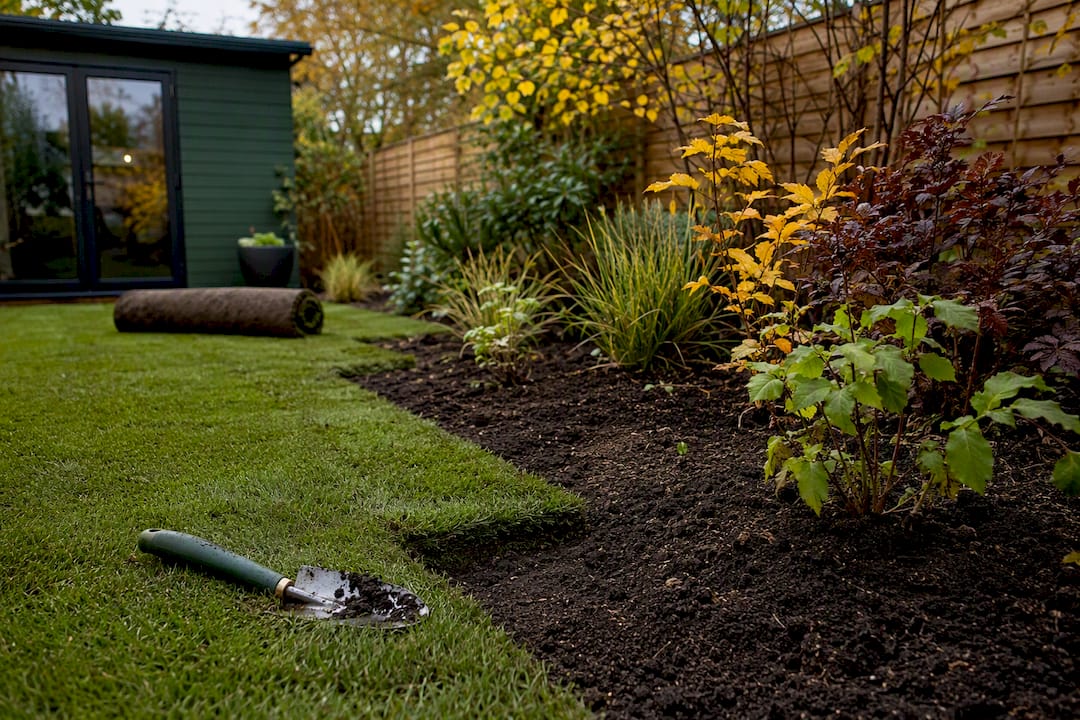
Autumn and winter bring quieter contractor schedules, making it a sensible time to book hard landscaping work such as patios, decking and fencing, since these don't depend on the growing season. Turfing and planting, by contrast, establish best in autumn or early spring when soil is moist and temperatures are moderate, so timing these tasks around the season rather than around your own convenience improves results and can reduce the need for costly replacement planting later.
Groundworks scheduled during wet winter months can also run slower, since heavy clay soils common across much of London become difficult to work when saturated, occasionally extending timelines beyond the original estimate.
Do you need planning permission for landscaping work in London?
Most routine landscaping, patios, turfing, planting and standard fencing, falls under permitted development and needs no planning application. However, several London-specific triggers change that picture, and borough rules vary enough that checking before you start saves real money.
Front garden paving over five square metres generally requires permeable materials or planning permission, a rule many London boroughs enforce more strictly than elsewhere due to surface water flooding concerns. Properties in conservation areas, which cover large parts of inner and outer London boroughs alike, often have tighter restrictions on hard surfacing, boundary walls and even tree removal. Fences and walls over one metre high next to a road, or two metres elsewhere, typically need permission regardless of borough.
Trees are a particular risk area: many mature trees across London sit under Tree Preservation Orders or conservation area protections, and removing or significantly pruning one without checking first can lead to a fine. Always check with your local borough planning department before finalising a design that involves boundary structures, front garden paving, or existing trees, and factor any application fee into your overall budget rather than treating it as an afterthought.
What London landscaping budgets get wrong most often
Homeowners compare three quotes on price alone, pick the cheapest, and then discover mid-project that the "cheap" quote never included a soakaway or licensed waste removal in the first place.
Conventional budgeting advice tends to focus on per-square-metre rates for paving or turf, which is useful but incomplete. It rarely addresses what actually separates London costs from the rest of the UK: a garden in zone 2 with no rear access costs more to landscape than an identical garden in Kent, not because the paving is different, but because getting a skip, a mini-digger and three tonnes of aggregate down a Victorian side return is genuinely harder logistical work.
If there's one thing worth prioritising above all else, it's this: get the drainage and access assumptions written into your specification before you compare a single price. A quote that's £3,000 cheaper but silent on access costs isn't actually cheaper, it's incomplete.
— Roman
Get a fixed London landscaping quote from LookDeVis Services
LookDeVis Services is the practical alternative to piecing a project together across multiple trades. Instead of separately hiring a designer, a groundworker and a waste carrier, you get one fully insured team covering the design, the build and the licensed waste removal under a single fixed quotation, with no gaps between contractors for costs to fall through.

That matters most on exactly the London projects this guide has covered: gardens with restricted access, drainage that needs doing properly, and quotes that need to be genuinely comparable rather than deceptively cheap. Our teams work across Greater London on both residential and commercial properties, handling everything from a small patio refresh through to a full garden transformation. We're equally set up for one-off projects and ongoing maintenance afterwards.
If you're ready to see what your garden would actually cost, request a free quote for landscaping services in London or call 07348 758581 to arrange a site visit. We'll give you a written specification you can compare against any other quote, line by line.
Sources
- How Much Does a Landscaper Charge in London? (2026 Rates) | What to Charge
- Landscaping Cost in London 2026 | Builderr
- How much does garden landscaping cost in 2026? | Checkatrade
- Landscaping Cost Calculator UK — Free 2026 GBP Estimate
FAQ
What are the average costs for landscaping in the UK?
The UK national average for a landscaping project sits around £8,500, with typical ranges of £3,500–£22,000 depending on garden size and scope. London projects incur costs noticeably above these national figures.
Why is landscaping so expensive in the UK, particularly in London?
Costs reflect labour rates, material prices and site complexity, with London adding further pressure from restricted access, parking, congestion charges and higher waste disposal fees. London day rates of £200–£335 run well above the national average largely because of these logistical factors.
How much is a gardener for three hours in London?
Using London's typical hourly rate of £36–£64, the cost of gardening work varies depending on the complexity of the task and the individual contractor.
How do landscapers price jobs in the UK?
Most landscapers price by combining a day or hourly rate with material costs, then adding site-specific factors such as access difficulty, drainage requirements and waste removal. Reputable contractors, including LookDeVis Services, provide an itemised specification rather than a single lump-sum figure, so you can see exactly what each element costs.
Is it cheaper to landscape a garden in autumn or winter?
Hard landscaping work such as patios, decking and fencing can often be booked more easily and sometimes more affordably in autumn and winter, when contractor demand is lower than during the busy spring season. Turfing and planting, however, are best timed to the growing season rather than to price alone.