
The most reliable way to get a garden that lasts is to commission a qualified landscaper for a design-led project that includes proper ground preparation and drainage checks, rather than treating paving or planting as separate afterthoughts. A professional scope typically covers patios, turfing, planting, fencing and drainage together, and before you request quotes it pays to check site access, any planning or permitted development restrictions and whether a watercourse runs near your boundary.
TL;DR:
- On Essex clay, prioritize excavation depth, a compacted subbase, and drainage before choosing finishes, since poor preparation can leave paving sinking or water pooling.
- Ask for a fixed groundworks price and written terms for surprises; quotes should itemize materials, labor, waste, and VAT, with payments tied to milestones.
- Front driveways over 5m² normally need permission if impermeable, while permeable surfacing can avoid it; decking above 30cm may also be restricted.
- Small patios may take days, medium paving and turf projects one to two weeks, and full transformations several weeks; restricted access increases time and cost.
- Budget for watering and establishment checks after turfing or planting, and include follow up care in the original quote rather than buying it later.
Table of Contents
- What services make up a professional landscaping project
- What happens from site survey to finished garden
- What drives the cost of a landscaping project
- Planning permission, permitted development and drainage rules
- Choosing a landscaper: questions to ask and what a quote should show
- Looking after your garden once the work is finished
- Why LookDeVis Services suits Essex landscaping projects
- Sustainable choices for your Essex garden
- Keeping a landscaping site safe
- Materials that suit the Essex climate
- How weather affects timelines and upkeep
- Commercial landscaping across Essex
- Why professional landscaping pays off long term
- Three priorities that make or break a landscaping project
- Get a free quote for your Essex garden
- FAQ
- Sources
What services make up a professional landscaping project
A garden transformation usually draws on two broad categories of work, and knowing the difference helps you brief contractors accurately and compare quotes fairly.
Hard landscaping covers the permanent structural elements: patios, paving, retaining walls, steps, edging and the drainage or sub-base work that sits beneath them. This is the part of the project that determines whether a surface stays flat and dry for years or starts to sink and puddle within a couple of seasons.
Soft landscaping covers the living, growing elements: turfing, planting schemes, hedges, borders and soil preparation. It tends to be quoted separately from hard landscaping because the skills, timing and materials involved are different.
Most full garden makeovers also pull in related trades, which is why choosing a provider that coordinates several services under one project often saves time:
- Garden clearance to remove overgrown vegetation and debris before groundworks begin
- Tree surgery where branches, roots or entire trees interfere with the proposed layout
- Waste removal for excavated soil, old paving and green waste
- Pressure washing to restore existing hard surfaces that will remain in the finished design
- Fencing to define new boundaries once groundworks are complete
A typical bundle for an outdated rear garden might combine clearance, groundworks, a new patio, turfing and planting into one coordinated schedule, which avoids the delays and finger-pointing that come from managing separate contractors for each stage.
What happens from site survey to finished garden
A landscaping project generally follows a sequence of stages, and understanding them gives you a practical checklist to measure any quote against.
- Site survey: a contractor assesses soil type, drainage, access, existing structures and sun exposure. Have boundary lines, any underground pipework and your rough budget ready to discuss.
- Design stage: you should receive a sketch or plan, a written specification of materials and a sequence of works, not just a verbal description.
- Groundworks and drainage: this includes excavation, sub-base installation and any sustainable drainage measures needed to manage surface water, which we cover in more detail in the planning section below.
- Installation: paving, decking or turfing goes down according to the design, with planting following a schedule suited to the season.
- Finishing and handover: pointing, edging, a final tidy-up and a walk-through so you understand any aftercare requirements.
Timeframes vary considerably. A small patio or planting refresh might take a few days, a medium garden with new paving and turf often runs to one or two weeks, and a full rear and front garden transformation with retaining walls or drainage work can extend to several weeks. Restricted access, such as a narrow side passage that rules out machinery, tends to add time and cost regardless of the size of the job, since materials then need to be moved by hand.
What drives the cost of a landscaping project
Landscaping costs vary widely because every garden presents a different combination of ground conditions, access and specification, which is why a genuine quote always follows a site visit rather than a phone estimate.
The main factors that push a price up or down include:
- Access: a garden reachable by vehicle or digger costs less to work on than one requiring materials to be carried through a house
- Excavation and ground conditions: clay, rubble or a high water table all add labour and sometimes specialist equipment
- Drainage requirements: soakaways, permeable paving or land drains add material and installation time
- Materials specification: natural stone, composite decking and bespoke planting schemes sit at a different price point to standard paving slabs or turf
- Specialist labour: retaining walls, structural steps or work near trees protected by preservation orders may need additional expertise
Costs are genuinely site-specific, so treat any figure you see as a starting point rather than a firm number until a surveyor has walked your garden. Our guide to landscaping costs sets out more detail on the pressures that shape pricing and the kind of contingency sensible homeowners build in. Hidden ground conditions and access restrictions discovered once work starts are the most common cause of costs running above the original estimate, so it is worth asking your contractor how they handle unforeseen issues before you sign anything.
A complete quote should break down materials, labour, waste removal and VAT separately, and set out a staged payment schedule tied to project milestones rather than asking for a single upfront payment.
Pro Tip: Ask for a fixed price on groundworks specifically, since this is the stage most likely to uncover surprises once excavation begins.
Planning permission, permitted development and drainage rules
Before any groundworks begin, it is worth checking a handful of planning and drainage rules that catch out homeowners more often than any other part of a garden project.
Under permitted development guidance, a front driveway laid with impermeable materials over 5m² normally needs planning permission, and decking raised more than 30cm above ground level may also be restricted, with tighter limits applying in Conservation Areas or other designated zones. These thresholds are worth checking against your own property before committing to a design, since restrictions vary by location.
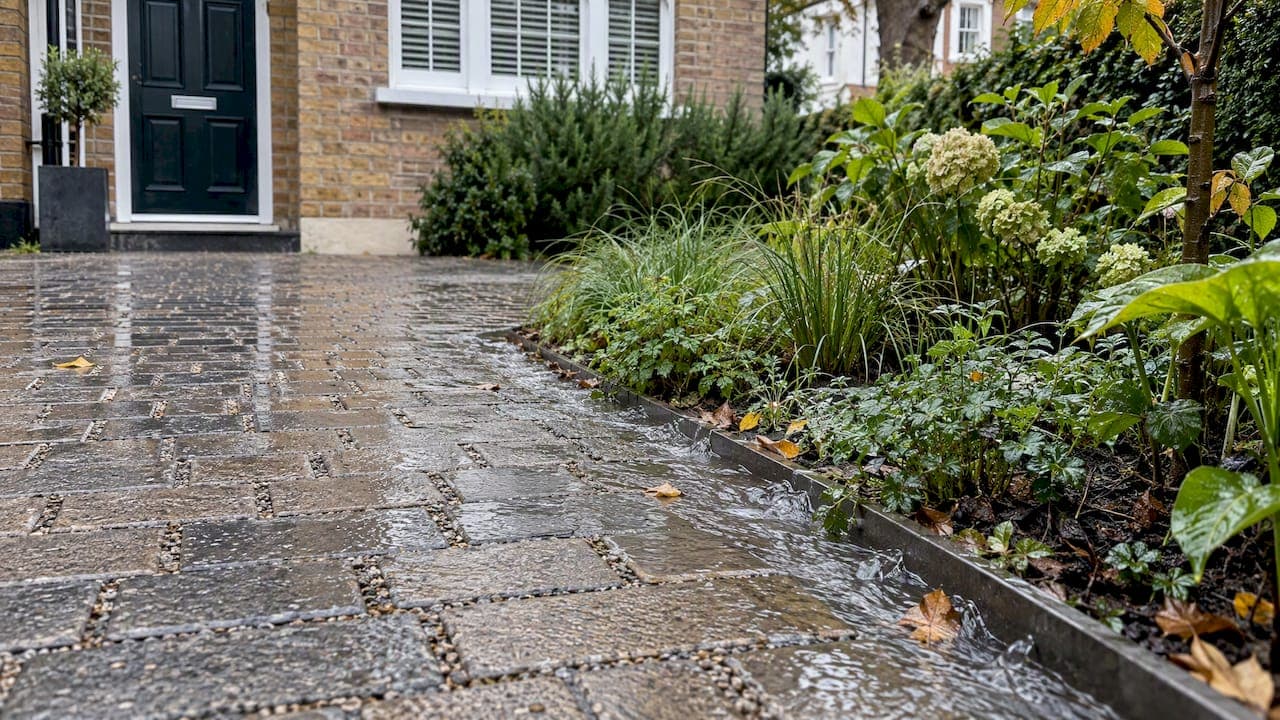
One practical route avoids the permission requirement entirely: GOV.UK guidance on permeable surfacing confirms that using permeable materials, or directing rainwater run-off to a permeable area such as a border or soakaway, removes the need for planning permission on front driveways. This makes sustainable drainage systems, often shortened to SuDS, a genuinely practical choice rather than just an environmental one. Our permeable paving guide sets out the surfacing options that typically qualify.

Where your garden backs onto a ditch or stream, you may hold riparian responsibilities for maintaining that watercourse. Essex County Council's ordinary watercourse maintenance guidance sets out that riparian owners are expected to inspect watercourses regularly, with major clearance work best timed for late September or October, and that unconsented alterations can lead to enforcement action or cost recovery.
Landowners across Essex carry a legal duty to maintain vegetation, hedges and ditches on their land, particularly where these border a public highway or watercourse, and neglecting that duty can lead to council enforcement.
If your project involves a protected tree, a listed building or sits within a flood risk area, it is worth contacting your local planning authority or an ecologist before finalising the design.
Choosing a landscaper: questions to ask and what a quote should show
A written quote tells you almost everything you need to know about how a contractor will run your project, so it is worth reading one closely before you accept it.
A complete quote should set out:
- The full scope of work, including groundworks, materials and finishing
- A drawing or plan showing the proposed layout
- Named materials and their specification, not generic descriptions
- A realistic timescale with a start date
- A staged payment schedule linked to milestones
- Confirmation of how waste will be removed and disposed of
Before accepting any quote, it is reasonable to ask a contractor whether they hold public liability insurance, whether they are a registered waste carrier for any material they remove from site, and whether they can show examples of similar projects they have completed. References from previous customers and clarity on what guarantee applies to workmanship are both fair questions to raise at this stage.
Trust signals worth looking for include a gallery or portfolio of completed work, before-and-after photos of similar gardens, and a named point of contact for your project rather than a rotating cast of tradespeople.
Pro Tip: Ask who is responsible for obtaining any planning permission or building control sign-off: a contractor who builds this into their scope removes one source of delay from your project.
On payment, a reasonable structure includes a deposit, a staged payment at the groundworks milestone and a final balance on completion, which gives you leverage if finishing details need attention.
Looking after your garden once the work is finished
New turf and planting need focused attention in the first few weeks to establish properly. Expect a watering schedule in dry spells, a first mow once grass reaches an appropriate height, and mulching or staking for young trees and shrubs.
Hardscaping needs lighter ongoing care: jointing in block paving may need topping up over time, debris should be cleared from drainage channels, and some natural stone benefits from periodic sealing to resist staining.
- Establishment visits: a one-off follow-up a few weeks after planting to check watering and settle any issues
- Scheduled maintenance plans: regular visits covering mowing, hedge trimming and border care through the growing season
- Seasonal care: autumn leaf clearance and winter cutting back to keep the garden tidy between major maintenance visits
If you are budgeting for ongoing patio care, an independent guide to patio cleaning costs gives a useful sense of what regular upkeep involves. Building aftercare into your original quote, rather than treating it as a separate purchase later, protects the investment you have made in the groundworks and planting.
Why LookDeVis Services suits Essex landscaping projects
We deliver both hard and soft landscaping, from patios, paving and retaining walls to turfing and planting schemes, alongside the waste removal, tree surgery and pressure washing that often sit around a garden project. Coordinating these under one team means fewer handovers between trades and one point of contact for the whole job.
Our teams work on an insured basis, waste we remove is handled through appropriate licensed carrier arrangements, and selected services offer same-day availability depending on location and team schedules.
- A site survey to assess access, ground conditions and drainage before any work is quoted
- A tailored written quote reflecting your specific garden rather than a generic price list
- Coordination across landscaping, waste removal and related trades within one project
Sustainable choices for your Essex garden
Sustainable drainage is increasingly built into good garden design rather than treated as an optional extra, partly because planners favour it and partly because it reduces the risk of waterlogging on heavy Essex clay soils. Permeable paving, soakaways and rain gardens all slow water down and let it soak away on site rather than overwhelming drains during heavy rainfall.
Native planting is a practical complement to this approach. Species suited to local conditions tend to need less watering once established and support the wider push towards nature recovery and biodiversity net gain that shapes planning policy across Essex, as set out in guidance on local nature recovery.
Water-efficient irrigation, such as drip systems targeted at borders rather than sprinklers covering an entire lawn, cuts water use during establishment and beyond. Mulching beds after planting also reduces how often you need to water, since it slows moisture loss from the soil surface.
Choosing permeable surfacing for driveways and paths serves a dual purpose: it manages run-off responsibly and, as covered earlier, can keep a front garden project within permitted development rules rather than requiring planning permission.
None of these choices need to compromise the finished look of a garden. A well-planned scheme blends native and ornamental planting, uses permeable materials where they make sense, and directs water to beds or soakaways rather than storm drains.
Keeping a landscaping site safe
Landscaping sites bring together excavation, power tools, heavy materials and often multiple trades working in sequence, so safe working practices matter throughout a project.
Excavated trenches and holes should be clearly marked or covered when not actively being worked on, particularly where children or pets have access to the garden. Materials such as paving slabs, turf rolls and timber should be stacked securely rather than left where they could shift or fall.
Power tools, cement mixers and cutting equipment carry their own hazards, and a competent contractor will use appropriate protective equipment and keep these tools secured when not in use. Underground services, including gas, water and electricity supplies, should be checked before excavation begins to avoid accidental damage.
Where a project involves tree work near a garden, overhead power lines or neighbouring structures add further risk, which is one reason tree surgery is often treated as a distinct, specialist stage rather than folded into general groundworks.
A tidy site also matters for safety: clear access routes, properly stored materials and prompt removal of waste all reduce the chance of trips, falls or damage to the garden as work progresses.
Materials that suit the Essex climate
Essex gardens often sit on heavy clay soil, which holds water after rain and can shift slightly with seasonal moisture changes. That makes groundworks, rather than the surface finish, the most important factor in how well paving or decking performs over time: a properly compacted sub-base and adequate drainage prevent the sinking and cracking that poor preparation eventually causes.
For hard landscaping, concrete block paving and natural stone both perform well where drainage is designed in from the outset, since standing water is the main threat to longevity on clay soils. Composite decking tends to resist the swelling and splitting that timber can experience through repeated wetting and drying, though well-maintained timber decking remains a popular and attractive choice.
For soft landscaping, turf and planting schemes that tolerate occasional waterlogging suit gardens with heavier clay, while raised beds or improved topsoil give more flexibility where drainage is poor. Native hedging species adapted to local conditions generally establish with less intervention than more demanding ornamental alternatives.
Whatever materials you choose, the groundwork beneath them, correct excavation depth, a well-compacted sub-base and effective drainage, does more to determine how the finished garden performs through wet Essex winters than the visible surface itself.
How weather affects timelines and upkeep
Weather shapes a landscaping project from the groundworks stage right through to ongoing maintenance. Wet weather delays excavation and can make a clay-based site unworkable for days after heavy rain, since waterlogged ground is difficult to compact properly and risks trapping moisture beneath new paving or turf.
Turfing and planting are generally more successful in cooler, damper conditions such as spring or autumn, when new grass and root systems establish without the stress of summer heat. Installing turf during a dry summer spell often means a more intensive watering schedule to prevent it drying out before roots take hold.
Frost can halt certain groundworks altogether, since laying a sub-base or compacting ground in freezing conditions risks long-term instability once temperatures rise again. For this reason, contractors often schedule major groundworks and paving for milder months where possible, though a well-run project can proceed through most of the year with the right planning.
Ongoing maintenance also follows the seasons: hedges and lawns need more frequent attention through spring and summer growth, while autumn brings leaf clearance and preparation for winter, and winter itself is the main window for structural pruning while plants are dormant. Building this seasonal rhythm into a maintenance plan, rather than treating the garden the same way all year round, keeps it in better condition with less reactive work.
Commercial landscaping across Essex
Landscaping is not only a residential concern. Commercial premises, managed developments and rental portfolios across the region also rely on well-maintained outdoor space to present a professional appearance to customers, tenants and visitors.
A typical commercial project might combine grounds maintenance with a one-off landscaping upgrade, such as replacing tired planting beds, refreshing paved areas or installing low-maintenance turf that can withstand regular foot traffic. These projects often need to be scheduled around business hours or tenant access, which makes clear communication between the landscaping team and the property manager as important as the groundworks themselves.
For managed and rental properties, landscaping frequently forms part of a wider property preparation project, sitting alongside pressure washing, waste removal and general exterior maintenance ahead of a new tenancy or sale. Coordinating these elements through one team reduces the scheduling complexity that comes from managing several separate contractors on a single site.
Whether the project is a single planting refresh or a full grounds overhaul, the same fundamentals apply as for a residential garden: a proper site survey, a clear written scope and attention to drainage and ground conditions before any surface finish goes down.
Why professional landscaping pays off long term
A professionally designed garden can offer value through how usable the space becomes, what it adds to your property, and how long it lasts without needing rework.
Usability is the most immediate benefit. A garden designed around how you actually use it, whether that is entertaining, growing food or simply somewhere to sit, tends to get used far more than one that was never planned with a purpose in mind. Defined zones for seating, planting and lawn make a garden feel larger and more functional than an undefined stretch of grass and borders.
Well-executed landscaping also tends to make a property more attractive to potential buyers, since a tidy, usable outdoor space is one of the first things visitors notice. While the exact value this adds varies by property and location, a garden that looks neglected or poorly finished rarely helps a sale, whereas one that is clearly cared for supports a positive first impression.
Longevity is where the investment in groundworks pays off. A patio laid on a properly excavated and compacted sub-base, with drainage considered from the outset, should perform for many years without sinking, cracking or pooling water, whereas shortcuts at the groundworks stage can surface as problems over time. Spending properly at this stage, rather than cutting corners to save on the visible finish, is what separates a garden that still looks good in ten years from one that needs rework much sooner.
Three priorities that make or break a landscaping project
Ground preparation and drainage matter more than any surface finish you choose: get the sub-base and water management right, and everything laid on top of it has a far better chance of lasting. A clear written quote that confirms access arrangements before work starts prevents most of the disputes and delays we see on garden projects. Finally, a sensible contingency for the unexpected, paired with proper aftercare once the work is done, protects the result you have paid for.
— Roman
Get a free quote for your Essex garden
We bring hard landscaping, soft landscaping, turfing, planting, waste removal and project coordination together under one team, so you deal with a single point of contact from the first site visit through to the final tidy-up.

Getting started is straightforward:
- Request a site survey so we can assess access, soil and drainage before quoting
- Receive a tailored written quote covering scope, materials, timescale and payment stages
- Agree a schedule and we coordinate landscaping alongside any waste removal or related trades your project needs
If your project runs toward paving, retaining walls or groundworks, our hard landscaping and groundworks page sets out what that work involves. For turfing, borders or planting schemes, our soft landscaping and turfing page covers the options available. Call us on 07348 758581 or email lookdeviscompanylegal@gmail.com to arrange your free quote.
FAQ
How much does a landscaper cost per day?
Day rates vary widely depending on the trade, location and complexity of the work involved, so there is no single figure that applies across all projects. The most reliable way to understand likely costs for your garden is a site-specific quote, since access, ground conditions and materials all affect the price far more than a generic day rate would suggest.
What plants should I choose for a landscape design?
Plant choice depends on your soil, light levels and how much maintenance you want to take on, with native and locally adapted species generally needing less watering once established. On heavier Essex clay soils, plants that tolerate occasional waterlogging tend to perform better than those requiring free-draining conditions.
What are the key rules for designing a garden?
There is no single official list of "golden rules", but experienced designers generally prioritise matching the layout to how the space will actually be used, getting drainage and ground preparation right before any surface finish, and balancing hard and soft landscaping so the garden feels proportionate. Planning for year-round interest and low-maintenance areas also helps a design stay practical long after installation.
What types of landscapes are there?
Garden landscapes are usually grouped by style and function rather than a fixed official list, ranging from formal and cottage-style gardens to low-maintenance, wildlife-friendly or courtyard designs. The right category for your garden depends on your household's needs, the size of the plot and how much time you want to spend on maintenance.
Do I need planning permission for a new driveway or decking?
A front driveway laid with impermeable materials over 5m² normally needs planning permission, unless you use permeable surfacing or direct water to a permeable area. Decking raised more than 30cm above ground level may also fall outside permitted development rights, so it is worth checking your specific property with your local planning authority before work begins.
Sources
- Gov
- Landowners urged to keep on top of vegetation maintenance | Essex County Council
- Ordinary watercourse maintenance
Recommended
- Lower Water Use in 2–3 Years: Eco Friendly Landscaping for London Gardens
- Small London garden ideas that actually work in tight urban plots
- Landscaping Services in Watford WD17-WD25 | Garden Design
- Hire One Insured Team for London Garden Maintenance and Clearance
Prices, timescales and information provided in this article are for general guidance and may vary depending on the property, site conditions, materials and scope of work. Please contact LookDeVis Services for an individual assessment and quotation. Where regulatory, planning or legal requirements apply, appropriate professional advice should be obtained.