
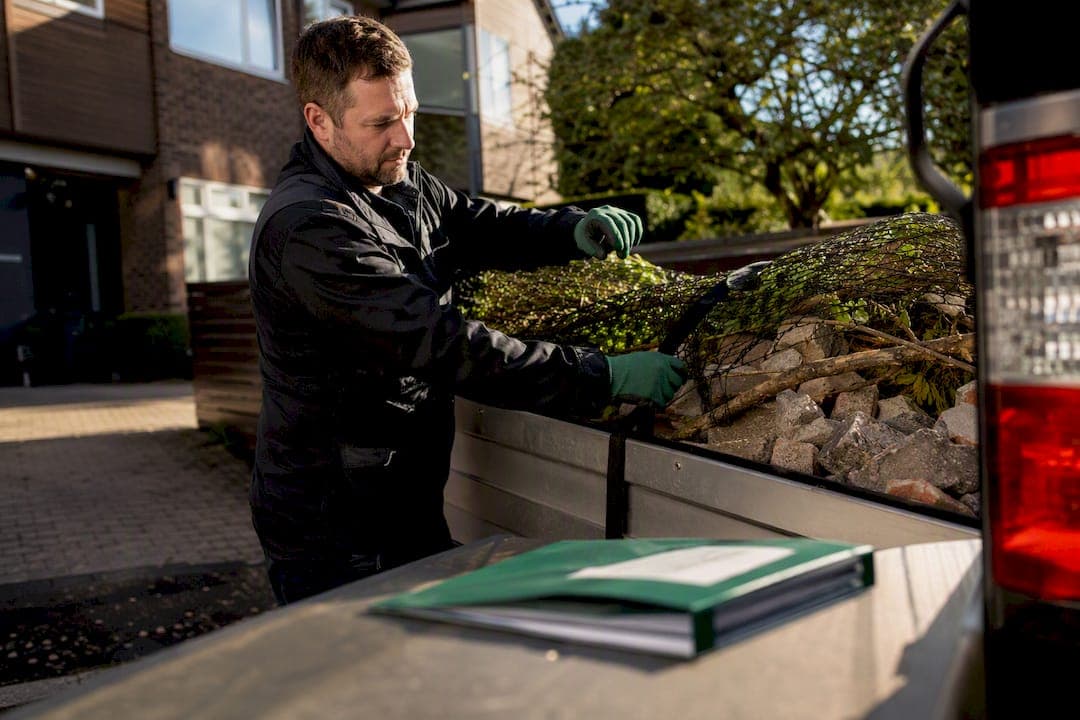
Hiring a licensed waste carrier and getting a Waste Transfer Note is the only reliable way to stay clear of fly-tipping liability in the UK. If a contractor removes your garden, household or builders' waste, you must confirm their carrier registration on the correct public register and keep documented proof of legal disposal. Skip that check and you, not just the carrier, can be held responsible if the waste ends up dumped illegally.
TL;DR:
- Waste carriers must have active Upper tier registration in their respective registers for third-party waste collection, especially in England, Wales, Scotland, and Northern Ireland.
- Always verify the carrier’s registration number on the appropriate government register and ensure the registration details match the quote and invoice before booking.
- Keep documented proof of waste transfer, including a Waste Transfer Note issued on collection day, screenshots of registration checks, and dated invoices, for at least two years.
- Landlords should maintain a comprehensive waste disposal record for each property, including WTNs, invoices, and register verifications, due to closer regulatory scrutiny.
- Using an unlicensed waste carrier risks legal penalties, environmental harm, and reputational damage, making proper checks and documentation essential before disposal.
Table of Contents
- The five-minute checklist before you book a collection
- How to verify a carrier and what a Waste Transfer Note must contain
- Service types, pricing and the checks to make on collection day
- Landlord and commercial obligations: why the bar is higher
- Penalties and legal consequences for using unlicensed waste carriers
- How to report suspected illegal waste disposal activities
- Waste carrier licensing tiers and what they actually cover
- Steps to obtain a waste carrier licence
- Common mistakes we see and how we protect clients
- Book licensed waste removal with LookDeVis Services in London
- Sources
- FAQ
The five-minute checklist before you book a collection
You don't need to be a compliance expert to protect yourself. You need five minutes and a short list of checks, done before any van arrives at your property.
1. Ask for the carrier's registration number. Every legitimate operator should give you this without hesitation, usually printed on their invoice or quote.
2. Verify it on the correct register. Cross-check the number against the Environment Agency's public register if the work is in England, or the equivalent devolved register if the job sits elsewhere. A carrier registered only with SEPA in Scotland may not appear on the English register at all, even if they're happy to collect in London.
3. Confirm the tier is Upper. Anyone collecting waste that isn't their own, meaning any contractor you hire, needs Upper tier registration, not the basic Lower tier that covers a firm's own trade waste.
4. Request a Waste Transfer Note before work starts. Ask that it will record the date, your address, a description of the waste, the quantity, and the carrier's licence details, as required for any non-hazardous transfer.
5. Check the practical details. Confirm public liability insurance is in place, ask whether the quote includes disposal fees and any parking or ULEZ charges, and insist on a traceable payment method with an invoice rather than a cash-only arrangement.
6. Keep dated records. Screenshot the register result, save the WTN, and file the invoice somewhere you can find it again in two years' time.
Pro Tip: Third-party lookup tools that combine England, Wales, Scotland and Northern Ireland registers into one search can save time if you regularly hire contractors who work across borders, but always double-check the result against the official government register before you commit.
How to verify a carrier and what a Waste Transfer Note must contain
You have four official registers to check, and which one applies depends entirely on where the collection happens, not where the company is based. England uses the Environment Agency's public register. Wales uses Natural Resources Wales. Scotland uses SEPA. Northern Ireland uses DAERA. A firm can be legitimately registered in one nation and completely absent from another, which catches out a surprising number of landlords managing properties across regional boundaries.
When you look a carrier up, check for three things specifically:
- Active status. A lapsed or revoked registration means the carrier is currently unauthorised, regardless of what they tell you.
- Upper tier registration. This is the tier required for collecting third-party waste, and it's the detail most homeowners never think to check.
- Matching details. The legal entity name and expiry date on the register should match what's on the quote and invoice you've been given.
Upper tier registrations run for three years before they expire, so a contractor you used two years ago without issue could be unregistered today. That's worth building into any repeat arrangement, particularly for landlords who use the same clearance firm between every tenancy.
The Waste Transfer Note itself is your primary evidence of lawful disposal for non-hazardous waste, covering everything from garden cuttings to builders' rubble. If any part of the load is genuinely hazardous, such as asbestos sheeting or certain chemical residues, a Hazardous Waste Consignment Note is required instead, and a standard WTN won't cover it. The government's own Waste Duty of Care Code of Practice is explicit that a van and a website are not proof of legitimacy. The check has to be active, and the record has to be kept, ideally for at least two years, in case a local authority ever needs to see it.
Service types, pricing and the checks to make on collection day
Licensed waste disposal covers several distinct service formats, and each suits a different job. Man-and-van removals work well for one-off garden or household clearances where a small crew loads and removes waste directly. House clearances suit larger jobs, often full properties, where volume and variety of items matter more than speed. Garden waste collections are typically priced per bag or load and suit ongoing maintenance work. Skip hire suits sustained building projects where waste accumulates over days or weeks rather than being removed in one visit.
Pricing usually depends on a mix of factors:
- Volume, whether charged by load size or by weight
- Waste type, since builders' waste and green waste often carry different disposal gate fees
- Labour and time on site, particularly where access is difficult
- Parking or ULEZ charges in central London boroughs
- The disposal site's own gate fees, which get passed through to you
Some materials need special handling and may be refused on the day if you haven't flagged them in advance, plasterboard in bulk, certain treated timbers, and anything genuinely hazardous among them. Always declare your waste type accurately when booking; not before, when the van arrives.
On collection day itself, a few checks take seconds and protect you completely: ask to see crew ID, note the vehicle's signage matches the company you booked, confirm the WTN is handed over there and then rather than "emailed later," and take a quick photo of the loaded waste alongside your written invoice.
Landlord and commercial obligations: why the bar is higher
Landlords and letting agents face closer scrutiny than individual householders under the duty of care set out in Section 34 of the Environmental Protection Act, largely because tenancy turnovers generate waste repeatedly and at volume. A single missed check on one property is a one-off risk. The same gap across a portfolio becomes a pattern a local authority will notice.
Treating waste transfers with the same paperwork discipline as rent receipts or deposit records reduces that exposure substantially. In practice, that means keeping:
- A Waste Transfer Note for every single collection, not just the larger ones
- Dated invoices that match the WTN's stated collection date
- Screenshots of the register check taken before the job was booked
- Confirmation of the disposal destination, plus any broker paperwork if one was involved
For tenancy turnovers specifically, build lawful disposal into the contractor brief from the outset. Ask for the carrier's registration number before you confirm the booking, not after, and get written confirmation of the disposal route in the same email thread as the quote. It takes minutes and gives you a paper trail if a dispute or inspection ever arises.
Penalties and legal consequences for using unlicensed waste carriers
Handing waste to an unregistered carrier doesn't just risk the waste being fly-tipped, it exposes you personally to enforcement action. Local authorities can issue a fixed penalty notice as an alternative to prosecution for breaches of the household waste duty of care, and councils increasingly use this power when waste linked back to a specific address turns up dumped on a verge or in a lay-by.
Prosecution remains the more serious route, and it's the one used where waste has caused environmental harm or where a pattern of non-compliance is evident, which is exactly the scenario landlords with multiple properties need to guard against. Fixed penalty notices tend to apply where the breach is a first or isolated failure to check.
The uncomfortable detail most people miss: it doesn't matter that you didn't personally tip the waste. If you handed it to someone without checking they were authorised, you carried the legal responsibility for what happened next. Local authorities lean heavily on documentary evidence when deciding whether to act, so a WTN and a register screenshot aren't bureaucratic box-ticking. They're the difference between being able to demonstrate reasonable care and having no defence at all.
The financial risk sits alongside a reputational one for letting agents and property managers. A tenancy dispute or a local authority enquiry involving illegal dumping is not something you want attached to a managed property, particularly if a landlord or freeholder later asks why proper checks weren't made before a contractor was engaged.
How to report suspected illegal waste disposal activities
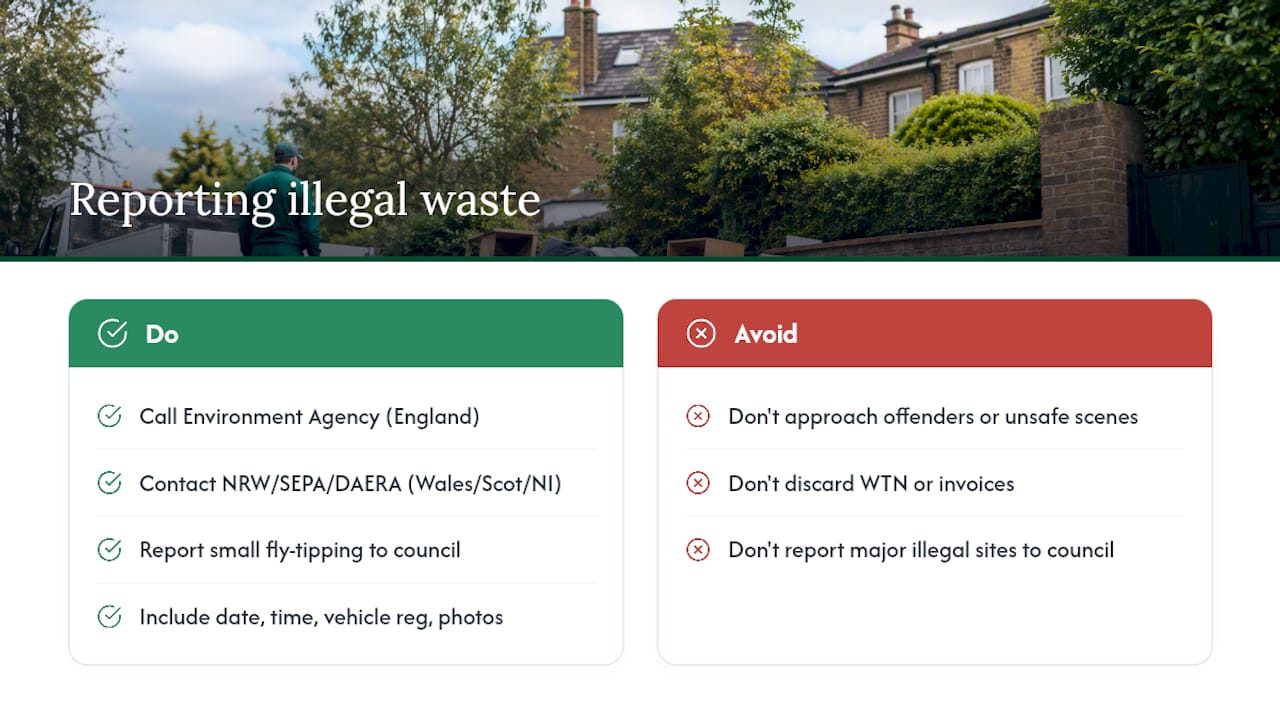
If you spot a van tipping waste somewhere it shouldn't be, or you suspect a contractor you've used has disposed of your waste illegally, the correct first step in England is the Environment Agency's incident hotline, which handles reports of fly-tipping and illegal waste sites. Wales, Scotland and Northern Ireland each route reports through their own environmental regulator, NRW, SEPA and DAERA respectively, rather than the Environment Agency.
Smaller-scale fly-tipping on public land, a mattress or a few bags left on a verge, is usually best reported to the local council, which holds primary responsibility for street-level clearance and local enforcement. Councils can also issue fixed penalty notices where they trace waste back to a specific household or contractor.
When you report, useful details include the date and time you saw the activity, the vehicle registration if visible, a description of the waste, and photographs if it's safe to take them. None of this is compulsory, but it materially increases the chance of the right enforcement action being taken.
If you're reporting because a contractor you paid has gone on to dump your waste illegally, keep hold of your own WTN and invoice. That documentation is exactly what an investigating officer will ask for, and it also protects you from being treated as a party to the offence rather than a victim of it.
Waste carrier licensing tiers and what they actually cover
Two tiers exist, and the distinction matters more than most people realise when they're choosing a contractor. Lower tier registration covers businesses that only ever transport their own waste, a builder taking away offcuts from their own job, for instance, and it's a lighter-touch category with fewer conditions attached.
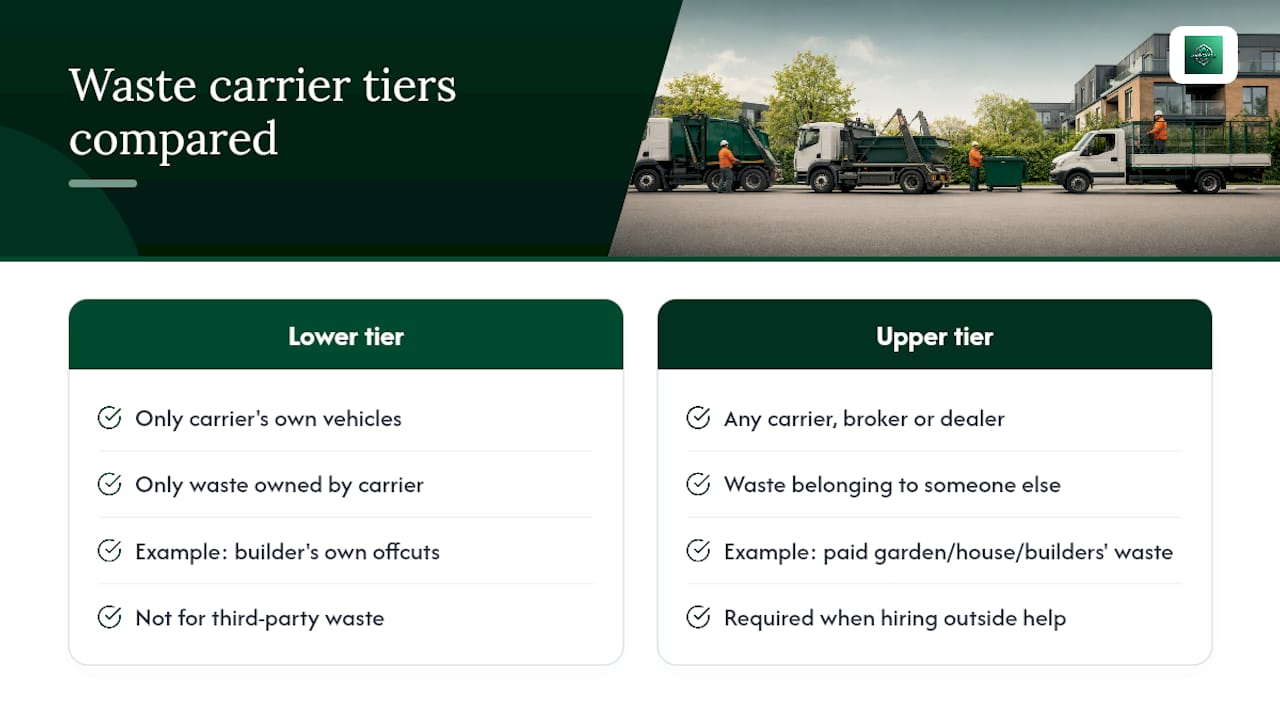
Upper tier registration is the one that matters for anyone hiring outside help. It's required for any carrier, broker or dealer handling waste that belongs to someone else, which covers virtually every scenario where you're paying a company to remove garden, household or builders' waste from your property. Upper tier registration must be actively held by the business collecting your waste, not by a subcontractor they've quietly passed the job to.
Registration under either tier is administered through the relevant national regulator, the Environment Agency in England, Natural Resources Wales, SEPA in Scotland, or DAERA in Northern Ireland, and each register operates independently of the others. A carrier working across more than one nation needs to hold registration in each one they operate in, not just the one where their office happens to sit.
Registration is a floor, not a guarantee of quality. It confirms a carrier is legally permitted to move waste, not that they'll dispose of it responsibly or that their pricing is fair. That's why the paperwork checks, the WTN and the register screenshot, matter just as much after you've confirmed someone is registered as before.
Steps to obtain a waste carrier licence
For property owners genuinely interested in the process rather than simply hiring a compliant contractor, registering as a waste carrier follows a fairly straightforward path through your national regulator's online service.
Applicants first decide which tier applies, Lower for transporting only their own waste, Upper for handling anyone else's. The application itself is completed online through the relevant regulator, requiring business details, the type of waste to be carried, and a registered contact address. There's a fee attached to Upper tier registration, and the registration, once granted, runs for three years before renewal is required.
Renewal isn't automatic. Carriers need to actively re-register before expiry, which is precisely why a contractor who was compliant on your last job might not be compliant on your next one if enough time has passed between bookings. Businesses operating across more than one UK nation need separate registration with each relevant regulator, English registration doesn't transfer automatically to Welsh or Scottish jobs.
None of this is a route homeowners typically need to take themselves. It's included here because understanding what registration actually involves makes it far easier to spot a contractor who's cutting corners, and to ask the right questions before you hand over a single bag of waste.
Common mistakes we see and how we protect clients
The mistakes that land people in trouble are rarely dramatic. They're small lapses: accepting a cash-only price because it's cheaper, skipping the register check because the driver "seemed fine," or relying on a verbal assurance from a tradesperson who says they'll "sort the waste" without any paperwork attached.
At LookDeVis Services, we build the checks into the job itself rather than leaving them to chance. We provide our registration details upfront, issue a Waste Transfer Note at the point of collection rather than promising one later, and we're happy to confirm the disposal site and permit we're using if a client asks. We also carry public liability insurance as standard, which matters as much for peace of mind as for legal compliance.
What we ask of clients in return is simple: tell us accurately what the waste is, and expect the paperwork to arrive without having to chase it.
— Roman
Book licensed waste removal with LookDeVis Services in London
LookDeVis Services is the practical alternative to hunting through van-and-man listings hoping for the best. We're a fully insured, registered waste carrier covering Greater London, and every collection comes with a Waste Transfer Note handed over on the day, not promised for later. If you want to confirm your disposal route before booking, just ask, we're transparent about which sites we use and can show the relevant permit details on request.

When you request a quote, it helps to include your property address, the type of waste (garden, household or builders'), a rough estimate of volume, a few photos if you have them, and your preferred collection date. Same-day and urgent availability may be possible in selected areas, subject to team and access. If your job involves more than just clearance, we also handle everything from garden waste removal to full landscaping and pressure washing under one team, and we work alongside trusted specialists such as Fresh Exteriors for driveway and patio cleaning where a job calls for it.
Ready to book? Call 07348 758581, email lookdeviscompanylegal@gmail.com, or head straight to our waste removal services page to check availability and get a fixed quotation.
Sources
FAQ
What counts as licensed waste disposal in the UK?
It means hiring a carrier who holds active Upper tier registration with the Environment Agency, Natural Resources Wales, SEPA or DAERA, and who provides a Waste Transfer Note as proof the transfer was lawful.
How do I check if a waste carrier is licensed?
Search their registration number on the Environment Agency's public register for England, or the equivalent devolved register for Wales, Scotland or Northern Ireland, and confirm the status is active and the tier is Upper.
What happens if I use an unlicensed waste carrier?
You can face a fixed penalty notice or prosecution if the waste is later linked to fly-tipping, because the duty of care makes you responsible for checking the carrier was authorised before handing over the waste.
Do landlords need stricter waste records than homeowners?
Landlords typically face closer scrutiny under Section 34 duty of care rules and should keep a Waste Transfer Note, invoice and register screenshot for every single collection across their properties.
Does LookDeVis Services provide a Waste Transfer Note?
Yes, LookDeVis Services issues a Waste Transfer Note at the point of collection and can confirm the disposal site and permit details used for your waste on request.