
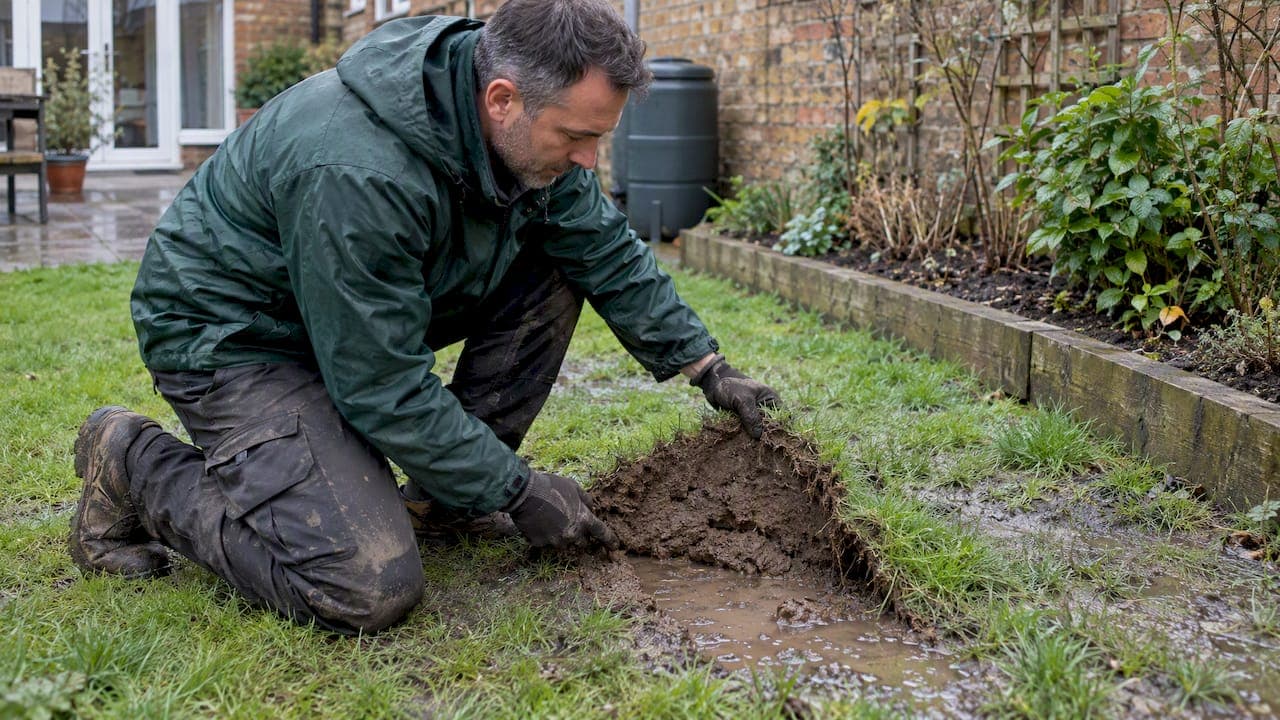
On London clay, we favour diverted or piped drainage over simple soakaways, because the soil's low permeability means infiltration often fails. Raised planting, engineered sub-bases and SuDS-aware design handle the water far more reliably. If your outfall is unclear or you need a pumped system, that's the point to bring in a professional rather than guess.
TL;DR:
- Drainage solutions on London clay should prioritize piped or engineered systems over soakaways due to low soil permeability.
- Conducting a pit test is essential to determine if infiltration is viable, with quick drainage indicating potential for sustainable drainage systems.
- Installing perforated pipes in a herringbone layout is a reliable method when infiltration fails, with proper fall and permission for outfalls being critical.
- Structural landscaping such as raised beds, raingardens, and permeable paving must include engineered sub-bases or storage options to handle water effectively.
- Timing matters; late summer through early winter offers the best conditions for groundworks, and securing outfall permissions is crucial before starting any work.
Table of Contents
- Immediate actions you can take today to reduce waterlogging
- Why soakaways and infiltration often fail on London clay
- Proven drainage installations for clay: piped systems, French drains and herringbone layouts
- Landscaping solutions for clay: raised beds, raingardens and permeable paving
- How to diagnose your garden: site tests, pit test and mapping outlets
- Best timing and practical site rules for working clay
- Materials and build specification checklist for patios and sub-bases on clay
- LookDeVis Services perspective: when to hire a local contractor and what to expect
- Author's note: practical priorities for London gardeners
- How LookDeVis Services can help
- FAQ
- Sources
Immediate actions you can take today to reduce waterlogging
Before any structural work, a few simple checks can reduce standing water within a day or two.
- Clear gutters and downpipes of leaves and silt so roof water reaches the ground where it's meant to, not against your foundations, using advice from pergola guttering systems to prevent standing water.
- Divert downpipes into a water butt or planter, or onto a gravel soakaway only where a pit test shows the soil nearby drains reasonably.
- Regrade the surface slightly away from the house and any seating areas, using a rake and firm tamping rather than machinery on wet ground.
- Dig shallow temporary channels to carry surface water to a lower corner of the garden while you plan permanent drainage.
- Build small mounds for new plants so roots sit above the saturated zone until proper beds are installed.
These fixes buy time and stop the problem worsening, but they rarely solve it outright. A regraded surface can revert after heavy rain, and a shallow channel silts up without maintenance. Think of them as first aid, not a cure, particularly on heavy clay that holds water through winter.
Pro Tip: Check your gutters again after the first autumn storm. Blocked downpipes are one of the most common causes of a sudden wet patch that looks like a drainage fault but isn't.

Why soakaways and infiltration often fail on London clay
London clay's structure explains most of the trouble in Greater London gardens. The soil swells when it's saturated in winter and shrinks back hard as it dries in summer, and its low permeability means water often has nowhere to go once the ground is wet. The RHS notes that heavy clay drains slowly after rain and can become very hard in dry weather, which is exactly the cycle that defeats a standard soakaway.
A soakaway works by letting water seep away into surrounding soil, but on ground that has very low permeability, it may fill up and overflow. That said, some London gardens sit over pockets of sand or made-up subsoil left from earlier building work, and these can behave very differently from the clay next door. A pit test is the only reliable way to know which you have: dig a hole, fill it with water, and watch what happens over a few hours and again overnight.
- If the pit drains reasonably quickly, infiltration may be viable, at least partially.
- If water remains for a prolonged period, treat infiltration as unreliable and plan for piped or attenuated drainage instead.
- Even a borderline result is worth treating cautiously, since clay behaviour changes with the seasons.
Where a soakaway is still wanted despite poor infiltration, an engineered version with an overflow pipe to a storm drain, or a lined and tanked system, gives you the storage benefit without relying on the clay to absorb everything. Current guidance on sustainable drainage systems favours exactly this approach: store and attenuate water near its source, use infiltration only where ground conditions genuinely allow it, and route the rest to a watercourse or surface water sewer where permitted.
Proven drainage installations for clay: piped systems, French drains and herringbone layouts
Once a pit test confirms infiltration won't carry the load, piped drainage becomes the dependable option for most London clay gardens. The RHS method for installing garden drainage sets out a build-up that contractors and confident DIYers both rely on.
- Lay perforated pipe on a firmed 5cm bed of coarse gravel at the base of the trench.
- Cover the pipe with a further 10cm of gravel to let surface water reach it quickly.
- Dig trenches 40 to 60cm deep, following a consistent fall towards the outfall.
- Space feeder trenches 3 to 6 metres apart in a herringbone pattern so each one collects from its own strip of garden.
- Connect to a suitable outfall, whether that's a soakaway, surface water drain or watercourse, with permission secured in advance.
A single French drain running along the lowest edge of a sloping garden suits plots where water runs off in one obvious direction. A full herringbone layout, with a main pipe fed by diagonal branches, suits larger or flatter gardens where water pools in several spots rather than one line. Where the garden sits below the level of the nearest outfall, a pumped system becomes the only workable route, and that's a cost worth discussing early with a contractor, since it adds both installation and ongoing running considerations.
Pro Tip: Ask any contractor quoting for piped drainage to show you the fall on their plan. A pipe laid dead level, or against the slope, won't clear water no matter how good the gravel bed is.
Landscaping solutions for clay: raised beds, raingardens and permeable paving
Structural landscaping can do a lot of the drainage work for you, provided it's designed with clay's behaviour in mind rather than against it.
- Raised beds should sit at least 20 to 30cm above the surrounding soil, with a free-draining mix of topsoil, compost and grit so roots aren't sitting in a bathtub during winter.
- Mounded planting areas work well for trees and shrubs where a full raised bed isn't practical, lifting the root ball clear of the saturated layer beneath.
- Raingardens can be built unlined where a pit test confirms some infiltration is possible, but on true clay they need an attenuation tank or a lined system to store water and release it slowly rather than relying on the soil beneath.
- Permeable paving always needs an engineered sub-base on clay, and government guidance on permeable surfacing of front gardens is clear that an overflow connection to a storm drain is often necessary because the ground may not accept infiltration at all.
- Planning permission and permitted development rules vary by borough and by how much hard surfacing you're adding, so it's worth checking local guidance before committing to a layout.
The common thread is that clay punishes any design that assumes water will simply disappear. Build in somewhere for it to go, whether that's a tank, a pipe or a slow release point, and the rest of the landscaping holds up far better through a wet London winter.
How to diagnose your garden: site tests, pit test and mapping outlets
A proper diagnosis before you spend money on landscaping saves a lot of regret later.
- Dig a test pit 30 to 60cm deep in the problem area and fill it with water.
- Leave it overnight and check the result the next morning.
- Standing water still present points to a high water table or genuinely poor-draining clay beneath, as the RHS guidance on wet soils explains.
- Water gone but the area still floods after rain suggests compaction or a blocked layer closer to the surface rather than the deep soil itself.
- Look for springs, mossy patches or sudden wet lines that might indicate a blocked land drain rather than natural clay behaviour.
- Map where water could realistically exit, whether that's a surface water drain, a ditch or a neighbouring property, and confirm in writing before diverting anything there.
Securing permission for any outfall that crosses a boundary is not optional, and it's usually the single biggest hold-up on a drainage project if left until the work has already started.
Best timing and practical site rules for working clay
Late summer through to early winter is generally the best window for groundworks on London clay, simply because the soil is at its driest and easiest to handle. The RHS drainage installation guidance notes that attempting major trenching in the wet winter months is often impractical, and working wet clay tends to compact it further, making the drainage problem worse rather than better.
Avoid walking heavy machinery, or even repeated foot traffic, across clay when it's saturated. Where access is tight, boards or purpose-made access mats spread the load and protect the lawn and borders either side of the dig. When excavating trenches, it helps to scarify or fork the sides and bottom rather than leaving a smooth, smeared face, since smeared clay can seal itself like a sump and stop water reaching the gravel at all.

Once installed, check falls and outlets each autumn before the wet season sets in, and again after any particularly heavy storm.
Materials and build specification checklist for patios and sub-bases on clay
Comparing quotes is much easier once you know roughly what a compliant build-up on clay should include.
- Open graded bedding layer, typically around 6mm, sitting directly beneath the paving units.
- Type 3 sub-base with sufficient void ratio to store water temporarily before it's released or drained away.
- Geotextile separator between the sub-base and the clay subgrade to stop fines migrating upwards and clogging the system.
- Overflow pipe or geocellular storage where the sub-base alone can't cope with peak rainfall, feeding to a storm drain or soakaway as appropriate.
- Product-specific depths vary by paving system and expected traffic load, so always check the supplier's own build-up table for the exact product chosen, as outlined in permeable paving guidance from Richmond's local authority.
| Checklist item | What to confirm |
|---|---|
| Fall away from the house | Surface slopes towards the drainage point, not the building |
| Distance to foundations | Sub-base and trenches kept clear of footings |
| Overflow connection | Pipe routed to an agreed, permitted outfall |
| Contractor warranty | Written cover for workmanship on the drainage element |
| Waste removal | Excavated clay and old materials cleared from site |
LookDeVis Services perspective: when to hire a local contractor and what to expect
We'd recommend an on-site survey wherever pooling persists for more than a day or two after rain, where the outfall isn't obvious, or where a pumped system looks likely. A proper survey typically includes mapping existing drains, measuring the fall across the garden and giving an estimate for excavation and waste disposal, so you know the full scope before any work starts.
We offer property services for drainage and garden issues, and handle waste through a licensed waste carrier arrangement. Quotes are provided, with the scope agreed before work begins so there are no surprises partway through a job.
Author's note: practical priorities for London gardeners
Improving clay long-term means building soil structure with organic matter, season after season, and accepting that no single fix changes the ground overnight. Quick wins like regrading or diverting a downpipe are worth doing, but they're a holding position, not a solution.
If I had one priority to give a London gardener facing a waterlogged plot, it would be this: diagnose and secure your outfall before you spend a penny on raised beds, patios or raingardens. A beautiful landscaping scheme built over an unresolved drainage problem just moves the water somewhere else in the garden. Once you know where water can legally and practically go, everything else, planting, paving, structure, becomes far more likely to last. Where that outfall question gets complicated, contacting LookDeVis Services for a survey is a reasonable next step.
— Roman
How LookDeVis Services can help
We cover drainage surveys, piped drainage installation, patio and sub-base work, raingarden construction and safe waste removal for gardens, helping the project run through one team rather than several trades.

To prepare for a free quote, it helps to have:
- Photos of the areas where water collects or pools
- A note of any previous drainage or landscaping work carried out
- Rough garden dimensions, even just paced out
Get in touch through LookDeVis Services to arrange a survey or request a quote for your garden.
FAQ
How to treat waterlogged garden clay soil?
Work organic matter into the topsoil over time to improve structure, while addressing the underlying cause with piped drainage or raised beds where water sits for long periods. A pit test first tells you whether the issue is a high water table or surface compaction, which changes the right fix.
Can I put topsoil on top of clay soil?
Yes, but a thin layer alone won't solve drainage, since water will still struggle to move through the clay beneath it. It works best combined with raised beds or mounding so plant roots sit above the saturated layer rather than in it.
Is it okay to lay turf on clay soil?
Turf can establish on clay, but the ground usually needs grading and some soil improvement first to stop water sitting on the surface after rain. Where puddling is already a problem, address drainage before turfing rather than after.
How to improve drainage in a garden?
The most reliable route on London clay is piped drainage, using perforated pipe on a gravel bed laid to a consistent fall, combined with raised planting areas. Soakaways alone are often unreliable on clay unless a pit test confirms the ground nearby can actually infiltrate water.
Sources
Prices, timescales and information provided in this article are for general guidance and may vary depending on the property, site conditions, materials and scope of work. Please contact LookDeVis Services for an individual assessment and quotation. Where regulatory, planning or legal requirements apply, appropriate professional advice should be obtained.