
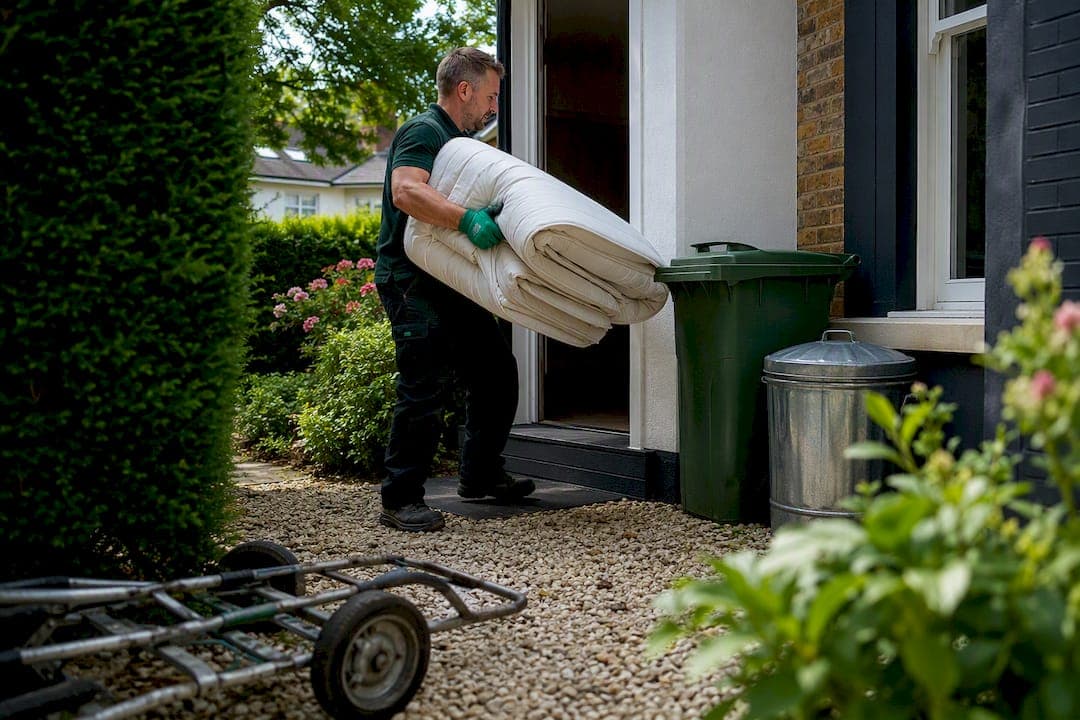
London residents have five realistic routes for getting rid of an old mattress: council bulky waste collection, a Household Waste Recycling Centre (HWRC) drop-off, charity donation, retailer take-back when buying new, or a private licensed waste carrier. Donate first if the mattress is clean and undamaged. If not, book your council or local tip for the cheapest legal option, or pay a licensed private collector when you need speed, guaranteed recycling, or same-day removal.
TL;DR:
- Most London council bulky waste collections have waiting times of up to two weeks and charge fees ranging from £10 to £60 depending on the borough.
- Self-transport to a Household Waste Recycling Centre is often free and quicker but requires proof of residency and access to a vehicle.
- Charities only accept mattresses that are clean, undamaged, and still display an intact fire-safety label, limiting reuse options.
- Retailer take-back services generally cost £20 to £55 and should be verified if the fee includes moving the mattress inside the property and if recycling is guaranteed.
- Using an unlicensed private waste carrier without confirming permits can lead to legal liabilities if the mattress is fly-tipped or improperly disposed of.
Table of Contents
- Mattress disposal options London: five routes compared
- How council collections and household recycling centres handle mattresses
- Charity donation and online rehoming: what actually qualifies
- Retailer take-back: what to ask before you buy a new mattress
- Choosing a legitimate private mattress recycler in London
- Preparing a mattress for collection or donation
- Duty of Care, licensing and what happens when a licensed carrier collects your mattress
- What happens to mattresses that can't be reused or recycled
- Cutting mattress waste before it becomes a disposal problem
- The mistake most guides get wrong about mattress disposal
- Book licensed mattress removal with LookDeVis Services
- Sources
- FAQ
Mattress disposal options London: five routes compared
Choosing between these five options comes down to three questions: how much time you have, whether the mattress is fit for reuse, and how much you're willing to pay. Here's how they stack up against each other.
- Council bulky waste collection: Booked online or by phone, typically costing a range of fees depending on the borough, with waits ranging from a few days to two weeks. Convenient if you're not in a hurry, but scheduling can be inflexible.
- HWRC (tip) drop-off: Free or low-cost for most residents who transport the mattress themselves. No waiting, but you need a vehicle and, in many boroughs, proof of local address.
- Charity donation or online rehoming: Free, and often includes a collection service, but only for mattresses that are clean, undamaged and carry an intact fire-safety label.
- Retailer take-back: Arranged when a new mattress is delivered, usually costing £20 to £55 depending on the retailer and mattress size. Convenient because someone else does the lifting.
- Private licensed waste carrier: The fastest route, often same-day, and the only one that reliably suits large volumes, difficult access, or mattresses in poor condition that charities won't touch.
None of these is universally "best". A mattress with damp patches or a broken frame isn't going anywhere near a charity shop, no matter how convenient that would be. A landlord clearing three flats before new tenants move in doesn't have time to book a council slot two weeks out. Match the route to your situation rather than defaulting to whichever one you've used before.
How council collections and household recycling centres handle mattresses
Every London borough runs its own bulky waste collection scheme, and the differences between them are bigger than most residents expect. Charges and service levels vary widely across the capital, with some councils charging as little as £10 for a mattress and others closer to £60, and a handful of offering free collections for residents on certain benefits. Booking slots can run from next-day to a fortnight out, so if you're on a tight deadline, check your borough's website before assuming this is the quick option.
HWRCs, commonly called tips, are usually the more flexible choice if you can transport the mattress yourself.
- Most London HWRCs accept mattresses free of charge for residents, though some require proof of address or a permit.
- Booking a slot in advance is compulsory at many sites, particularly since capacity limits were introduced.
- Mattresses dropped at council-run facilities are typically broken down into component materials for recycling rather than sent straight to landfill, and the NLWA reports around 98% material reuse at its contractor facility, with the remainder going to energy recovery rather than landfill.
If you only have one mattress and a car, the tip usually beats waiting for a council slot. If you're clearing several, or you don't drive, a booked collection makes more sense.
Charity donation and online rehoming: what actually qualifies
Charities won't take every mattress, and it's worth knowing the criteria before you call one. Reuse schemes typically require the mattress to be clean, undamaged, and to still carry its original fire-safety label — without that label, most charities can't legally resell it. Stains, tears, sagging, or a missing label rule out donation almost immediately.
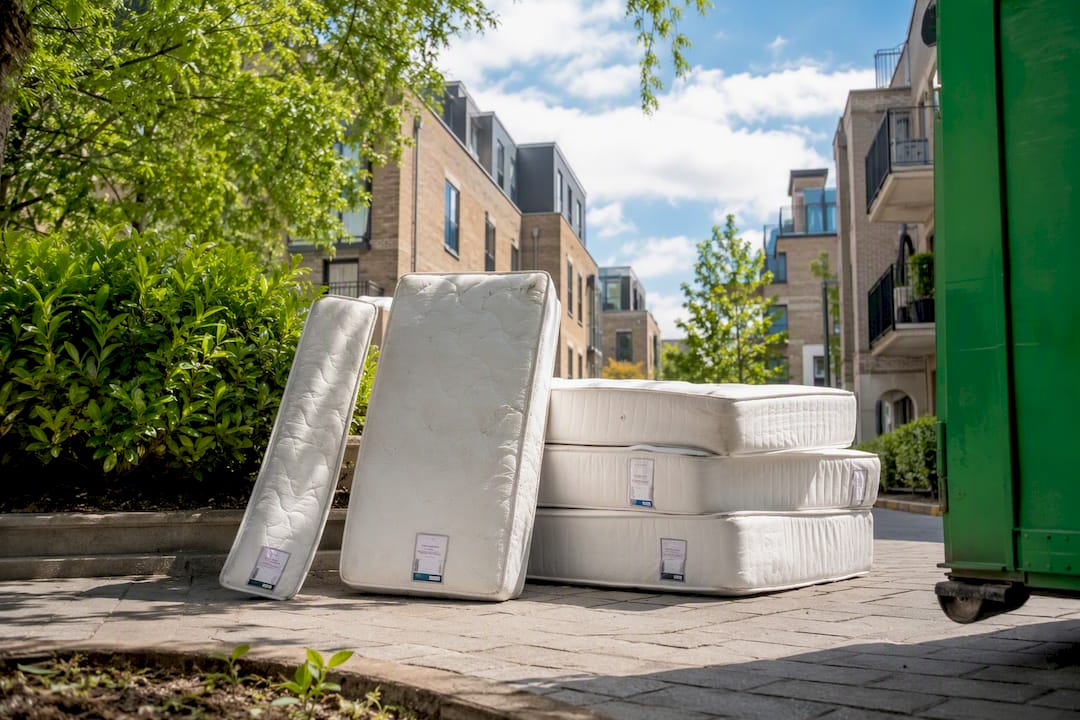
If your mattress qualifies, photograph it clearly from several angles and note the size, brand and approximate age when you contact a charity or list it online. Rules differ between organisations, so check with each one directly rather than assuming a national policy applies everywhere.
Avoid leaving a mattress outside your property "for whoever wants it." Unclaimed items left on pavements attract fly-tipping enforcement and rarely get collected the way donors expect. Arrange collection or drop-off directly instead.
Retailer take-back: what to ask before you buy a new mattress
Buying a replacement mattress is often the easiest moment to solve disposal. Many retailers offer to remove your old mattress when delivering the new one, with fees typically ranging from £20 to £55 depending on the company and mattress size.
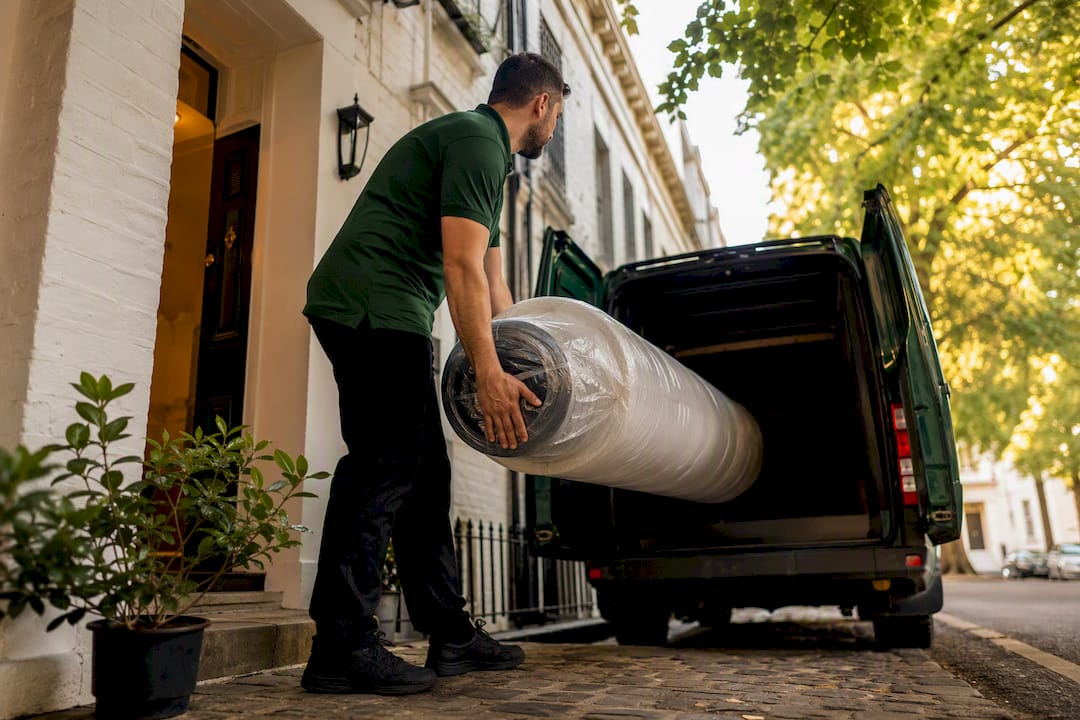
Before you pay, ask two questions: does the fee include carrying the old mattress out of the property, or just from your doorstep, and what happens to it afterwards? Some retailers guarantee recycling; others send old mattresses straight to landfill or energy recovery. If convenience matters more than anything else, this route wins, but it's worth confirming disposal practice rather than assuming it's handled responsibly.
Choosing a legitimate private mattress recycler in London
Paying for private collection is the fastest route, but it's also where most disposal problems happen. Anyone using a private waste business must check that company is a registered waste carrier and that the site it uses holds the correct permits or exemptions. Skip this check and you could be the one held responsible if your mattress ends up fly-tipped.
- Search the public register of waste carriers to confirm the company holds an upper-tier licence where required.
- Ask which facility the mattress goes to and whether it names a specific recycling contractor or permit holder.
- Request a transfer note or receipt as proof of legal disposal.
- Watch for red flags: cash-only payment, no paperwork, a vague or unverifiable business address.
Pro Tip: Ask the collector to name their recycling facility outright. A legitimate operator will tell you exactly where the mattress is going and can usually provide a permit reference on request.
Preparing a mattress for collection or donation
A few minutes of preparation avoids failed collections and awkward phone calls on the day.
- Strip all bedding and, if possible, vacuum or wipe down the mattress surface.
- Photograph any stains or damage, and check whether the fire-safety label is still attached and legible.
- Measure the mattress and confirm access routes, since most standard collections only cover ground-floor pickup unless you've specifically booked an in-home service.
- Never leave the mattress on a pavement before your collection slot; doing so risks a fly-tipping offence even if you've booked a genuine collection for later that day.
If you're on an upper floor without a lift, mention this when booking. Carrying a mattress down three flights of stairs takes longer and needs more hands than most collectors budget for by default.
Duty of Care, licensing and what happens when a licensed carrier collects your mattress
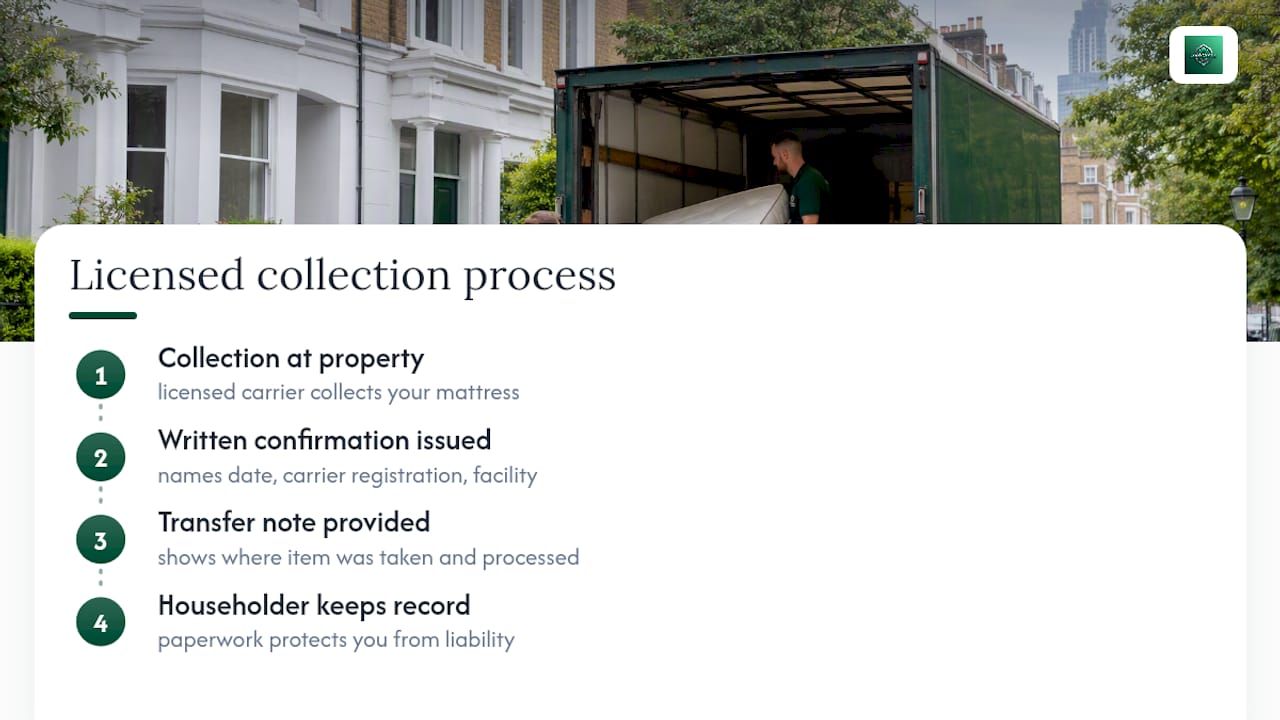
Duty of Care isn't just a phrase on a council website. It's a legal obligation that puts responsibility on the householder to ensure their waste ends up at a permitted site or with a licensed carrier, and failing to check can leave you liable if that waste is fly-tipped. Hiring the cheapest van you find on a classifieds site without asking a single question isn't a shortcut. It's a risk you're taking on personally.
LookDeVis Services operates as a registered waste carrier, fully insured, and provides a transfer note confirming where your mattress was taken and how it was processed. That paperwork is your protection.
When a licensed carrier collects your mattress, you should receive written confirmation naming the collection date, the carrier's registration details, and the facility the item was taken to. That record is what separates a legal disposal from a liability sitting quietly on your conscience.
What happens to mattresses that can't be reused or recycled
Not every mattress can be saved. Memory foam that's collapsed, springs that have rusted through, or a mattress soaked through with damp or mould won't pass a charity's inspection and may be too degraded even for standard mechanical recycling. Damp, mouldy or heavily stained mattresses are unlikely to be accepted for reuse, which pushes the outcome toward energy recovery rather than material recycling, and can sometimes increase the collection charge because more handling is involved.
Landfill restrictions across the UK have steadily reduced how much bulky waste can go straight into the ground, particularly for items like mattresses that take up disproportionate space and don't compress well. That's part of why council sites and private recyclers increasingly separate mattresses into foam, fabric, and metal springs rather than sending them whole to landfill, as facilities used by councils and the NLWA demonstrate.
For genuinely unrecoverable mattresses, energy-from-waste processing is usually the realistic endpoint rather than landfill. It's not the ideal outcome environmentally, but it's a considerably better one than an item sitting in the ground for decades. The practical takeaway is straightforward: the condition of your mattress when you dispose of it directly shapes what happens to it next, so anything you can do to keep it clean and dry during storage or waiting periods keeps more options open.
Cutting mattress waste before it becomes a disposal problem
The best disposal decision is often the one you make before the mattress becomes waste at all. A sagging mattress isn't automatically beyond saving. Flipping or rotating it regularly during its useful life slows uneven wear, and a mattress topper can extend comfortable use by a year or two without any structural repair.
Repair is worth considering for higher-value mattresses. A local upholsterer can sometimes replace a failed section of springs or restitch a torn seam far more cheaply than a full replacement costs, particularly on pocket-sprung or hybrid designs where only part of the structure has failed.
Repurposing has real limits, but it isn't nothing. Foam sections can become pet bedding, garden kneeling pads, or packing material for house moves. Fabric covers occasionally have a second life as drop sheets for decorating work. None of this eliminates the eventual need for disposal, but it delays it, and every year a mattress stays useful is a year it isn't adding to the estimated volume of bulky waste London's councils and HWRCs process annually.
The habit worth building is simple: check your mattress condition every six months or so, rather than waiting until it's visibly failing to think about what comes next.
The mistake most guides get wrong about mattress disposal
Most guides to mattress disposal treat this as a purely logistical question: which bin, which website, which fee. That framing misses the point. The real risk in London isn't picking the wrong disposal method. It's picking a collector without checking anything about them, because a van and a low quote look identical whether the driver is licensed or not.
The conventional advice to "just find someone cheap on a local listings site" is where most fly-tipping liability actually starts. Householders assume that once the mattress leaves their property, it's no longer their problem. Duty of Care law says otherwise, and that's the piece the mainstream guides tend to skate past in a single sentence.
What should change is the order of operations. Check the carrier's registration before you check the price. Ask for a transfer note before you agree a collection time. Those two habits cost you nothing and protect you completely, whereas skipping them can cost considerably more than the collection fee you were trying to save.
— Roman
Book licensed mattress removal with LookDeVis Services
Skipping the guesswork around registration checks and transfer notes is exactly what LookDeVis Services in London handles for you. As a registered waste carrier, fully insured and operating across Greater London, we collect mattresses directly from residential and commercial properties, including upper-floor flats where standard services often stop at the doorstep.

Booking is straightforward: you tell us the mattress condition, size and access, we confirm a fixed price with no hidden fees, and same-day or urgent slots are available depending on your location and our team's availability. Every collection comes with documented confirmation of where your mattress was taken, so you're never left wondering whether it was disposed of legally. This sits alongside our wider licensed waste removal services for households and landlords managing bigger clearances.
Call 07348 758581 or email lookdeviscompanylegal@gmail.com to arrange collection, or request a free quote through our waste removal page today.
Sources
- Gov
- Mattresses | NLWA
- How to dispose of a mattress | Which?
- How to dispose of a mattress, according to experts | The Independent
FAQ
How do I dispose of a mattress for free in London?
Charity donation is usually free if your mattress is clean, undamaged and has an intact fire-safety label. Most HWRCs also accept mattresses at no charge for local residents, though some require proof of address.
How much does mattress disposal cost in London?
Council bulky collections typically run a range of fees depending on the borough, while retailer take-back when buying new commonly costs £20 to £55. Private licensed collectors like LookDeVis Services can offer fixed quotes based on access and volume.
Can I take a mattress to the tip in London?
Yes, most London HWRCs accept mattresses, though many require you to book a slot in advance and show proof of local residency. Mattresses dropped off are usually separated into materials for recycling rather than landfilled.
What is the best way to get rid of an old mattress?
Donate it if it's clean, undamaged and has a fire-safety label attached. If it's not suitable for reuse, book a council collection, visit an HWRC, or hire a licensed private carrier such as LookDeVis Services for guaranteed legal disposal with paperwork to prove it.
Is it legal to leave a mattress on the street for collection?
No. Leaving a mattress unattended on a pavement or public space risks a fly-tipping offence, even if you intend for it to be collected later that day. Always arrange direct collection instead.