
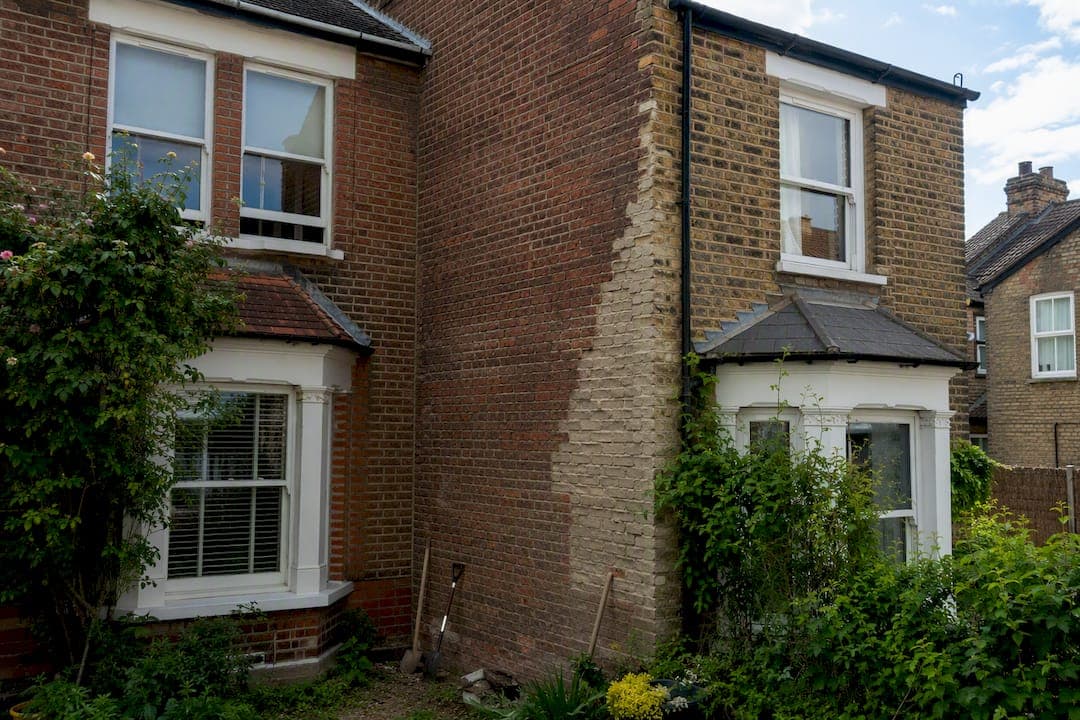
You must give written notice under the Party Wall etc. Act 1996 before doing structural work on or at the boundary, before altering a shared party wall, or before excavating close to a neighbour's foundations. If your project falls into any of those three categories, the Act applies, and you need to act before the diggers arrive, not after.
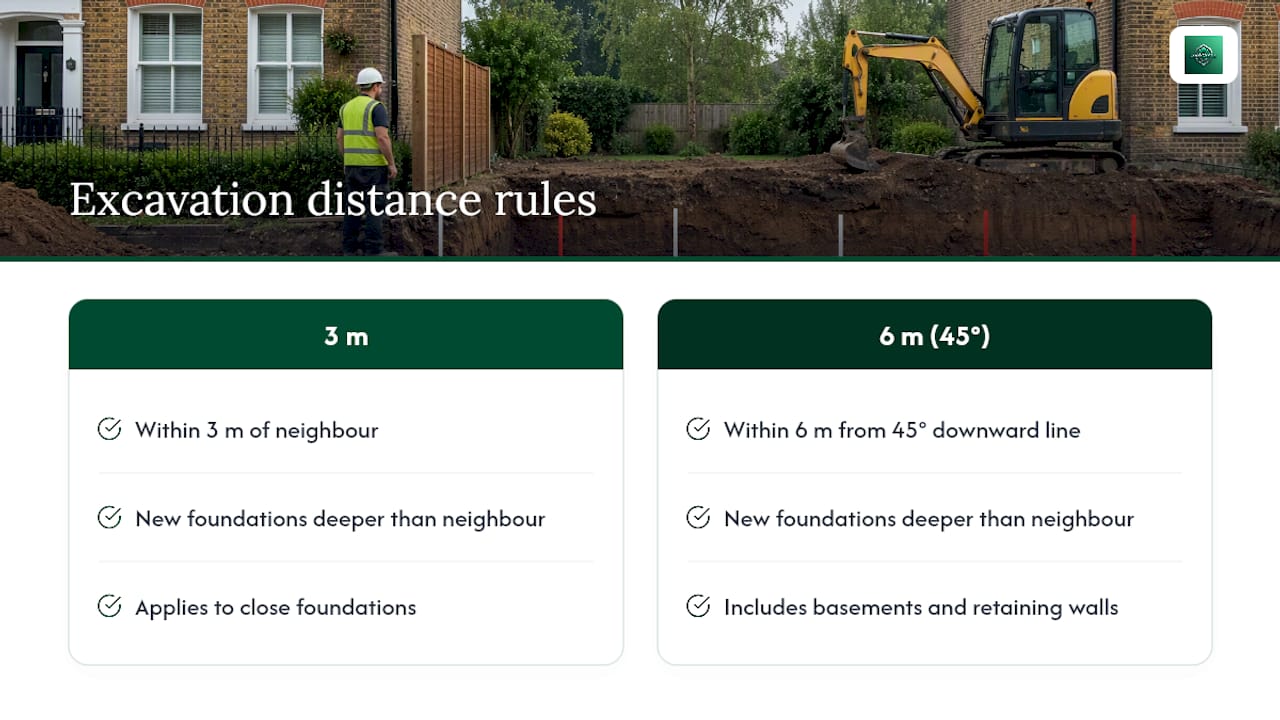
The rule of thumb is straightforward. Any structural work to an existing party wall or party structure, any new wall built on or astride the boundary line, and any excavation within 3 metres of a neighbour's foundations (if your new work goes deeper) or within 6 metres on a diagonal 45 degree line all trigger a notice requirement.
- Two months' notice is required before starting work to an existing party wall or party structure.
- One month's notice applies to new boundary walls and most qualifying excavation works.
- Your neighbour has 14 days to respond in writing, and silence counts as a dissent.
Statistic callout: A notice served under the Act stays valid for 12 months from the date it's given, but if you don't start work within that window, you'll need to serve it again. Miss the notice stage entirely and you risk an injunction stopping work mid-project, plus liability for any damage caused.
Your immediate next step is simple: work out which notice applies to your project, draft it properly, and serve it on every adjoining owner before you touch a brick. If your neighbour dissents or stays silent past 14 days, you'll need a party wall surveyor.
Key Takeaways
Compliance with the Party Wall etc. Act 1996 depends on correct notice type, statutory lead times, and documented evidence, not goodwill alone.
| Point | Details |
|---|---|
| Check the trigger | Works to a party wall, a new boundary wall, or nearby excavation all require written notice. |
| Match the notice type | Party structure notices need two months' notice; line of junction and excavation notices need one month. |
| Respond within 14 days | Silence or objection from a neighbour counts as a dissent and triggers the surveyor process. |
| Keep planning and party wall separate | Building regulations and planning permission do not replace the notice requirement, or vice versa. |
| Plan the practical side early | LookDeVis Services supports site surveys, waste removal, and groundworks once an Award allows work to proceed. |
Table of Contents
- What does the Party Wall Act cover?
- Which party wall notice do I need to serve?
- What happens if my neighbour dissents or doesn't reply?
- Who pays for a party wall agreement?
- Does party wall notice replace planning permission?
- How do I prepare and serve a party wall notice?
- How LookDeVis Services helps with party-wall-related projects
- Why the paperwork matters more than most homeowners assume
- Get help with the practical side of your project
- Sources
- FAQ
What does the Party Wall Act cover?
The Party Wall etc. Act 1996 applies across England and Wales, and it covers three distinct categories of work. Understanding which one applies to your project determines everything else, from which notice you serve to how long you need to wait before starting.
A party wall is a wall that stands on the land of two (or more) owners, forming part of a building, or a wall that separates two buildings belonging to different owners. Think of the shared wall between two semi-detached houses, or the internal wall dividing a pair of Victorian terraces. A party fence wall is different again: a freestanding wall (not part of a building) that sits astride the boundary, such as a garden wall separating two rear gardens. A party structure extends the concept further to cover shared floors and structures, such as the floor slab separating two flats in a converted building.
Everyday projects that trigger the Act
Most homeowners encounter the Act through one of a handful of common projects:
- Loft conversions that require new steel beams to bear on a party wall, or that raise the party wall to accommodate a dormer.
- Removing a chimney breast on a wall shared with a neighbour, even if you're only working on your side.
- Underpinning, thickening, or raising an existing party wall as part of an extension.
- Building a new wall right on the boundary line, or astride it, such as a garden wall or an extension wall.
- Cutting into a party wall to insert flashing, damp-proof courses, or supports.
- Excavating for new foundations, a basement, or trench footings near a shared boundary.
A loft conversion is one of the most frequent triggers homeowners encounter, precisely because the new floor loading and roof structure typically need support from the party wall itself. If you're planning a house extension that runs along or crosses a boundary, expect the Act to apply almost by default.
The excavation distance rules explained
Excavation is where many homeowners get caught out, because the Act doesn't only cover work to the wall itself. If you're digging new foundations within 3 metres of a neighbour's building and your new foundations will go deeper than theirs, notice is required. The distance extends to 6 metres if your excavation falls within a line drawn at 45 degrees downward from the bottom of the neighbour's foundations, as set out in the Act's explanatory booklet. This catches basement conversions, deep trench foundations for extensions, and even some garden landscaping work involving retaining walls built close to a boundary.
Which party wall notice do I need to serve?
Three notice types exist under the Act, and picking the wrong one, or missing the timing, can delay your project by weeks. Each notice type corresponds to a specific category of work, so the first task is matching your project to the right form.
- Party structure notice — required for work to an existing party wall or party structure, such as underpinning, raising, cutting into, or demolishing and rebuilding. This carries a two month minimum lead time before work can start.
- Line of junction notice — required when building a new wall on or astride the boundary line. This carries a one month minimum lead time.
- Notice of adjacent excavation — required for excavation work within the 3 metre or 6 metre thresholds described above. This also carries a one month minimum lead time in most cases.
Every notice must include your name and address as the building owner, a clear description of the proposed works, drawings or plans showing what's involved, and the proposed start date. For excavation notices, you'll also need to show the depth of the new foundations and their position relative to the boundary. If special foundations (using steel beams or reinforced concrete in ways that go beyond ordinary foundations) are involved, these must be specifically identified, since the adjoining owner has the right to object to special foundations even after otherwise consenting to the work.
Proof of service matters more than most homeowners realise. Sending a notice by recorded delivery, hand-delivering it and keeping a signed acknowledgement, or using a solicitor or surveyor to serve it on your behalf all create a paper trail that protects you if a dispute arises later. Email alone is riskier unless your neighbour has explicitly agreed to accept notices that way.
Pro Tip: Talk to your neighbour before the notice lands on their doormat. A quick conversation over the fence, explaining what you're planning and roughly when, defuses most objections before they become a formal dissent. Formal notice is still required by law, but it lands better when it's not a complete surprise.
Once served, a notice remains valid for a specified period. If your project slips beyond that window before work starts, you'll need to serve it again, so build a realistic margin into your programme rather than serving notice the moment planning permission lands.
What happens if my neighbour dissents or doesn't reply?
If your neighbour doesn't respond within 14 days of receiving a valid notice, the law treats that silence as a dissent, and a formal dispute is deemed to have arisen under section 10 of the Act. The same applies if they write back objecting. Either way, you can no longer simply proceed on your own terms. The Act's surveyor process takes over from here.
You have three routes to appoint a surveyor once a dispute exists:
- Agreed surveyor — you and your neighbour jointly appoint a single, impartial surveyor to act for both of you. This is usually the fastest and cheapest route.
- Two surveyors — each party appoints their own surveyor, and those two surveyors then select a third surveyor as a fallback.
- Refusal to appoint — if your neighbour refuses to name a surveyor, you can serve a further notice, and after 10 days, appoint one on their behalf.
Statistic callout: RICS guidance sets out that whichever route is taken, the surveyor (or surveyors) must act impartially, even when appointed and paid for by one side. An agreed surveyor doesn't work for you; they work for the Act.
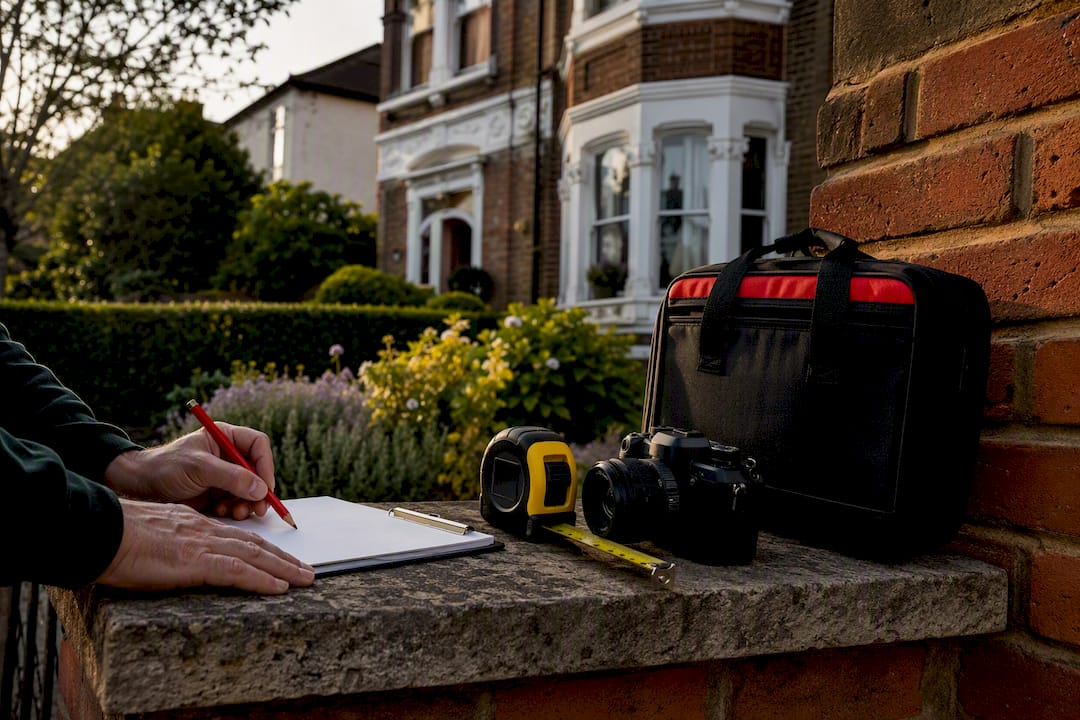
Once appointed, surveyors carry out a schedule of condition, a detailed photographic and written record of the adjoining property before work starts, which protects both sides against later disputes over what caused any damage. They then produce a Party Wall Award, the legally binding document that sets out what work can be done, when, how, and what safeguards must be in place, such as working hours, access arrangements, and protective measures to the neighbour's property.
Timescales vary with complexity, but straightforward domestic Awards, such as those for loft conversions or single-storey extensions, typically take a few weeks from surveyor appointment to a signed Award, assuming both surveyors are responsive. More complex or contested cases involving structural engineers, deeper excavations, or multiple adjoining owners can run considerably longer.
The Award also allocates who pays for what, and it can require the building owner to pay the adjoining owner's reasonable surveyor fees. Crucially, an Award isn't the final word if either party genuinely disagrees with it: either owner can appeal to the county court within 14 days of the Award being served. Miss that window, and the Award becomes binding and enforceable.
Who pays for a party wall agreement?
As a general rule, the building owner, the person carrying out the work, pays for it. This covers the surveyor's fees (yours and, in most cases, your neighbour's), any remedial repairs needed if the work causes damage, and reasonable costs the adjoining owner incurs in protecting their own property during the works.
There's an important exception. Where works genuinely benefit both properties, such as rebuilding a party wall that's failing structurally on both sides, costs can be apportioned between the two owners according to use and benefit. This doesn't happen automatically; it's something the surveyor addresses as part of the Award, based on the specific circumstances.
Typical cost elements to budget for include:
- Your own surveyor's fees, whether acting alone or as part of an agreed surveyor arrangement.
- The adjoining owner's surveyor fees, which you'll usually be liable for if a dispute arises.
- Costs of a schedule of condition survey, often the cheapest form of protection you can buy.
- Temporary protection measures to the neighbour's property, such as covering, propping, or weatherproofing during works.
- Any making good required after completion, from an Award's "in accordance with the Act" repair obligations.
Pro Tip: Get a written estimate from your builder before serving notice, and share the broad scope with your neighbour early. Nothing sours a party wall relationship faster than a neighbour discovering the scale of work only after the notice arrives. Where possible, propose an agreed surveyor rather than two separate ones; it's almost always cheaper and quicker for straightforward domestic projects.
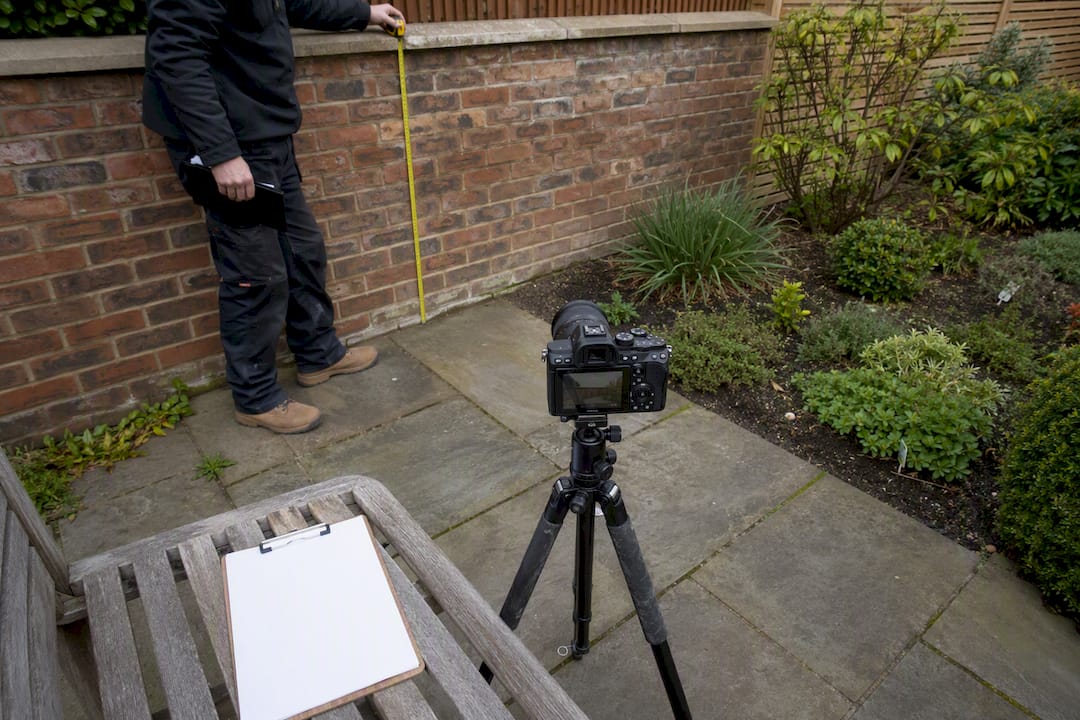
Photographic condition records, taken before work starts and shared with your neighbour, are one of the cheapest forms of insurance available to you. They remove ambiguity about what damage, if any, existed before your builders arrived, which is exactly the kind of dispute that drags out and adds unplanned surveyor time.
Does party wall notice replace planning permission?
No. Complying with the Party Wall etc. Act does not remove your obligation to secure planning permission or satisfy building regulations, and the reverse is equally true: having planning permission or a building regulations sign-off does not exempt you from the party wall notice process. GOV.UK is explicit that these are separate legal regimes that happen to apply to many of the same projects.
A loft conversion is the clearest example. You may need planning permission (or rely on permitted development rights), building regulations approval for structural work and fire safety, and a party wall notice for the beams bearing on the shared wall, all for the same job. Missing any one of the three creates a separate legal problem, regardless of how well you've handled the other two.
The practical sequence that avoids delays runs like this:
- Confirm planning status first, since it shapes the design and may take the longest.
- Contact your local authority's building control team early, ideally at the design stage, so structural and fire requirements are baked in before drawings are finalised.
- Serve your party wall notice once drawings are settled enough to describe the works accurately, factoring in the one or two month statutory lead time.
- Build these lead times into your project programme from the outset rather than treating notice as a formality to sort out once builders are booked.
Property owners who leave party wall notice to the last minute, assuming building regulations approval covers it, are the ones who end up with a stalled start date.
How do I prepare and serve a party wall notice?
Getting this right from the outset saves weeks further down the line. Follow this sequence in order, and don't skip the documentation steps even when your neighbour seems relaxed about the project.
- Establish whether the Act applies. Match your project against the three trigger categories: work to an existing party wall, a new wall at the boundary, or excavation within the statutory distances.
- Identify the correct notice type. A party structure notice, line of junction notice, or notice of adjacent excavation, depending on the work.
- Prepare your documents. You'll need clear plans or drawings, a proposed start date, and, where relevant, particulars of any special foundations.
- Draft the notice itself, including your details as building owner, a full description of the works, and the relevant plans.
- Serve the notice with proof. Use recorded delivery, hand delivery with a witness, or a solicitor or surveyor acting on your behalf.
- Commission a schedule of condition for the adjoining property before work starts, ideally with photographs dated and shared with your neighbour.
- Wait for the response window to close. Fourteen days for consent, dissent, or silence (which counts as dissent).
- If consent is given in writing, proceed once the statutory lead time (one or two months) has passed.
- If dissent occurs, appoint a surveyor (agreed, or one each) and await the Award before starting work, unless your neighbour gives separate written agreement to proceed sooner.
Pro Tip: Keep every piece of correspondence, every drawing revision, and every date in one file from day one. When surveyors get involved, the first thing they ask for is a clear paper trail, and homeowners who've kept one save real time and surveyor fees compared with those reconstructing events from memory.
Budget realistically for surveyor involvement even if you expect your neighbour to agree. A modest contingency for an agreed surveyor's fee is far cheaper than discovering, three weeks into a stalled project, that you need one urgently.
How LookDeVis Services helps with party-wall-related projects
Once your notice has been served and, where needed, an Award is in place, the practical work of preparing a site and carrying out permitted building work begins. This is where LookDeVis Services fits in. We don't provide legal party wall advice, and we'd always recommend a qualified party wall surveyor for anything statutory. What we do handle is the practical groundwork that surrounds these projects.
Our teams across Greater London support party-wall-related projects with:
- Site surveys and photographic condition records to support the schedule of condition process before works start.
- Licensed waste removal for clearance before, during, and after building work, fully compliant with waste carrier obligations.
- Temporary protection measures for boundary structures and neighbouring property during works.
- Hard landscaping and groundworks, including boundary and retaining wall rebuilding, once an Award permits work to proceed.
- Building refurbishment, loft conversions, and extension support once statutory approvals are confirmed.
We schedule our work around the access arrangements, working hours, and protective conditions set out in a Party Wall Award, coordinating directly with the surveyor's requirements rather than working around them. That matters in practice, because an Award will often specify exactly when and how work can happen near a boundary, and a contractor who doesn't respect those terms can put the whole agreement at risk.
| Point | Details |
|---|---|
| Statutory advice | LookDeVis does not provide party wall legal advice; a qualified surveyor handles the statutory process. |
| Practical support | Site surveys, condition records, and licensed waste removal are available once works are permitted. |
| Scheduling | Work is planned to match Award conditions on access, hours, and protective measures. |
If you're preparing a site for work covered by a Party Wall Award, get in touch on 07348 758581 or lookdeviscompanylegal@gmail.com for a free quote.
Why the paperwork matters more than most homeowners assume
The conventional advice on party wall compliance treats it as a box-ticking exercise: serve the notice, get the signature, move on. That undersells what the Act is actually doing. It's a deliberately procedural mechanism designed to head off litigation before it starts, by forcing both sides through notice, response windows, and impartial surveyor scrutiny rather than leaving disputes to fester until someone calls a solicitor.
Where homeowners go wrong most often isn't ignorance of the Act; it's underestimating the schedule of condition. People fixate on the notice period and forget that a decent photographic record, taken before a single brick moves, is the cheapest protection available and the thing that actually prevents disputes escalating to an Award appeal. Good early neighbour conversation matters too, but it's not a substitute for the paperwork; it just makes the paperwork land better.
Prioritise documentation and honest early conversation over speed. Serving notice a fortnight sooner rarely matters. A missing condition record when a crack appears six weeks later matters enormously.
— Roman
Get help with the practical side of your project
Handling a party wall notice yourself, or through a surveyor, is only half the job. The other half is the physical work: clearing a site, protecting a boundary, and carrying out the build once your Award is signed off, and that's where a lot of homeowners find the process stalls simply because no one has lined up a reliable team for the practical stage.

LookDeVis Services is fully insured, licensed for waste carrying, and used to coordinating with party wall surveyors rather than working around their conditions. We handle the site survey and photographic record that feeds into a schedule of condition, clear waste under proper licensed disposal, and carry out the hard landscaping and groundworks or refurbishment work once your Award permits it, scheduled to the access hours and protective measures the Award specifies rather than a generic build timetable. We serve Greater London and the surrounding areas, so if your project sits within that footprint, we can typically get a team to you.
To be clear: we don't give legal party wall advice, and for the notice itself or any dispute, you'll still need a party wall surveyor. What we handle is everything practical around that process. If you're at the stage of preparing a site or planning the build once notice is served, request a free quote for garden and groundworks support and we'll talk through timing against your Award conditions.
Sources
Four sources cover almost everything a homeowner needs to check before serving notice or appointing a surveyor.
- The Party Wall etc. Act 1996: explanatory booklet
- RICS party wall legislation and procedure (professional standard)
FAQ
What can I do if my neighbour builds without a party wall agreement?
You can apply to court for an injunction to halt the work, and you may be entitled to compensation for any damage caused. Contact a party wall surveyor promptly, since acting quickly strengthens your position considerably.
How do I get a party wall agreement in the UK?
Identify the correct notice type for your project, serve it on your neighbour with proof of delivery, and wait for the 14 day response window. If they consent in writing, you can proceed after the statutory lead time; if they dissent or stay silent, a surveyor produces a binding Award.
Can I sell a house without a party wall agreement?
Yes, selling is legally possible without one, but unresolved party wall issues can complicate a sale, since buyers' solicitors often ask whether any notifiable works were carried out and whether proper notice was served. Outstanding disputes or missing documentation can delay completion or affect a buyer's mortgage offer.
What happens if a neighbour breaks a party wall agreement?
Breaching the terms of a Party Wall Award is a breach of a legally binding document, and the affected party can seek enforcement through the county court. This can include an order to comply with the Award's conditions or a claim for damages caused by the breach.