
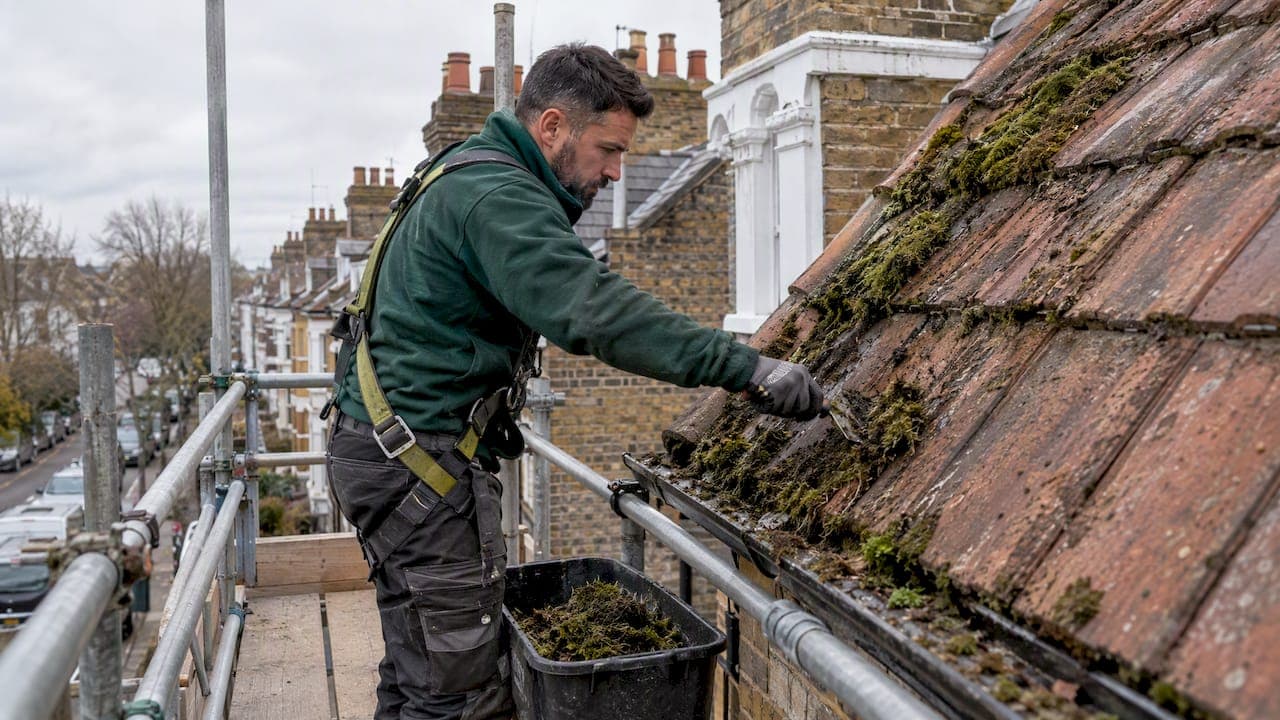
For moss, algae and stains on pitched roofs, hire a professional, insured roof cleaning team. Soft wash or manual removal is usually the safest method, while pressure jetting is rarely the right choice for tiles or slate. We offer free surveys and quotations for roof cleaning across Greater London, and can advise on the right approach for your property.
TL;DR:
- Slate roofs need soft washing or steam rather than scraping, while pressure can strip the protective granules from asphalt shingles.
- Before anyone accesses the roof, request a written safety plan covering fall protection, access equipment, and fragile sections, not verbal assurances.
- If a contractor removes moss or debris, verify its waste carrier registration number, which should begin with CBDU, before work starts.
- Most domestic roof cleans finish within one day, while scaffold setup or extensive manual removal can extend the job to two or three days.
- Get the method, materials, and total price in a written quote, and avoid paying a large deposit before the scope is agreed.
Table of Contents
- Why roof cleaning matters for appearance, longevity and drainage
- Soft wash, manual removal and why pressure washing is usually avoided
- Safety and legal duties: HSE guidance and the waste duty of care
- Typical costs and job timeframes for roof cleaning
- How to choose a roof cleaning company in London
- Why we're a practical choice for Greater London roof cleaning
- Preparing your property before roof cleaning begins
- What to check after the job and how to keep your roof clear
- How London properties have approached roof cleaning projects
- Keeping health and safety standards high on every visit
- Matching the cleaning approach to your roof's material
- Environmental considerations and eco-friendly treatment options
- A property manager's quick action plan
- Book a free quote or site survey with us
- FAQ
- Sources
Why roof cleaning matters for appearance, longevity and drainage
Moss and algae do more than mark the surface of your roof. They trap moisture against tiles and slates, and that trapped damp raises the risk of cracking, frost damage and slow leaks into the loft space below.
A clean roof lifts a property's kerb appeal immediately, which matters whether you are selling, letting or simply enjoying your home. Beyond looks, removing growth protects the building fabric and keeps water moving off the roof the way it was designed to.
Roof cleaning pays off in several practical ways:
- Reduces moisture retention that leads to cracked or lifted tiles
- Clears blocked valleys and gutters caused by moss build-up
- Lowers the likelihood of costly repairs further down the line
- Improves kerb appeal ahead of a sale, letting or valuation
For landlords and property managers, roof cleaning fits naturally into a wider maintenance cycle alongside gutter clearance and tree pruning, since all three affect how much debris lands back on the roof.
Soft wash, manual removal and why pressure washing is usually avoided
Professional roof cleaners generally choose between a small number of proven methods, depending on the roof type, the extent of growth and how fragile the surface is.
- Soft washing applies a regulated biocide solution at low pressure, killing moss and algae at the root rather than just stripping the surface; the treatment typically keeps regrowth at bay for a reasonable period before a top-up is needed.
- Manual removal uses scrapers and brushes to lift heavy moss clumps by hand, often followed by a soft wash to treat remaining spores.
- Steam cleaning suits delicate or older tiles where chemical treatment is unsuitable, loosening grime without soaking the roof structure.
High-pressure jet washing is usually avoided on pitched roofs because the force can dislodge tiles, strip protective granules from asphalt shingles, or drive water under the roof covering. A professional might use light pressure washing only on specific, robust surfaces such as certain flat roof coatings, and only after assessing the material's condition.
Pro Tip: Ask your contractor which method they plan to use and why, rather than assuming a pressure washer is the default tool for every roof.
Partner guidance on removing moss without causing damage sets out similar reasoning for homeowners wanting to understand the mechanics before booking a job.
Safety and legal duties: HSE guidance and the waste duty of care
Roof work carries serious risk, and the HSE's guidance on roof work highlights falls through fragile materials as a major cause of death and injury. Any roof cleaning job should be planned carefully, not treated as a quick add-on to other tasks.
A competent contractor plans the job before anyone accesses the roof edge. This includes a documented safe system of work, not a verbal assurance on the day.
Before work starts, you should expect a contractor to:
- Provide a written plan covering access, equipment and fall protection
- Confirm whether scaffolding, a MEWP or roof ladders will be used
- Show valid public liability insurance before work begins
- Explain how they identify and avoid fragile roof sections
Waste matters too. Under the waste duty of care code of practice, if a contractor removes moss, debris or old materials from your property, you should check they are an authorised waste carrier. Registered carrier numbers starting with "CBDU" help verify this and asking for this number before work starts is a simple way to reduce liability risk if waste is improperly disposed of.
Typical costs and job timeframes for roof cleaning
Costs vary with roof size, pitch, access and how heavily moss or algae has established itself. A straightforward soft wash on a semi-detached house will generally cost less than a job requiring scaffold access or extensive manual scraping.
Several factors tend to push the price up:
- Difficult access, such as steep pitches or terraced rows with limited side access
- The need for scaffold or a mobile elevating work platform rather than ladders
- Total roof area and the number of separate roof sections or valleys
- Severity of moss and algae growth, which affects treatment time
Most domestic roof cleans are completed within a single day, though properties needing scaffold erection or extensive manual removal may run over two or three days. For related cost context on moss removal specifically, our guide to roof moss removal costs in London sets out indicative price bands for different roof sizes.
Before booking, Citizens Advice guidance on home improvements recommends getting a written quote and avoiding large deposits upfront. A reputable contractor will agree the scope of work in writing before requesting any payment.
How to choose a roof cleaning company in London
A short checklist makes comparing quotes far easier, especially when prices and promises vary between contractors.
- Ask for a written quote that sets out the method, materials and total price.
- Request proof of public liability insurance covering the specific job.
- Check their approach to working at height, including whether they use a MEWP, scaffold or roof ladders with proper edge protection.
- Confirm their waste carrier registration number if they are removing moss, debris or old materials.
- Ask to see examples of previous roof cleaning work in London, ideally on a similar roof type.
Beyond the paperwork, ask a few direct questions: which method they plan to use, whether a biocide treatment is included and how long it should last, and who is responsible for removing and disposing of the waste.
Pro Tip: Treat a contractor's reluctance to share insurance or waste carrier details as a reason to keep looking, not a detail to chase up later.
Watch for red flags such as no written quote, pressure to pay the full amount in cash upfront, or vague answers about where waste ends up. These are the same signals that apply across most home improvement trades, from waste removal through to larger refurbishment work.
Why we're a practical choice for Greater London roof cleaning
We bring insured teams, licensed waste handling and professional equipment to roof cleaning jobs, covering the checklist above in a single booking rather than several separate checks.
Our process starts with a site survey to assess roof type, access and the extent of moss or algae before quoting. Every job comes with a written quote setting out scope and price, and teams remove moss and debris through proper waste channels rather than leaving it for you to arrange separately.
Because gutter clearance, tree pruning and general garden maintenance are often involved, roof cleaning can be scheduled alongside the work that actually causes regrowth, such as overhanging branches shedding debris onto the roof. That coordination is explained further in our piece on hiring one insured team for garden maintenance and clearance.
What this means in practice for a booking:
- One contractor for roof cleaning, gutters and surrounding garden work
- A waste carrier handling moss, debris and old materials
- Appointments available subject to location and team availability
Preparing your property before roof cleaning begins
A little preparation on your side makes the job quicker and reduces the chance of mess or disputes afterwards.
Move garden furniture, potted plants and any delicate items away from the base of walls where ladders or scaffold will stand. If you have a car parked on a driveway directly below the roofline, it is worth relocating it for the day, since soft wash runoff and loosened moss will fall during the work.
Letting neighbours know is good practice, particularly in terraced streets or close-set housing common across London. Scaffold or a MEWP positioned near a shared boundary can affect access to a neighbour's garden or driveway for a day, and a short conversation beforehand avoids any awkwardness on the day itself.
Inside the property, it helps to mention any known loft access points or skylights to the contractor in advance, since these affect how they plan their route across the roof and where they will avoid stepping. If you have solar panels, satellite dishes or aerials fitted, flag these too, as they influence which sections need extra care during soft washing or manual removal.
Finally, check whether your property is in a conservation area or has any listed status, since this can occasionally affect what materials or methods a contractor should use on visible roof surfaces. A competent team will ask about this during the survey, but it helps to have the answer ready.
What to check after the job and how to keep your roof clear
Once the work is finished, walk the perimeter of the property and look up at the roofline from several angles rather than relying on a single view from the front door. Check valleys, ridge lines and any flat sections for leftover debris, and confirm gutters are running clear rather than clogged with dislodged moss.
Ask your contractor to confirm what treatment was applied and roughly how long it should keep regrowth at bay, since this varies with roof orientation, surrounding trees and local weather exposure. A north-facing roof shaded by trees will generally need attention sooner than a south-facing one that dries out quickly after rain.
Simple ongoing steps help maintain the result:
- Keep overhanging branches trimmed back to reduce shade and falling debris
- Clear gutters at least once or twice a year to stop standing water near the roofline
- Have a visual check done after major storms to catch any dislodged tiles early
Bundling a roof clean with regular gutter clearance and tree pruning is a practical way to extend the time before moss and algae re-establish themselves, since both debris and shade are major contributors to regrowth.
How London properties have approached roof cleaning projects
Property conditions vary enormously across Greater London, from Victorian terraces with steep slate roofs to 1930s semis with clay tiles and newer builds with concrete tiles or flat roof sections. Each presents a different combination of access and growth pattern, and the right approach reflects that rather than applying one method everywhere.
Terraced rows with limited side access often need careful planning around scaffold placement and neighbouring properties, while detached houses with more open access can sometimes be treated with ladders and a MEWP instead of a full scaffold. Properties overshadowed by mature trees, common in leafier parts of the city, tend to show heavier moss growth on north-facing slopes and benefit from scheduling tree pruning alongside the roof clean itself.
For landlords managing several properties across different boroughs, the common thread is coordinating roof cleaning with other exterior maintenance so visits are efficient rather than piecemeal. A survey at the start of a tenancy change, paired with garden clearance and waste removal, often reveals roof issues that would otherwise go unnoticed until a leak appears.

Keeping health and safety standards high on every visit
Professional roof cleaning teams should maintain sensible hygiene and safety practices on every job, not just when working at height. This includes keeping access routes tidy, using appropriate protective equipment for handling biocide treatments, and briefing anyone on site about where work is taking place that day.
Clear communication before a visit, confirming arrival times and any access requirements, helps reduce unnecessary contact and keeps the job running smoothly for both the property owner and the team on site. Where a property is occupied by vulnerable residents or young children, it is reasonable to ask the contractor how they plan to manage noise, equipment storage and site safety during the visit.
Good practice extends to equipment too: biocide products and cleaning solutions should be stored and applied according to manufacturer guidance, with care taken around guttering, downpipes and nearby planting to avoid unintended runoff into drains or soil.
Matching the cleaning approach to your roof's material
Greater London's housing stock includes a mix of roofing materials, and each responds differently to cleaning.
Clay and concrete tiles, common on Victorian and interwar housing, generally tolerate soft washing well and respond to manual scraping for heavy moss clumps. Slate roofs, found on many older terraces, are more delicate and usually call for soft washing or steam rather than any scraping, since the surface can chip.
Asphalt shingles, seen on some flat or low-pitch extensions, need particularly gentle treatment, as high pressure strips the protective granules that shield the material from UV damage. Flat roofs with felt or single-ply membrane coverings are sometimes suited to light pressure washing on robust sections, but only once a contractor has confirmed the membrane's condition.
Given this variation, a proper survey before work starts matters more than any fixed formula. What suits a slate roof in Islington may be entirely wrong for a concrete-tiled roof in Uxbridge, and a competent contractor will adjust the method rather than running the same process on every job.
Environmental considerations and eco-friendly treatment options
Biocide treatments used in soft washing are designed to be applied at controlled, regulated concentrations, and responsible contractors follow manufacturer guidance to limit runoff into drains, soil and nearby planting. Covering or redirecting downpipes during treatment, and avoiding application during heavy rain, are both sensible steps that limit how much product reaches watercourses.
For gardens and borders close to the roofline, it is worth asking your contractor how they plan to protect plants during treatment, particularly if you keep edible crops or have ponds nearby. Steam cleaning and manual removal, while more labour-intensive, offer a chemical-free alternative where chemical treatment is unsuitable or unwanted.

Choosing a contractor who can explain their product choice and application method, rather than treating it as a standard step they do not discuss, is a reasonable way to gauge how seriously environmental impact is taken on a job.
A property manager's quick action plan
If you manage rental or commercial properties, act on roof moss and algae before it becomes a tenant complaint or an insurance headache. Inspect the roofline during routine visits, book a survey as soon as growth becomes visible, and request three written quotes to compare method, price and waste handling.
Check each contractor's insurance and waste carrier registration before signing anything, and schedule the roof clean alongside gutter clearance or tree pruning to reduce repeat visits. Get the agreed scope and safe system of work in writing before authorising anyone onto the roof.
— Roman
Book a free quote or site survey with us
We provide free site surveys and written quotations for roof cleaning across Greater London, covering everything from a single terraced roof to larger managed portfolios.

Our teams work as licensed waste carriers and fully insured specialists, so moss, debris and old materials are removed properly rather than left for you to sort out. Same-day and urgent appointments may be available depending on your location and the scope of work.
- Request a survey before committing to a method or price
- Combine roof cleaning with pressure washing for driveways and patios in one visit
- Pair the clean with licensed waste removal for debris and old materials
Get in touch for a free quote and we will arrange a survey at a time that suits you.
FAQ
How much does it cost to clean a house roof?
Costs depend on roof size, pitch, access and how established the moss or algae growth is, with scaffold or MEWP access pushing prices higher than a straightforward ladder-access job. Our roof moss removal cost guide for London sets out indicative price bands based on typical roof sizes and access conditions.
What time of year is best for roof cleaning?
Drier, milder periods in spring or autumn tend to suit roof cleaning best, since biocide treatments need dry conditions to work effectively and extreme heat or frost can affect application. Avoiding the depths of winter also reduces the safety risks associated with wet or icy roof surfaces during access.
How often should gutters be cleaned?
Most properties benefit from gutter clearance at least once or twice a year, with more frequent checks needed near mature trees that shed heavily in autumn. Pairing gutter clearance with a roof clean helps catch moss or debris build-up before it causes blockages.
Should I jet wash my roof tiles?
High-pressure jet washing is usually avoided on roof tiles because the force can dislodge or crack them, strip protective coatings, or force water under the covering. Soft washing or manual removal is generally the safer, more widely recommended approach for pitched tiled roofs.
What should I check before hiring a roof cleaning contractor?
Ask for a written quote, proof of public liability insurance, and their waste carrier registration number if they are removing debris, in line with Citizens Advice guidance on home improvements. It is also worth confirming how they plan to work safely at height before any work begins.
Sources
Recommended
- London Six Point Compliance Checklist for Skip Hire or Rubbish Removal
- 9 step waste duty of care checklist for London businesses & landlords
- Avoid Prosecution: 4 Waste Transfer Steps for UK Builders
- Five minute landlord checklist for licensed waste disposal in the UK
Prices, timescales and information provided in this article are for general guidance and may vary depending on the property, site conditions, materials and scope of work. Please contact LookDeVis Services for an individual assessment and quotation. Where regulatory, planning or legal requirements apply, appropriate professional advice should be obtained.