
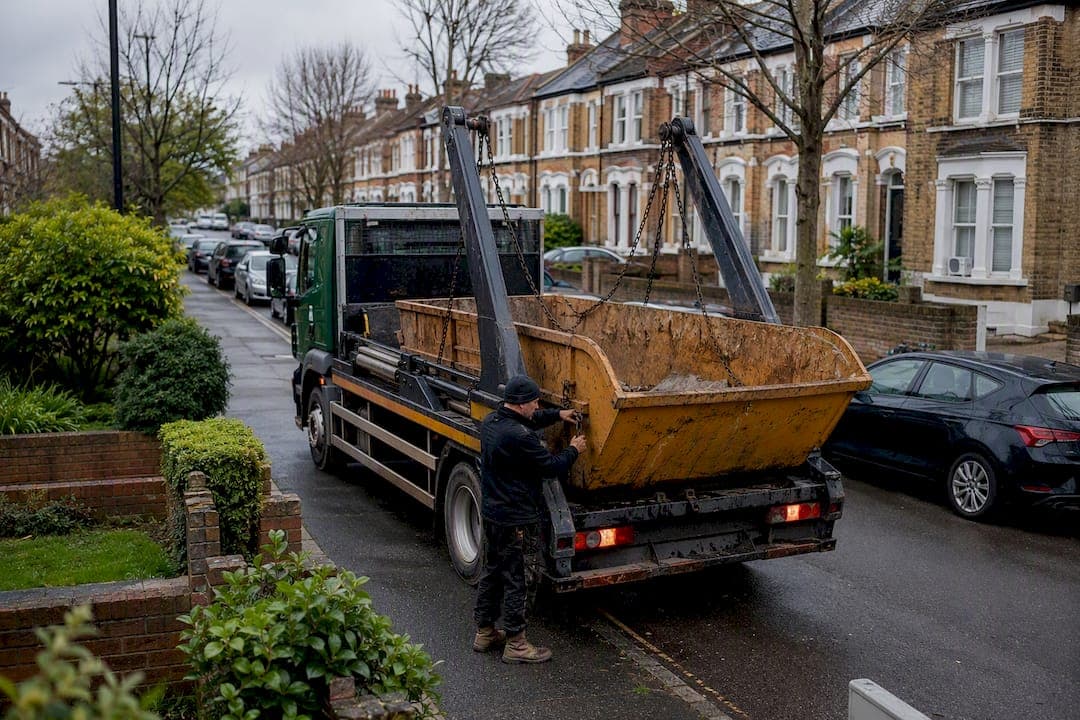
A week-long skip hire in London typically costs between £120 for a small mini skip and £450 or more for a large builders skip, with a typical figure around £290 for a standard household job using a midi or builders skip. That's roughly 30% above the UK average, driven by borough permit fees, tighter access and higher disposal costs at London waste sites.
Before you book anything, work out one thing: will the skip sit on private land (your driveway, front garden) or does it need to go on the road? That single question determines whether you need a council permit, and permits are where most quote surprises come from.
- Mini skip (2 to 3 yards): from £120 a week
- Midi skip (4 to 5 yards): from £180 a week
- Builders skip (6 to 8 yards): from £250 to £450 a week
- Large skip (10+ yards): often needs a permit and specific council sign-off
Quick fact: London's typical weekly skip hire price sits around £290, against a UK-wide typical of roughly £220. Get a written quote that separates the skip hire fee from any permit or disposal surcharge before you commit.
Key Takeaways
| Point | Details |
|---|---|
| Typical London price | Expect £120 to £450+ per week depending on skip size, with £290 a fair median for a standard job. |
| Permits depend on placement | A road-based skip needs a borough permit, typically £20 to £165, while driveway skips need none. |
| Weight matters more than volume | Dense waste like rubble fills the weight limit long before the skip looks full, triggering overweight fees. |
| Book ahead for road permits | Councils usually need 3 to 7 working days to process a permit application. |
| Get itemised written quotes | Confirm permit inclusion, waste type charges and overweight policy before booking. |
Table of Contents
- Skip prices London: cost by size
- What affects your skip hire quote in London
- Skip permits in London: when you need one and what they cost
- Extra charges that catch people out
- How skip hire is charged: daily, weekly and extensions
- Choosing the right skip size for your job
- Ways to cut your skip hire costs in London
- What to tell your skip supplier before booking
- Sample cost scenarios for typical London jobs
- Where to check permit rules and pricing
- Why the permit, not the skip, is where the real cost sits
- Sources
- FAQ
Skip prices London: cost by size
Picking the right size is the single biggest lever on your final bill, more than which supplier you choose. Order too small and you'll pay for a second skip or an overfill charge. Order too large and you're paying for capacity you never use.
Here's how the main sizes stack up for a typical London job, based on current market pricing and size-banded cost data:
A mini skip holds roughly the equivalent of 30 to 40 bin bags, which suits a small garden tidy-up, a single-room strip-out, or clearing a shed. A midi skip fits a kitchen or bathroom refit, including old units and tiling. Builders skips are the workhorse size for loft clearances, small extensions, and general renovation rubble. Large skips tend to be reserved for full house clearances or bigger construction sites, and they almost always require a road permit because of their footprint.
- Mini: garden waste, small DIY jobs, single-room clearances
- Midi: kitchen or bathroom strip-outs, medium garden clearances
- Builders: loft clearances, extensions, mixed renovation waste
- Large: full house clearances, multi-room refurbishments, small building sites
Pro Tip: Weight limits catch more people out than size limits. Most skip firms cap weight per skip size (commonly around one tonne for a mini skip), and going over triggers an automatic overweight charge regardless of how full the skip looks. If your job involves heavy waste like soil, rubble or tiles, it's often cheaper to book one size up than to risk an overweight fee on a smaller skip.
Denser materials, hardcore, soil, bricks, plasterboard, fill the weight allowance long before they fill the visible space in the skip. A builders skip full of garden waste and old furniture might weigh next to nothing, while the same skip half-filled with rubble could already be over its limit.
What affects your skip hire quote in London
Two identical-looking jobs on paper can produce very different quotes once you factor in these five drivers.
- Skip size and weight allowance: larger skips and higher weight caps cost more, but overloading a smaller skip usually costs more still once surcharges apply.
- Type of waste: mixed household waste is the cheapest to dispose of. Hardcore, rubble, plasterboard and green waste often carry higher disposal fees because they're processed differently at the tip.
- Access and travel time: narrow streets, no direct driveway access, or a long carry from the truck to the skip position can add a call-out or labour charge.
- Borough permit requirements: if the skip needs to go on a public road, the council permit fee gets added to your bill, and this varies enormously by borough.
- Timing and urgency: same-day or next-day bookings, and deliveries into central London or a controlled parking zone, typically cost more because of restricted delivery windows and tighter scheduling.
Hardcore and plasterboard are worth flagging specifically. Plasterboard is classified separately at most disposal sites because it releases hydrogen sulphide gas when it breaks down with other waste, so many operators either charge extra to take it or refuse mixed plasterboard loads outright. If your job includes stripped-out plasterboard walls, tell your supplier upfront.
Deliveries into tight central London streets, CPZs and high-density boroughs often need more planning than a straightforward suburban drop, and that planning shows up as a higher quote. If you're in Zone 1 or 2, or your street has restricted loading times, mention this when you request quotes rather than finding out at delivery.
Skip permits in London: when you need one and what they cost
You need a skip licence any time the skip is placed on a public road, pavement or council-owned land. If it sits entirely on your driveway, front garden or private land, no permit is required. Gov that the skip must carry safety lights, cones or reflective markings once it's on the road, and non-compliance can attract fines of up to £1,000.
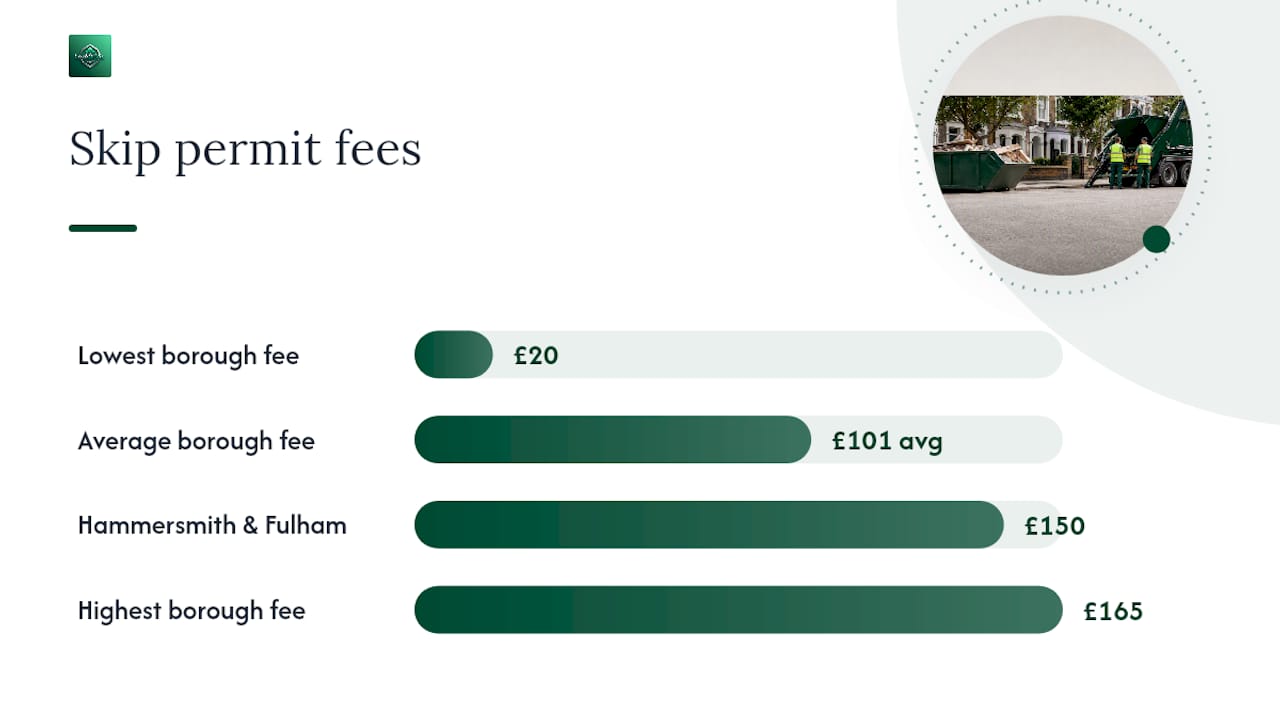
Quick fact: London borough permit fees typically range from £20 to £165, averaging around £101, with processing usually taking 3 to 7 working days. Some boroughs set flat fees regardless of duration. Hammersmith & Fulham, for instance, charges £150 per fortnight for a skip licence, well above the borough average, so it pays to check your specific council before assuming a standard rate.
- Confirm whether your skip will sit on private land or the public highway
- Ask your supplier whether the permit fee is included in the quote or billed separately
- Check your borough's own permit page for the exact fee and lead time
- Ensure the skip carries required safety markings once it's on the road
Pro Tip: Book your skip at least a week ahead if it needs to go on the road. Councils generally need 3 to 7 working days to process a permit, and a late application can push your whole project back by days, not hours.
Most licensed skip operators handle the permit application on your behalf as standard, since they know their local borough's exact requirements. Confirm this in writing before booking. It's the difference between a smooth delivery and a skip sitting on the back of a lorry because the paperwork wasn't in place.
Extra charges that catch people out
Quotes that look competitive at first glance can grow once these line items appear. Ask your supplier to itemise all of the following before you sign anything.
- Overweight charges: billed if your skip exceeds its stated weight limit, often calculated per extra tonne
- Overfill or contaminated waste fees: applied if waste sits above the skip rim or mixed prohibited items are found
- Hazardous or restricted items: paint, asbestos, fridges, tyres and batteries are typically not accepted and may incur a rejection or return fee
- Extended hire charges: a daily rate applies once you go past your booked period
- Delivery and same-day surcharges: urgent bookings usually cost more than a standard week's notice
- Permit admin fees: some suppliers add a handling charge on top of the council's own permit cost
Quick fact: Putting prohibited items such as asbestos or electricals into a skip isn't just a contractual issue, it's a legal one. Under GOV.UK's licensing rules, operators can refuse collection or charge for a separate hazardous waste run, and repeated breaches risk fines for improper waste disposal.
Ask for a written, itemised quote rather than a single headline figure. If a supplier can't tell you upfront what counts as "overweight" or "contaminated," that's a sign to get a second quote.
How skip hire is charged: daily, weekly and extensions
Most London skip hire quotes are priced by the week, covering a standard 7 to 14 day hire window depending on the supplier. Shorter "wait and load" services, where the lorry waits while you fill a smaller skip on the spot, are charged by the hour or job instead and suit quick, urgent clearances.
- Standard hire: priced weekly, typically 7 to 14 days as standard
- Extensions: usually charged at a daily rate once the initial period ends
- Wait and load: priced per job or hour, useful when time is tight
- Permit lead time: allow 3 to 7 working days if the skip needs to go on the road
If your job needs a permit and you're on a tight deadline, factor in the council's processing time before you commit to a start date. Booking the skip itself is fast; getting council sign-off rarely is.
Choosing the right skip size for your job
Under-hiring is the costlier mistake. A second skip delivery, or an overfill charge on the first one, almost always costs more than booking one size up from the start.
For a rough guide: a small garden tidy or single-room clearance usually fits a mini skip. A kitchen or bathroom strip-out, including old units, tiling and packaging, typically needs a midi skip. A loft clearance with bulky furniture, or a small extension's worth of rubble, generally needs a builders skip. Full house clearances or multi-room renovations tend to need a large skip, or two builders skips run back to back.
- Small garden tidy or single-room clear-out: mini skip
- Kitchen or bathroom refit: midi skip
- Loft clearance or small extension: builders skip
- Full house clearance or multi-room renovation: large skip, or multiple builders skips
Pro Tip: A rough visual rule: one cubic yard holds about 10 to 12 standard bin bags of loose waste. If you can estimate your job in bin bags, divide by 10 to get a ballpark yard count, then round up rather than down. If your estimate lands right on the boundary between two sizes, the larger skip is almost always the cheaper route once you account for potential overfill fees.
For garden-specific jobs, a dedicated garden waste removal service can sometimes work out simpler than a skip, particularly for green waste that a council recycling centre would otherwise charge extra to process.
Ways to cut your skip hire costs in London
A few practical habits consistently bring the final bill down, regardless of skip size.
- Get at least three quotes. Prices for the same skip size can vary by £50 to £100 across suppliers in the same borough.
- Book ahead where possible. Last-minute and same-day bookings almost always carry a premium, especially if a permit is also needed.
- Keep waste separated. Mixed loads, especially hardcore mixed with general waste, often cost more to process than clean, single-category loads.
- Confirm what's included. Ask whether the permit fee, delivery, and collection are all bundled into the quoted price before comparing suppliers.
- Consider wait and load for small jobs. It skips (no pun intended) the permit process entirely for quick, contained clearances, though it's impractical for multi-day projects.
For smaller jobs, a licensed waste removal team can be the more sensible choice rather than a skip at all; to compare costs and services, see the top garbage can cleaning service cost providers for insights into related waste-service pricing. If you're clearing a single room, a garden, or a modest volume of household waste, LookDeVis Services' licensed waste removal collects and disposes of the load directly, with no permit application, no weight-limit guesswork, and no skip sitting on your drive for a week. It tends to suit jobs where access is tight or the volume doesn't justify a full skip hire.
| Approach | Best suited to |
|---|---|
| Skip hire | Ongoing renovation projects generating waste over several days |
| Wait and load | Quick, contained jobs with no permit needed |
| Licensed waste removal | Small clearances, tight access, or one-off collections |
What to tell your skip supplier before booking
Getting an accurate quote depends on giving the supplier the full picture upfront, not discovering the gaps once the skip arrives.
- The exact delivery address and whether the skip will sit on the road or private land
- The type of waste you're disposing of, including any hardcore, plasterboard or green waste
- Your preferred delivery and collection dates, with any flexibility noted
- Any access restrictions: narrow streets, parking bays, steps, or a long carry distance
Before confirming, ask your supplier these questions directly:
- Do you handle the permit application, and is the fee included in this quote?
- What happens if the skip is overweight or overfilled at collection?
- Can you confirm your waste carrier licence and insurance details?
- Will I receive a written, itemised quote and a waste transfer note?
A supplier that hesitates on any of these is worth a second look before you commit.
Sample cost scenarios for typical London jobs
These figures assume standard mixed household or renovation waste, a road-based permit where noted, and a typical London borough permit fee of around £101, based on borough permit averages.
- Prices assume no overweight or contamination surcharges apply on collection
- On-road jobs add the borough permit fee, which varies from around £20 to £165 depending on council
- Final invoices commonly differ from initial quotes when the actual waste weight or mix differs from what was declared at booking
If your final invoice comes in higher than quoted, ask specifically whether it's a weight, contamination, or permit discrepancy. That's almost always where the gap comes from.
Where to check permit rules and pricing
Check your own borough's highways or licensing page for the exact permit fee and lead time before booking, since these figures vary widely across London.
- Gov for the legal basics on when a permit is required
- Bexley Council's skip permit page as an example of borough fee structure
- Hammersmith & Fulham's skip licence page for a flat-fee borough example
- Checkatrade's skip hire pricing guide and Costwise's skip hire calculator for current UK-wide and London pricing benchmarks
Why the permit, not the skip, is where the real cost sits
Most people shopping for skip hire fixate on the size and the weekly rate, then treat the permit as an afterthought. That's backwards. The skip itself is a commodity, prices across suppliers for the same size rarely differ by more than a few percent, but permit costs swing by over £140 between boroughs, and processing delays can cost you a week of project time that no amount of haggling on the hire rate will fix.
The conventional advice to "shop around for the cheapest skip" misses where the real variance lives. I'd tell any London homeowner or site manager to sort the permit question first: can this skip sit on private land, and if not, what does your specific borough charge and how long does approval take? Answer that before you compare a single supplier's weekly rate.
For smaller jobs, especially anything under a couple of tonnes with awkward access, skip hire often isn't the efficient choice at all. A licensed removal team collects, disposes, and leaves, with none of the permit admin or the week-long wait for collection. That's worth weighing before defaulting to a skip out of habit.
Sources
- Gov
- Skip hire cost calculator 2026 | Costwise
- Skip hire costs in the UK: Pricing breakdown 2026
- Skip permits (Bexley council)
- Skip licence | London Borough of Hammersmith & Fulham
FAQ
How much does it cost to hire a skip in London?
London skip hire typically costs between £120 a week for a mini skip and £450 or more for a large builders skip, with around £290 a fair typical figure for a standard home project. Add a borough permit fee of £20 to £165 if the skip needs to go on the road.
Do you pay for skips per day or per week?
Most London suppliers quote skip hire by the week, usually covering a 7 to 14 day period as standard. Going past that window typically incurs a daily extension charge, and shorter "wait and load" jobs are priced separately by the hour or job.
How much is a 10 yard skip in the UK?
A skip of this size falls into the large category, which in London typically starts from around £350 and can reach £490 or more per week, according to current size-banded pricing. Skips this size almost always require a council road permit given their footprint.
How much is a 4 yard skip in the UK?
A 4-yard skip sits in the midi size band, typically costing from £180 to £260 a week in London based on current market rates. It suits jobs like a kitchen or bathroom strip-out.