

Most tenancy agreements split garden duties simply: tenants keep the garden tidy day to day, and landlords handle anything structural, specialist or dangerous. The tenancy agreement itself is what actually decides the detail, and Section 11 of the Landlord and Tenant Act 1985 sets the legal floor underneath it. Get the clause wording and evidence right from move-in, and most disputes never happen.
TL;DR:
- Tenants are typically responsible for routine gardening tasks such as mowing, weeding, and rubbish removal, but only within the boundaries of the tenancy agreement and reasonableness.
- Landlords must handle structural, safety-critical, or specialist work like fence repairs, tree surgery, and major landscaping, as dictated by Section 11 of the Landlord and Tenant Act 1985.
- Clear, detailed, and measurable clauses in the tenancy agreement, supported by verified photographs and careful record-keeping, are essential to prevent disputes over garden maintenance.
- Mid-tenancy inspections and prompt written communication about emerging issues can significantly reduce the likelihood of deposit disputes and legal challenges.
- Professional services, including tree work and waste removal, can support landlords in maintaining the garden in a lettable condition and help avoid complications during changeovers.
Table of Contents
- Who is responsible: legal and contract basics
- What tasks are tenants usually expected to do?
- What are landlords normally responsible for?
- How do you write a garden clause that actually holds up?
- How can you prevent and resolve garden disputes during the tenancy?
- What should happen at check-out?
- How LookDeVis Services can help landlords and tenants in London
- Author perspective: what actually works on the ground
- Sources
- FAQ
Who is responsible: legal and contract basics
The tenancy agreement is the first place to look, not general assumption. It sets out, in writing, what each side must do with the garden, and it takes priority over vague custom or "that's just how it's always been done." The NRLA's guidance for landlords makes clear that while agreements govern day-to-day upkeep, they cannot override statutory repair obligations.
That statutory floor comes from Section 11 of the Landlord and Tenant Act 1985, which implies a covenant requiring landlords to keep the structure and exterior of a property in repair. It also limits what a lease can demand of a tenant for matters that fall under this section, meaning a landlord cannot simply write "tenant responsible for all garden structures" into a contract and expect it to override the law.
Tenants, meanwhile, have a general duty to use the property in a "tenant-like manner." Shelter's guidance on repair responsibilities explains this means keeping a garden reasonably tidy and not letting it fall into neglect, but it stops well short of expecting specialist or hazardous work.
Seasonal reality matters too. A garden inspected in January will look different from the same garden in July, and adjudicators factor this in constantly. Reasonable expectations shift with the calendar:
- Growth slows or stops in winter, so a "neglected" look in December may simply be dormancy.
- Weeds and grass grow fastest between April and September, so mowing frequency should reflect that.
- Deciduous shrubs losing leaves in autumn is not damage.
- Bare patches from summer heat often recover on their own by spring.
What tasks are tenants usually expected to do?
Routine, low-skill, low-risk jobs sit with the tenant. According to the NRLA's landlord guidance, the tasks that come up again and again are:
- Mowing the lawn regularly during the growing season, typically at intervals matching the growth rate, with more frequent mowing from spring through summer.
- Weeding borders, patios and paths so plants and paving don't disappear under growth.
- Removing rubbish promptly, including fallen leaves, litter and general garden debris.
- Pruning low-growing plants and shrubs that a person can safely reach from ground level.
- Watering plants and lawns during dry spells, where a garden was maintained and green at check-in.
None of this requires a ladder, a chainsaw, or specialist knowledge. Anything that does sits with the landlord instead, and that includes tree surgery, major hedge reductions above head height, and any structural repair to fences, walls or paving. A tenant handed a pair of shears and asked to tackle a leylandii hedge that's outgrown the fence line is being asked to do a landlord's job.
Pro Tip: Keep a rough diary of what you did and when, even a few phone photos with dates. If a dispute ever arises, "I mowed every fortnight from April" is a far stronger position than a memory nobody can verify six months later.
Practical logistics matter here too. Many London boroughs now charge for garden waste collections, so tenants and landlords should agree upfront who pays for green waste disposal, particularly if a council changes its policy mid-tenancy. Where a mower or strimmer isn't provided, that should be clarified in writing before move-in, not argued about in month three.
What are landlords normally responsible for?
Anything structural, safety-critical or specialist falls to the landlord, and Section 11 is the reason why. The NRLA's guidance lists the recurring categories clearly:
- Fences and boundary walls, including repairs after storm damage or general deterioration.
- Patios, decking and paved surfaces, where cracking, subsidence or trip hazards develop.
- Guttering and drainage connected to the garden or affecting it, such as downpipes discharging onto beds.
- Large or mature trees, particularly anything requiring a ladder, power tools or arboricultural expertise.
- Sheds and outbuildings where structural integrity, roofing or safety is a concern.
When a tenant reports a problem, such as a collapsing fence panel or a tree shedding large limbs, the landlord's response time matters. There's no fixed legal countdown for garden issues the way there is for gas safety, but a landlord who sits on a written report for months and then tries to blame the tenant at check-out will struggle in any dispute. Documenting the report date, the response, and any contractor visit protects both sides.
Landlords are entitled to bring in professionals for this kind of work, and doing so is often the sensible route rather than expecting a tenant to attempt it. One limitation worth knowing: the Tenant Fees Act 2019 restricts what landlords can charge tenants directly for during a tenancy, so routine gardener costs generally cannot simply be passed on as a tenancy fee outside of what's already built into rent or a specific, lawful arrangement.
How do you write a garden clause that actually holds up?
Vague clauses lose disputes. "Tenant to maintain the garden" sounds reasonable until an adjudicator asks what "maintain" means, and by then it's too late to define it. The NRLA's own guidance recommends converting broad obligations into specific, measurable terms.
Compare the two approaches:
| Vague clause | Enforceable clause |
|---|---|
| "Tenant to keep garden tidy" | "Tenant to mow lawn fortnightly April to September, weed borders monthly" |
| "No damage to plants" | "Tenant not liable for plants above 2m in height or trees; landlord responsible for pruning above this line" |
| "Garden to be maintained" | "Tenant responsible for green waste disposal; landlord to arrange annual hedge reduction" |
A strong clause names the task, the frequency, and the exclusion in the same sentence. That precision is what separates a clause that survives adjudication from one that collapses under questioning.
Inventory evidence carries just as much weight as the clause itself. Gardening ranks among the most common reasons for deposit deductions referred to tenancy deposit schemes, and clear inventories with photographic evidence dramatically strengthen a landlord's position, or a tenant's defence.
Good inventory practice includes:
- Dated, timestamped photographs at check-in covering every bed, boundary and lawn area.
- Written notes on the condition of specific features (a young tree, a recently laid lawn, an established rose bed).
- Matching photographs at check-out, taken from the same angles where possible.
- Any mid-tenancy photos taken during inspections, kept on file rather than discarded.
If a feature needs special care, such as a newly planted tree that shouldn't be pruned in its first year, that instruction needs to be given in writing at the start of the tenancy. MyDeposits guidance on garden responsibilities is explicit that adjudicators look for this kind of documented instruction before holding a tenant liable for damage to a delicate feature they were never warned about.
How can you prevent and resolve garden disputes during the tenancy?
Waiting until check-out to discover a problem is the single most avoidable cause of a deposit dispute. Mid-tenancy checks catch issues early, when they're cheap and easy to fix, rather than late, when they've calcified into an argument over money.
- Schedule inspections with proper notice. Twenty-four hours' written notice is standard practice and keeps the visit cooperative rather than confrontational.
- Photograph consistently. Use the same angles as the check-in inventory so comparisons are meaningful, not just a fresh set of unrelated snaps.
- Raise concerns in writing immediately. An email sent the day of the inspection carries far more weight than a conversation recalled months later.
- Give tenants a reasonable window to act. If a lawn has been left too long, a written note asking for it to be addressed within two weeks is fair; an instant deduction threat is not.
- Escalate through the right channel if needed. The Tenancy Deposit Scheme and mediation services exist precisely so disputes don't need to go to court, and both sides should present dated photos, the tenancy agreement clause, and any written communication as evidence.
The NRLA's case examples on avoiding garden disputes show a consistent pattern: adjudicators grant a seasonal allowance and expect proof of neglect beyond normal wear and tear before siding with a landlord. Claims built on assumption rather than evidence tend to fail, whichever side makes them.
What should happen at check-out?
The expectation is a return to broadly the same condition as move-in, adjusted fairly for the season and for however many months or years have passed. A garden checked out in November should not be judged against a photo taken in June; growth patterns and dormancy are not decline.
Adjudicators draw a firm line between genuine neglect and ordinary change. A lawn with dead, compacted patches from a trampoline left in one spot for a year points to negligence. Temporary yellowing after a dry August, or leaves scattered under a tree in October, is fair wear and tear and won't support a deduction.
Both sides benefit from gathering the same core documents before any conversation about the deposit starts:
- The original inventory report and its check-in photographs.
- Dated photographs from the check-out visit, ideally matching the same angles.
- Any invoices from contractors, particularly where work claimed against the tenant should have been the landlord's responsibility (tree surgery being the classic example that gets wrongly billed to tenants).
- Written permissions or instructions given during the tenancy, especially around delicate features.
Adjudicators assess proportionality carefully. If a landlord's invoice bundles legitimate tenant negligence together with work that was always their own obligation, such as pruning a tree above head height, that portion of the claim is likely to be rejected even if the rest succeeds.
How LookDeVis Services can help landlords and tenants in London
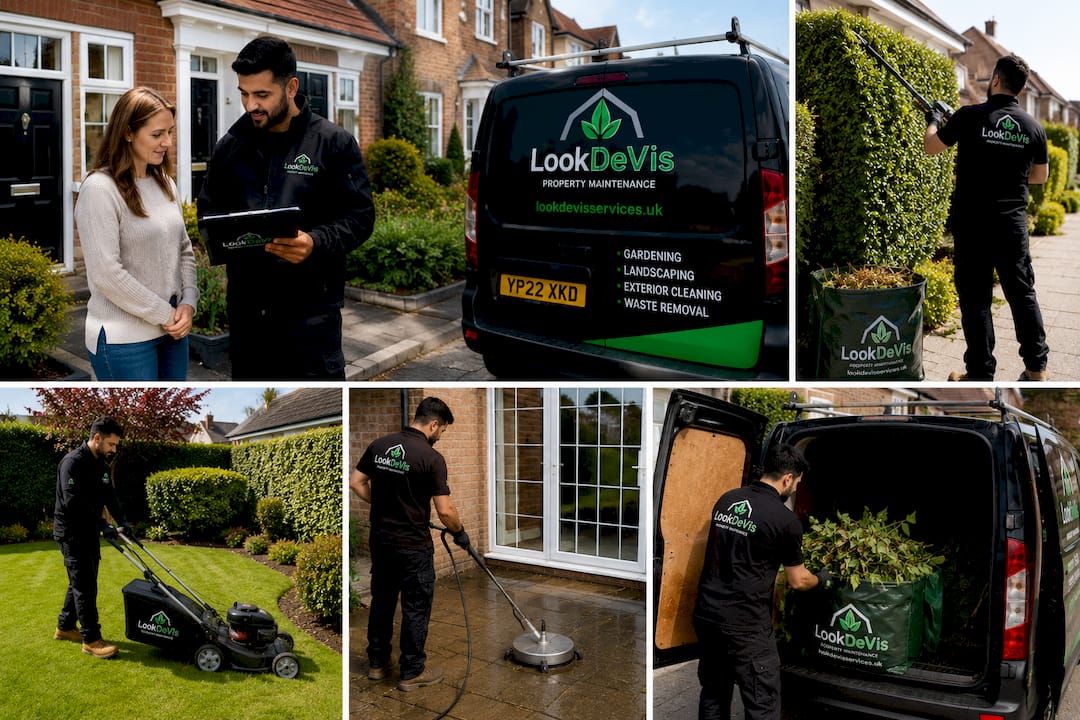
Getting a garden into a defensible, tenancy-ready state doesn't need to be guesswork, and it doesn't need to fall entirely on the tenant either. Professional services give London landlords support for jobs that sit firmly on their side of the line, from hedge reductions and tree work through to full clearances between tenancies, so nothing gets left to chance before a new inventory is signed.

A garden left to run wild for a few months between tenants can turn a straightforward changeover into a costly one. Lookdevisservices offers professional gardening services for landlords who want a garden brought back to a lettable standard before check-in photographs are taken, along with licensed waste removal for anything left behind by a departing tenant. For gardens needing more than a tidy, our teams also handle tree surgery safely and to the standard adjudicators expect from landlord-arranged work, not tenant DIY. As a licensed waste carrier operating fully insured across Greater London, we're set up to take on exactly the tasks that fall outside a reasonable tenant's remit. Get in touch for a free, no-obligation quote before your next changeover.
Author perspective: what actually works on the ground
Most disputes over garden care could be settled with a single clear conversation before anyone signs anything, not with a heated exchange at check-out. Small London terraces are the trickiest cases: a tiny paved-over patch might have one tree, one bed, and a fence panel shared with next door, and every one of those elements needs a clear owner from day one.
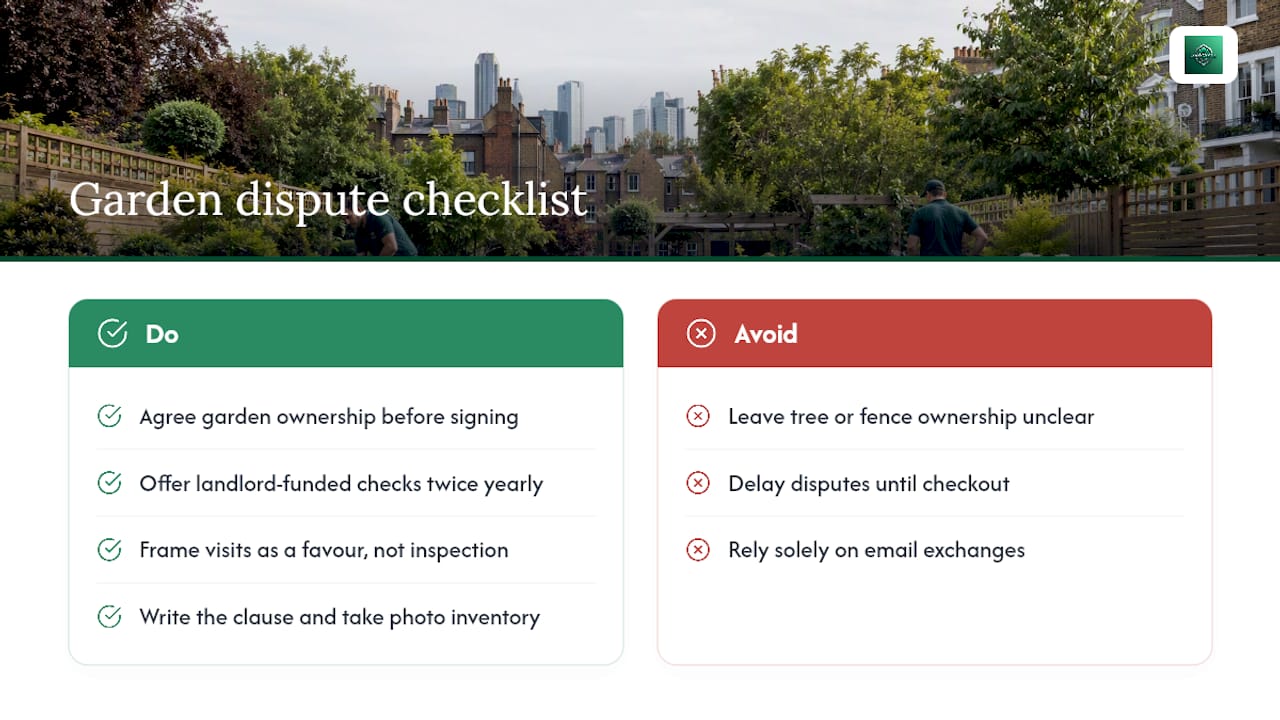
The landlords who avoid trouble tend to do one simple thing: they offer a landlord-funded seasonal check, twice a year, framed as a favour rather than an inspection. It keeps communication open, catches fence or tree issues before they become emergencies, and gives both sides a shared record instead of competing memories. Write the clause properly, take the photos, and most of this guide becomes unnecessary in practice.
If you're preparing a property for a new tenancy or trying to work out what's fair after one ends, a short site visit usually settles the question faster than any amount of back-and-forth over email.
— Roman
Sources
- The landlord's essential guide to garden maintenance (NRLA)
- Legislation
- AskTDS: Maintaining gardens in rented properties (Tenancy Deposit Scheme)
- Landlord and tenant responsibilities for repairs (Shelter)
FAQ
Is it the tenant's responsibility to maintain the garden?
Generally, yes for routine tasks like mowing, weeding and rubbish removal, but the exact split always comes down to the wording in the tenancy agreement and what the NRLA's guidance sets out as reasonable.
Do tenants have to clean outside windows in the UK?
There's no blanket legal rule requiring tenants to clean external windows, particularly upper-floor ones that aren't safely accessible; this typically depends on what the tenancy agreement specifies and what's genuinely safe to do without equipment.
Are tenants responsible for cutting trees?
No. Tree work, especially anything above head height or requiring tools beyond hand shears, falls to the landlord under Section 11 obligations, and Lookdevisservices' tree surgery team is the kind of specialist provision landlords should arrange rather than tenants attempting it themselves.
Can a neighbour complain about my garden?
Yes, a neighbour can raise concerns, particularly about overgrown hedges, overhanging branches or rubbish that affects their property, and persistent complaints can prompt a landlord to intervene under their own repair and nuisance obligations.
Recommended
- Small London garden ideas that actually work in tight urban plots
- Regular Garden Maintenance Plans in Enfield
- Garden Clearance Services Acton | Professional Clearing W3 W12
Prices, timescales and information provided in this article are for general guidance and may vary depending on the property, site conditions, materials and scope of work. Please contact LookDeVis Services for an individual assessment and quotation. Where regulatory, planning or legal requirements apply, appropriate professional advice should be obtained.